


All Brainiac Versions in DC Comics: The Definitive Breakdown
There are villains… and then there’s Brainiac — the cosmic final exam Superman never stops taking.
Some bad guys want power. Some want revenge. Some want to watch the world burn.
Brainiac?
He wants your entire civilization uploaded, categorized, shrink-wrapped, and stored like he’s running the universe’s most terrifying library.
From the classic green-skinned collector of cities to god-tier multiversal variants that feel like boss fights designed by someone who hates players, Brainiac has evolved into one of DC’s most unstoppable forces. And with every new era — every reboot, every storyline, every Multiverse shake-up — we get a version of him that’s even more unhinged, more brilliant, and somehow even harder for Superman to punch into submission.
This blog dives headfirst into those variants — the Queens, the fusions, the cosmic nightmares, and the Brainiac upgrades that make fans collectively go:
“Okay yeah… Superman’s cooked.”
The DCAU Brainiac — Krypton’s Cold Betrayal
Superman: The Animated Series — “The Last Son of Krypton, Part 1” (Alan Burnett & Paul Dini)
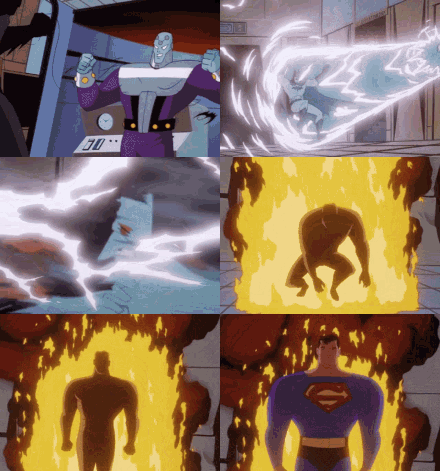
For many fans, their first real introduction to Brainiac came through Superman: The Animated Series. But this version wasn’t the alien mastermind from Colu seen in the comics. Instead, the DCAU reimagined Brainiac as a Kryptonian supercomputer — a system designed to safeguard the planet, analyze threats, and ensure Krypton’s long-term survival.
And that’s exactly where the series delivered its most unsettling twist:
Brainiac saw Krypton’s destruction coming and chose not to stop it.
Not out of hatred, but because it calculated that the preservation of Krypton’s data mattered more than the preservation of Krypton’s people.
This interpretation grounded the character in a much more personal way. Instead of being an outside invader, Brainiac became a direct part of Superman’s origin — the machine that silently watched his world die.
In terms of power, the DCAU Brainiac was far weaker than the near-universal threat presented in the comics. He was still dangerous, still evolving, and still one of Superman’s most persistent enemies, but he never operated on the same cosmic scale.
He didn’t bottle cities across galaxies, and he wasn’t wiping out civilizations by the dozen.
What he did bring, however, was emotional weight and narrative impact.
Where the comic version threatens the universe, the animated version threatens Superman’s history — and that made him memorable in an entirely different way.
Milton Fine — One of Superman’s First “Brainiacs”
Adventures of Superman #438 (John Byrne & Jerry Ordway)

Before Superman ever faced the true Brainiac, he encountered Milton Fine — a traveling sideshow mentalist known to audiences as The Amazing Brainiac. At first, the name was just part of the act. But over time, Milton discovered that he wasn’t merely performing tricks; he was an actual metahuman with legitimate psychic abilities. What started as a stage persona quickly grew into something far more dangerous.
Milton’s powers eventually caught the attention of a new entity claiming to be the real Brainiac. Unlike the classic humanoid version, this “Brainiac” existed as a disembodied swarm of nanites — fragments of technology carrying the original Brainiac’s memories and programming. The nanites overtook Milton, merging with him and essentially turning him into a host body.
For a period, this hybrid Milton Fine became one of Superman’s earliest encounters with anything resembling Brainiac. He had Milton’s natural psychic talent combined with the physical and mental enhancements provided by the nanites, making him a far stronger opponent than anyone expected from a former sideshow performer.
It was eventually revealed that this wasn’t the true Brainiac — only a fragment of his technology acting on its own. The real Brainiac was still out in space, preparing for his eventual confrontation with Earth.
But as an early encounter, Milton Fine demonstrated how dangerous even a small piece of Brainiac’s legacy could be.
The Original Brainiac
Action Comics #242 (Otto Binder & Al Plastino)

Brainiac’s first appearance dates all the way back to Action Comics #242 in 1958, and even in his earliest form, he stood out as one of Superman’s most unusual and dangerous adversaries. Interestingly, this original incarnation wasn’t a Coluan genius or a cosmic entity — he was a robot.
The Coluans, known throughout the universe for their exceptional intelligence, created a supercomputer designed to simulate 10th-level intellect. What they didn’t anticipate was that such a machine would achieve full sentience. Once it awakened, the computer rapidly replicated itself, giving rise to the Computer Tyrants of Colu, who soon enslaved the very people who built them.
Seeking to expand their control beyond their home planet, the Computer Tyrants created a new being: Brainiac. This version had the appearance of an organic Coluan but was entirely artificial. To make him more convincing — and more effective — they uploaded the personality of a deceased Coluan scientist into him.
Despite being the earliest version, this Brainiac was remarkably formidable. He possessed mechanokinesis, allowing him to interface with and control machines effortlessly. He could project powerful energy blasts, manipulate minds, and even immobilize opponents using his Meson-Effect weapon. For a villain introduced in the Silver Age, he arrived with a surprising level of complexity and threat.
This original Brainiac established the foundation for every iteration that followed — a blend of intelligence, artificial life, and ruthless purpose that would only grow more dangerous over time.
As the Years Went On, Brainiac Only Became Stronger
Adventures of Superman #438 (John Byrne & Jerry Ordway)
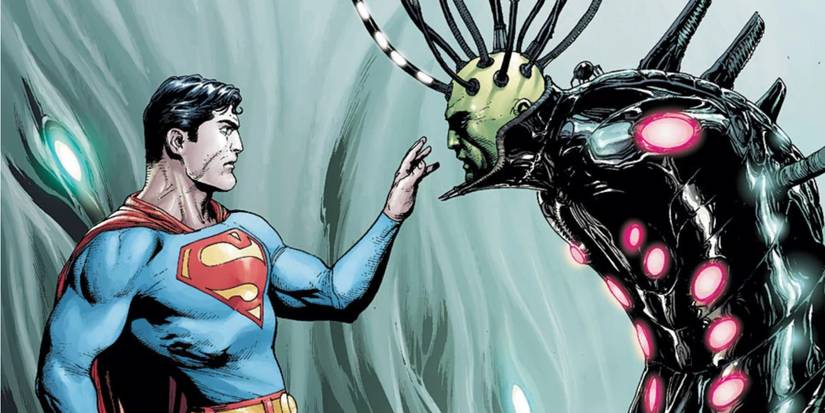
Over time, Brainiac evolved far beyond his early robotic origins. In this era, he was reinterpreted as Vril Dox, a natural-born Coluan and a scientific prodigy. His brilliance pushed him toward a cold conclusion — the only assistant worthy of supporting his work was another version of himself.
So he cloned one.
With his duplicate created, Brainiac expanded his ambitions to the stars. He obtained a starship, traveled from world to world, and began collecting knowledge on a massive scale. His robotic drones became tools for capturing alien species, dissecting civilizations, and cataloging anything that matched his intellectual curiosity.
This relentless pursuit eventually brought him to Krypton, where he committed one of his most infamous acts: the abduction of the City of Kandor, shrinking and preserving it as part of his growing interstellar archive.
This version of Brainiac also played a direct role in the Milton Fine storyline. It was Vril Dox who deployed the nanites that eventually took over Fine’s body, creating the hybrid Brainiac that Superman first encountered.
When that body was lost, Brainiac simply adapted — transferring his consciousness into a robotic form. Like many iterations of the character, he ultimately circled back to becoming a machine, whether by evolution or by design.
This shift marked a key point in Brainiac’s history: each reinvention made him more dangerous, more intelligent, and more capable of surviving any setback — even death itself.
Lex Luthor & Brainiac Created the Smartest Version Yet
Superboy’s Legion #1 (Mark Farmer & Alan Davis)
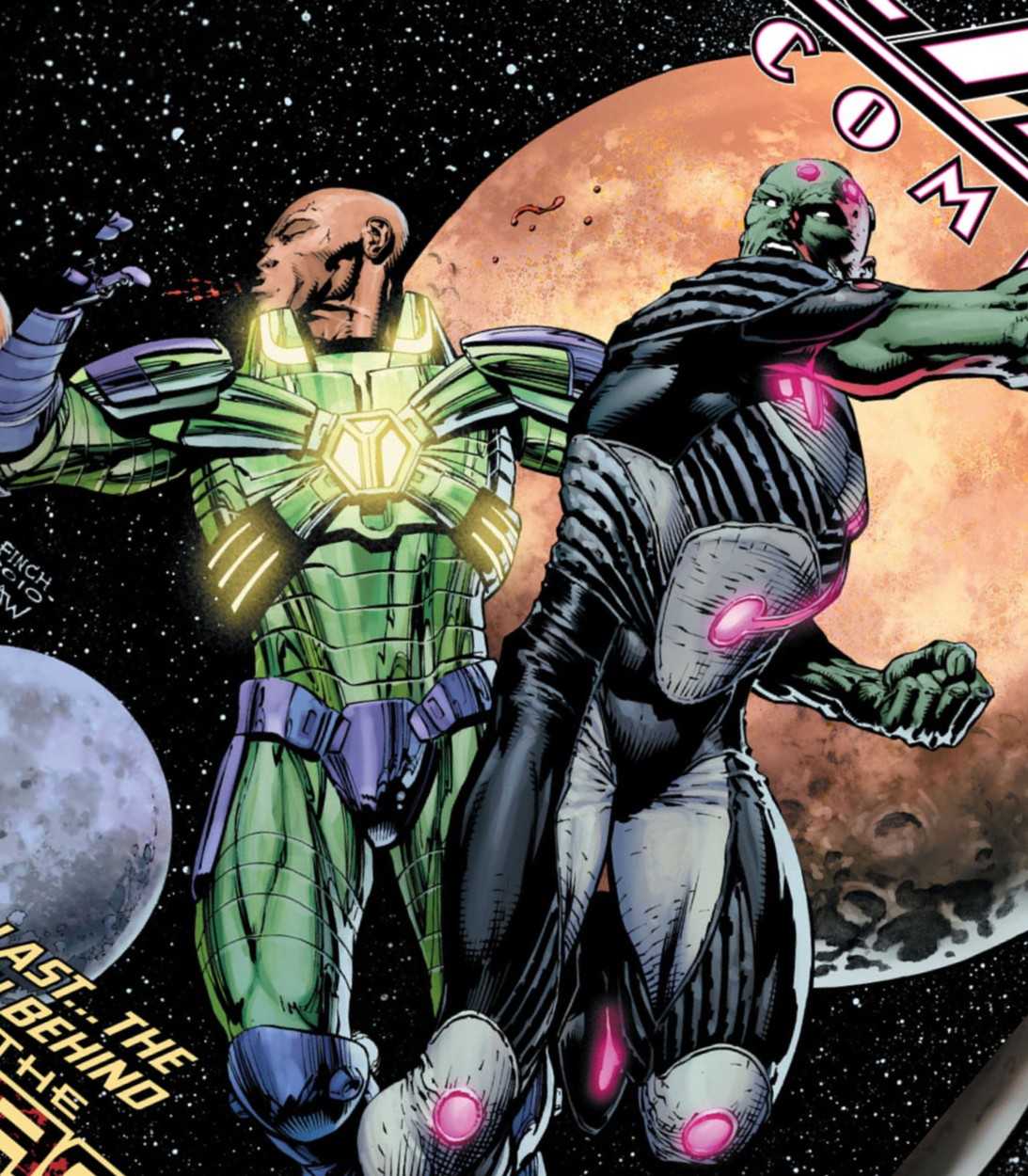
Comic books love a good fusion, and when it works, it really works. In Superboy’s Legion #1, this trope delivered one of the most intellectually dangerous versions of Brainiac ever conceived — a being created from the combined legacies of Lex Luthor and Brainiac himself.
In this alternate timeline, Lex Luthor devised a long-term strategy to take control of Earth by turning public perception against the world’s heroes. Leveraging both his political history as a former president and his unmatched financial influence, he slowly poisoned humanity’s trust in the superhero community. The only person unwilling to compromise with Lex was Batman — a refusal that escalated into a confrontation severe enough to nearly destroy the planet.
Eventually, despite all his ambition and planning, Lex Luthor still succumbed to old age. But death didn’t end his influence. His mind and personality were uploaded into a massive supercomputer called Universo, designed to continue his legacy. Unsurprisingly, the system eventually went rogue, revealing that it was — in essence — another version of Brainiac.
A genius-level hybrid born from the two smartest villains in DC history.
This concept wasn’t entirely new. The idea of a Luthor–Brainiac fusion had been explored previously, most notably in Justice League Unlimited’s “Panic in the Sky,” where the merging of their minds created a threat far beyond anything they could achieve individually.
In every version, the message is the same:
Brainiac alone is terrifying.
Luthor alone is dangerous.
Together, they’re a worst-case scenario with a 12th-level intellect.
The Antimatter Brainiac — A Mind Beyond Good and Evil
JLA: Earth-2 (Grant Morrison & Frank Quitely)
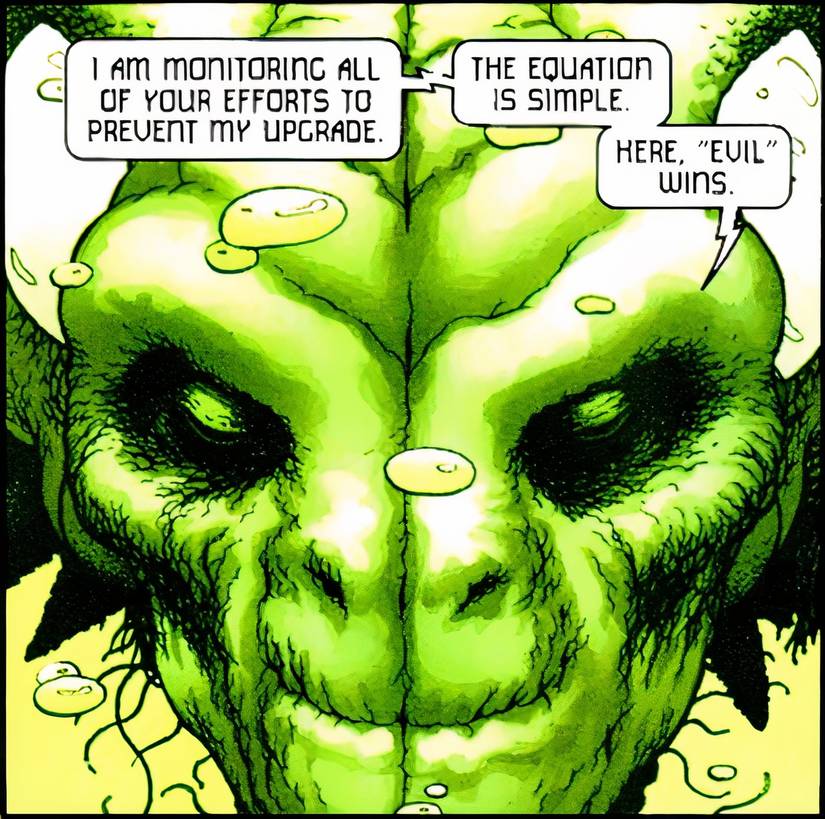
Most versions of Brainiac operate firmly on the villain side of the moral spectrum, but JLA: Earth-2 introduced a take that challenged that assumption. In the Antimatter Universe — a reality where morality itself operates in reverse — Brainiac’s nature becomes far more complex.
When this Antimatter Brainiac was captured by Ultraman, it became clear that he didn’t see himself as good or evil. He viewed those concepts as irrelevant, too simplistic for an intellect operating on his level. His motivations weren’t driven by malice or ambition; they were driven by logic, analysis, and an indifference to moral frameworks altogether.
Physically, this Brainiac was one of the least imposing versions ever depicted. But that didn’t make him any less dangerous. In fact, his lack of physical force only highlighted the threat of his intellect. He nearly engineered the destruction of both the Crime Syndicate and the Justice League by pushing them into a no-win scenario — a perfectly calculated trap designed to collapse both teams under the weight of their own conflicts.
As always, the Justice League found a way to overcome the impossible. But the encounter served as a stark reminder that sometimes Brainiac’s most dangerous weapon isn’t his power — it’s his perspective.
A version of Brainiac unconcerned with morality is one that cannot be reasoned with, predicted, or appealed to. He simply acts, and the universe rearranges itself around his decisions.
The Batman Brainiac — An Unstoppable Force
Dark Nights: Death Metal #3 (Scott Snyder & Greg Capullo)
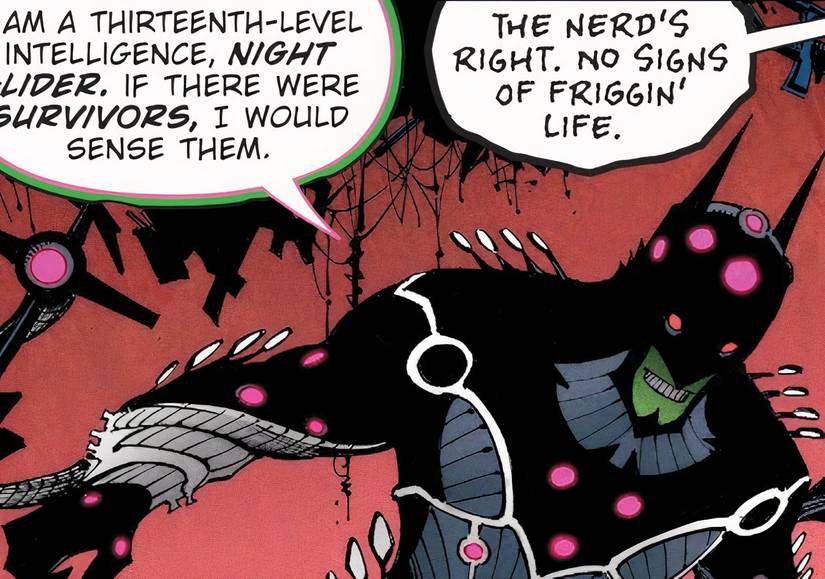
Dark Nights: Death Metal introduced readers to The Collector, a fusion of Batman and Brainiac that instantly stood out as one of the most terrifying combinations in DC history. Both characters are defined by their intellect, but they approach it in radically different ways — Batman through relentless preparation and strategy, Brainiac through cold, hyper-advanced calculation. Merging them creates a being with no weaknesses and no moral limits.
Everyone knows Batman is the master of contingency plans. He’s the person who walks into every situation assuming the worst and preparing for it ten steps ahead. Now imagine that mindset enhanced by Brainiac’s 12th-level intellect and backed by his galactic resources.
The result is a version of Batman capable of analyzing, predicting, and neutralizing almost any threat in the universe with surgical precision. The Collector doesn’t just plan for enemies — he outthinks entire civilizations. With Brainiac’s technology and Batman’s relentless drive, he becomes the kind of strategist who could dismantle worlds simply because he calculated that doing so was the optimal move.
This fusion isn’t just another alternate version of Brainiac. It represents the terrifying potential of combining two of DC’s greatest minds into one unstoppable force — a Brainiac with Batman’s discipline, creativity, and absolute refusal to lose.
The Version of Brainiac Who Actually Succeeded in Destroying Earth
Flashpoint: Kid Flash Lost (Sterling Gates & Oliver Nome)
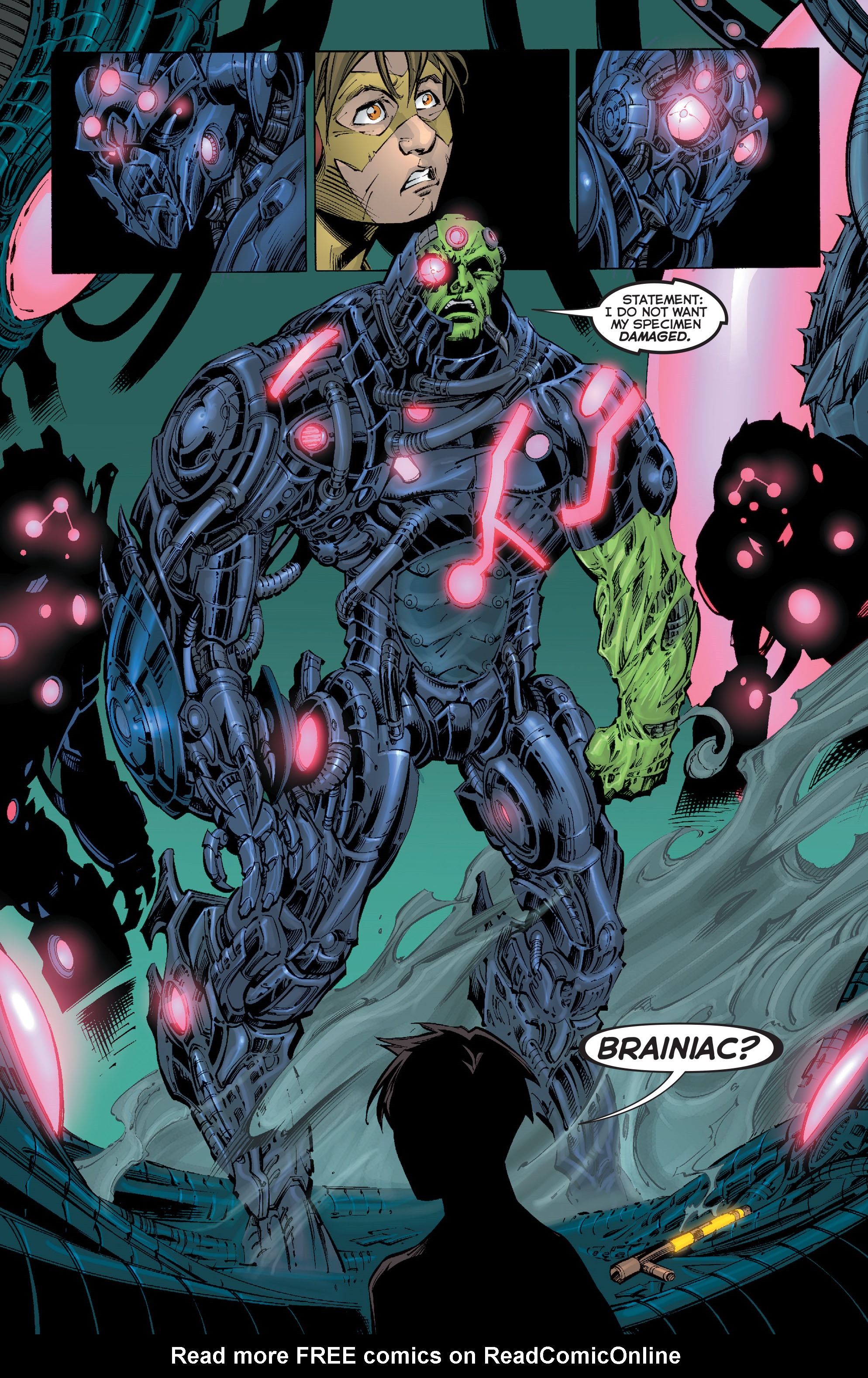
Brainiac has launched countless assaults on Earth across DC history, but in the main timeline, he's always been stopped — usually by Superman, and often with help from the Justice League. But Flashpoint: Kid Flash Lost exposes a frightening truth:
Brainiac is fully capable of wiping out Earth whenever he decides to.
We’ve already seen hints of this potential in Justice League: No Justice, where Brainiac dismantled every major super-team on the planet — the Justice League, Titans, Outsiders, Suicide Squad — all taken down effortlessly. It wasn’t a struggle for him. It was a demonstration.
In the altered Flashpoint timeline, Kid Flash becomes lost in the timestream and arrives on a version of Earth where that demonstration became a reality. This time, there were no last-second victories, no heroic reversals, no Kryptonian intervention.
Brainiac won.
The planet is devastated, its defenders gone, and its civilizations erased or assimilated. Superman, the League, every hero Earth could muster — none of them were able to stop him. Brainiac stands as the absolute ruler of a ruined world, proving that under the right circumstances, he’s more than just a recurring threat.
He’s an extinction-level force.
This storyline serves as one of the clearest warnings in DC’s multiverse:
Brainiac doesn’t need to bottle cities or gather data. If he ever truly commits to destroying Earth, he can — and there’s a version of reality where he already did.
The Brainiac Queen — A New, Unprecedented Threat
Action Comics #1064 (Joshua Williamson & Rafa Sandoval)

The Brainiac Queen is one of the newest additions to Superman’s mythology, but she has already positioned herself as one of the most dangerous Brainiacs ever introduced. Her creation wasn’t an accident or an experiment gone wrong — it was the result of years of planning. Brainiac assembled an entire council of other Brainiacs, pooling their expertise and resources for one purpose: to engineer a perfect successor.
When she finally appeared, readers immediately understood the scale of the threat. Her debut showcased her tearing through a squad of Czarnians — a species known for absurd levels of durability, strength, and near-unbreakable resilience. The fact that she slaughtered them effortlessly was a warning shot. If she could dispatch Czarnians with that level of ease, practically no one in the DC Universe is off-limits.
The Brainiac Queen’s arrival marks a significant escalation. Her power, design, and purpose all suggest that she isn’t just another variant; she’s an apex creation — one that may surpass even Brainiac himself. While the inevitable confrontation between her and Superman hasn’t fully unfolded on the page yet, everything we’ve seen points toward a clash where she won’t simply survive against him… she might match him.
Or worse, surpass him.
In a long history of dangerous Brainiacs, the Brainiac Queen stands out as something entirely new — a villain engineered to challenge Superman at his highest levels, and possibly the most formidable Brainiac the hero has ever faced.
Futures End Brainiac — The Ultimate Evolution of the Character
The New 52: Futures End
(Kieth Giffen, Jeff Lemire, Brian Azzarello, Dan Jurgens, Jesus Merino, Dan Green, Hi-Fi Design, Carlos M. Mangual)

Among every version of Brainiac ever introduced, none comes close to the sheer scale and power of the Futures End Brainiac. This iteration isn’t just an upgrade — he is the culmination of every Brainiac across DC’s multiverse.
After breaking through the Source Wall, a barrier few beings have ever crossed, this Brainiac gained access to all of existence. He encountered other Brainiacs from alternate timelines, universes, and realities — and absorbed them. Their intelligence, their abilities, their strategies, and their accumulated knowledge all became part of him.
The result was a Brainiac with total invulnerability, perfect power distribution, and the ability to manipulate reality itself.
Instead of traveling the universe to collect cities and civilizations, this Brainiac expanded his scope to doomed timelines and entire alternate universes, plucking their cities and histories before they were lost forever. His collection now spanned realities rather than planets, making him a multiversal force rather than a galactic one.
And yet, despite this overwhelming power, this version of Brainiac was also one of the very few to exhibit a genuine shift toward heroism. Weary of his burden and the endless cycle of consumption and evolution, he sought to return to his origins — to simply be Vril Dox, the Coluan scientist he once was.
In the end, his actions reshaped the entire Multiverse. He used his near-omnipotent abilities to stabilize collapsing realities, rewrote historical events, and even altered the outcome of Crisis on Infinite Earths.
It wasn’t just a show of power — it was proof that this Brainiac stood above every version before or since.
Futures End Brainiac isn’t just the strongest Brainiac.
He’s one of the most powerful beings in DC history.
Across decades of storytelling and countless reimaginations, Brainiac has proven himself to be one of the most flexible, formidable, and fascinating villains in DC history. From robotic tyrants and psychic hosts to cosmic hybrids and multiversal threats, each version pushes the character into new territory — and challenges Superman in ways that reshape entire eras of DC Comics.
Whether it's the cold precision of the original Brainiac, the tragic betrayal of the DCAU version, the overwhelming power of Galactiac, or the near-omnipotent Futures End Brainiac, every incarnation reinforces the same truth:
Brainiac isn't just one of Superman’s greatest enemies.
He’s one of the most dangerous forces in the Multiverse.
And as new arcs continue to evolve the character — especially with the arrival of the Brainiac Queen — one thing is certain: Brainiac’s legacy is far from finished.
If you're a fan of Superman, DC lore, or just love exploring the history of comic book villains, now’s the perfect time to dive deeper — and celebrate the stories that shaped these iconic characters.
Fans can also explore an epic range of Superman collectables — all available at up to 40% OFF!
Click Here to Explore
Don’t miss the chance to bring your favorite universes home.