


DC’s Best Supergirl Villains: Origins, Powers, and Key Stories
Supergirl has encountered a wide range of villains throughout her history, from psychic threats like Blackstarr and Psi to heavy-hitting antagonists such as Reign. Even without a signature archenemy the way Superman has Lex Luthor or Batman has the Joker, Kara Zor-El has repeatedly proven she can stand toe-to-toe with some of the most dangerous beings in the DC Universe.
What makes Supergirl compelling is the diversity of threats she faces. Characters like Emerald Empress, Satan Girl, and even cosmic forces such as the Anti-Monitor all contribute to the evolution of her character, pushing her beyond the traditional role of “Superman’s cousin” and solidifying her identity as a hero in her own right.
Born in the Silver Age and often misunderstood, Supergirl has spent decades navigating battles that weren’t always meant for her. Much of her rogues gallery overlaps with Superman’s, which makes defining her top adversaries difficult — but not impossible. Despite lacking a central nemesis, her story is packed with unique, memorable foes who challenge her physically, mentally, and morally.
These are Supergirl’s top 10 villains — a lineup ranging from reality-warping psychics to universe-destroying forces, each shaping Kara Zor-El into one of DC’s most resilient and enduring heroes.
Blackstarr
First Appearance: Supergirl Vol. 2 #4 (1983)
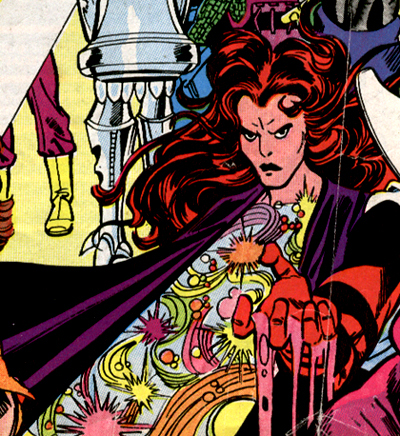
Blackstarr is one of Supergirl’s more obscure adversaries from the 1980s, yet she remains one of the most unsettling villains Kara has ever faced. While she’s known primarily for her gravity-manipulating abilities — powerful enough to challenge Supergirl head-on — it’s her extreme ideology and intellectual fanaticism that truly define her character.
Despite her eccentric costume and psychedelic energy blasts, Blackstarr isn’t a lighthearted Silver Age throwback. She’s portrayed as a deeply intelligent, deeply dangerous individual fueled by hatred and authoritarian beliefs. Her origin is especially controversial: a Holocaust survivor who eventually embraces Nazi rhetoric, a narrative choice that has been widely criticized for its insensitivity and poor handling of real-world trauma.
Though her time in DC Comics was brief, Blackstarr represents a rare type of villain in Supergirl’s history — not just a physical threat, but an ideological one. Her appearance may be short-lived, but her impact is remembered for the uncomfortable and morally charged territory her character introduced.
Psi
First Appearance: The Daring New Adventures of Supergirl #1 (1982)

Psi, also known as Gayle Marsh, is another memorable creation from the early 1980s and one of Supergirl’s most intriguing psychic adversaries. Her powers are extensive — including telepathy, telekinesis, psychokinesis, flight, and a range of mental attacks — making her one of the few foes capable of matching Supergirl in a non-physical arena.
Raised in a cult-like environment and manipulated by her adoptive father, Psi was indoctrinated into believing she existed to eliminate “the Decay,” a vague threat used to control her actions. This conditioning shaped her worldview and set her on a path that eventually brought her into direct conflict with Supergirl.
Psi even manages to overpower Kara during their first encounter, restraining her in a telekinetic lock and forcing Supergirl to confront the reality of how dangerous a fully trained psychic can be. Over time, Psi begins to question the mission she was programmed to follow, adding layers of doubt and internal conflict to her character.
Her appearances across DC Comics — including time with the Suicide Squad — show that Psi is more than a one-off villain. She’s a complex, morally conflicted character who deserves far more exploration than she’s typically given.
Reign
First Appearance: Supergirl Vol. 6 #5 (2012)

Reign stands out as one of the most formidable villains ever created for Supergirl — not just physically, but conceptually. She is a Worldkiller, a line of biologically engineered weapons developed on Krypton and later outlawed due to their uncontrollable destructive potential. Created by Kryptonian science and later condemned by the very same scientific institutions, the Worldkillers were deemed too dangerous to exist. Although most were destroyed, five survived Krypton’s end — with Reign emerging as their leader.
Driven by a desire to understand her origin and purpose, Reign travels to Earth in search of answers. And because Earth is home to Kryptonian survivors like Supergirl, she fixates on it as the key to unlocking her identity. Her conclusion is simple and brutal:
to fulfill her purpose, she must conquer the planet.
Supergirl, naturally, refuses to accept this. Their conflict escalates when Reign assumes Kara might join her cause — a miscalculation that quickly turns violent. Reign and the other Worldkillers launch a full assault, pushing Supergirl to her limits. Although Kara ultimately forces them out of New York City, the confrontation establishes Reign as a uniquely dangerous opponent.
Her strength, her origins, and her relentless drive make Reign one of Supergirl’s most defining enemies — a villain who embodies Krypton’s darkest scientific ambitions and challenges Kara Zor-El on every level.
Emerald Empress
First Appearance: Adventure Comics #352 (1966)

The Emerald Empress is defined by one of the most dangerous artifacts in DC history — the Eye of Ekron, an ancient weapon capable of corrupting anyone who wields it. Far more than a simple cosmic relic, the Eye grants its user tremendous power: flight, energy projection, enhanced stamina, and a level of raw force capable of challenging even a Kryptonian. Three different women have taken on the mantle of Emerald Empress over the years, ranging from a bullied teenager to a wielder driven to madness. But it is Sarya of Venegar — Sarya of Venegar — who becomes Supergirl’s most direct adversary.
Though Sarya is traditionally an enemy of the Legion of Super-Heroes, she crosses paths with Supergirl during DC’s Rebirth era. Traveling from the future and believing Supergirl responsible for her father’s death, Sarya forms a new version of the Fatal Five and launches a targeted campaign to erase Kara Zor-El and dismantle the DEO.
Their confrontation is intense and destructive, culminating in Supergirl tearing apart the Eye of Ekron itself — an act that causes the Emerald Empress to vanish from existence. Although Sarya eventually resurfaces, she does not engage Supergirl again.
Her brief but memorable role in Kara’s modern stories highlights how dangerous the Emerald Empress can be: a villain empowered by a sentient artifact, fueled by vengeance, and equipped with abilities capable of challenging one of DC’s strongest heroes.
H'el
First Appearance: Supergirl Vol. 6 #13 (2012)

H’el — H'el — is one of the most emotionally challenging and morally complex villains Supergirl has ever confronted. When he first approaches Kara with a bold proposition to restore Krypton, she listens. The offer is tempting, heartbreaking, and deeply personal. As a surviving Kryptonian clone created to preserve the planet’s legacy, H’el carries Krypton’s history, knowledge, and ideals within him. His arrival on Earth is turbulent, and he quickly fixates on the remaining Kryptonians — believing Supergirl to be the perfect ally.
To prove his sincerity, H’el grants Kara the ability to speak English, forging an immediate connection. Together, they begin working on his ambitious plan: constructing a machine capable of consuming the Sun to bring Krypton back. It is only when Supergirl realizes the full cost — Earth’s destruction — that she understands the true weight of H’el’s mission.
Faced with the impossible choice between her lost home and the world she now protects, Kara chooses Earth. Their conflict becomes a defining moment for her character. It highlights her vulnerability — the longing that makes her susceptible to H’el’s vision — but also her resilience, empathy, and ability to move forward from tragedy.
H’el isn’t just another antagonist. He is a mirror held up to Supergirl’s grief, loyalty, and identity. And in challenging her, he helps shape the hero she becomes.
Satan Girl
First Appearance: Adventure Comics #313 (1963)


Satan Girl is one of Supergirl’s most visually striking and narratively unusual adversaries — a character who has gone through several drastic reinterpretations across DC history. Her debut in the Silver Age introduced her as an evil counterpart to Kara, created when Supergirl was exposed to Red Kryptonite. This original Satan Girl was essentially a dark mirror of Kara Zor-El, complete with her powers and a ruthless, domineering personality.
In the modern era, the mantle was reimagined through Dolores Pratchet — Dolores Pratchet — a woman who practiced satanic magic and made a desperate pact with the demon Carnivore — Carnivore — to save her daughter’s life. Her deal resulted in a timeline-shifting confrontation with Supergirl, pulling Kara out of her own era and into a deadly scenario where she was nearly executed at the stake. Supergirl ultimately restored the timeline, causing this version of Satan Girl to crumble into sand.
The character would return again under very different circumstances, now known as S’tanicule Gyrstress — S'tanicule Gyrstress. Freed from an ancient Brocian statue after Brainiac 5 destroys it, she unleashes the deadly Crimson Plague across the universe. Her resurgence is brief; she is ultimately forced back into the statue and imprisoned once more.
Across all iterations, Satan Girl remains a compelling visual and thematic concept — a demonic counterpart or corrupted force tied directly to Supergirl’s identity. Unfortunately, inconsistent writing and disconnected backstories have kept her from achieving the lasting impact she deserves. With her unique aesthetic and rich potential, an updated, unified version of Satan Girl could easily reestablish her as one of Supergirl’s most memorable foes.
Silver Banshee
First Appearance: Action Comics #595 (1987)

The Silver Banshee has one of the most distinctive arcs among Supergirl’s recurring foes — a character who has shifted from villain to uneasy ally across multiple continuities. Initially introduced as a Superman antagonist, her story soon crossed paths with Supergirl, creating a dynamic that remains one of the more compelling relationships in Kara’s rogues gallery.
In the original continuity, Silver Banshee is Siobhan McDougal — Siobhan McDougal — a Gaelic woman frustrated by the rigid patriarchy of her ancestral clan. Attempting to complete a forbidden ritual alone, she is pulled into the Netherworld, where a mystical figure known as the Crone — The Crone — transforms her into the Silver Banshee. Driven by power, obligation, and a desperate need to reclaim her father's occult book, she becomes a recurring presence in Metropolis, clashing with Superman and Supergirl across several storylines.
The New 52 overhaul reimagines the character entirely. Now named Siobhan Smythe — Siobhan Smythe — she is introduced not as a villain but as a fast-growing friend to Supergirl. Their bond becomes central to this version of the mythos, especially when Siobhan’s estranged father, the Black Banshee — Black Banshee — attacks them in a café. The confrontation forces Siobhan to unlock her curse and become the Silver Banshee once again.
This reinterpretation reframes the Banshee’s powers as a burden rather than a gift, bringing emotional weight to her transformations. Her friendship with Supergirl also adds valuable depth to Kara’s personal life — an aspect often overshadowed by her Kryptonian legacy.
Across eras, Silver Banshee remains an evolving and versatile character: sometimes a supernatural antagonist, sometimes an unexpected ally, and always a reminder that Supergirl’s world extends far beyond cosmic threats.
Bizarro Supergirl
First Appearance: Superman #140 (1960)

A staple of the Superman mythos is the existence of “Bizarro” counterparts — twisted, imperfect reflections of iconic characters. Supergirl is no exception. Bizarro Supergirl, also known as Bizarro Girl, is created by Bizarro 1 as a weapon meant to combat cosmic threats. In an impulsive yet strangely affectionate gesture, he sends her hurtling toward Earth, inadvertently unleashing chaos as she struggles to understand her purpose.
When Supergirl eventually returns Bizarro Girl to Bizarro World, the situation worsens. Instead of welcoming her home, the inhabitants condemn her as a traitor for failing to help defend the planet against the invading Godship. Rejected and terrified, Bizarro Girl retreats to Bizarro World’s version of the Fortress of Solitude, where Supergirl discovers something unexpected — beneath the distorted speech and chaotic logic, Bizarro Girl mirrors Kara’s emotional state far more accurately than anyone else.
Their story isn’t built on the “opposite” dynamic seen between Superman and Bizarro. Instead, Bizarro Girl serves as a reflection of Kara Zor-El’s own inner turmoil. Still grappling with the loss of New Krypton and the weight of her identity, Kara sees in Bizarro Girl a character struggling with belonging, purpose, and grief — just through a warped lens.
This blend of emotional depth and classic Bizarro absurdity makes Bizarro Supergirl one of the most unique figures in Supergirl’s rogues gallery. She brings humor, heart, and genuine character exploration, making her a fan-favorite presence who always brings something meaningful — and surprisingly sincere — whenever she returns.
Reactron
First Appearance: The Daring New Adventures of Supergirl #8 (1983)

Reactron — Reactron — holds a uniquely devastating place in Supergirl’s history. His impact on Kara Zor-El is so profound that when she is exposed to the fear toxin of Scarecrow in Superman/Batman #77, she hallucinates Reactron as her worst nightmare. Few villains have been engineered so specifically to break Supergirl, and even fewer have succeeded as thoroughly.
Originally introduced as one of Kara’s dedicated enemies, Reactron quickly became a recurring source of trauma in her life. His radioactive abilities and unstable physiology make him dangerous enough — but it is his actions, not his power set, that define him. Reactron murders Zor-El, Supergirl’s father, setting the stage for a long and bitter rivalry. But his most catastrophic attack comes later, when he triggers a self-detonated explosion on New Krypton, an act that kills countless Kryptonians, including Kara’s mother, Alura In-Ze.
This single event plunges Supergirl into overwhelming grief, anger, and self-doubt. The destruction of New Krypton is one of the most defining tragedies in her modern character arc — and Reactron is the one responsible.
Reactron’s legacy isn’t built on universal power or cosmic scale. It’s built on the emotional and psychological scars he leaves behind. His actions reshape Kara’s life, pushing her into one of her darkest periods and forcing her to confront trauma on a scale few heroes endure.
For that reason, Reactron stands as one of Supergirl’s most significant and deeply personal villains — a reminder that sometimes the greatest threats aren’t cosmic gods, but the individuals who destroy the things a hero holds most dear.
Anti-Monitor
First Appearance: Crisis on Infinite Earths #2 (1985)

Few moments in DC Comics history are as haunting or as defining as Supergirl’s death during Crisis on Infinite Earths #7. The cover — Superman cradling Kara’s lifeless body — remains one of the most emotionally devastating images the publisher ever produced. It signaled a turning point for DC: a declaration that no hero, no matter how iconic, was beyond being erased if the story demanded it. Supergirl would not return to continuity until 2004, leaving nearly two decades of absence in her wake.
The villain responsible for that tragedy is none other than the Anti-Monitor — Anti-Monitor — unquestionably the most powerful adversary Supergirl has ever faced. A being of antimatter encased in a towering, armor-like shell, the Anti-Monitor operates on a scale that borders on cosmic horror. His purpose is destruction at the multiversal level. His presence alone destabilizes realities.
He is also the only villain to successfully kill Supergirl in mainline continuity — a fact that underscores just how overwhelmingly dangerous he truly is.
Despite serving as the catalyst for one of DC’s most influential events, the Anti-Monitor has made surprisingly few appearances in modern comics. But perhaps that’s appropriate. His impact — narratively and historically — is so monumental that he doesn’t need to return often. His legacy is already cemented.
For Supergirl, the Anti-Monitor isn’t just a foe.
He is the villain who ended her story — and, almost twenty years later, helped define her comeback.
Supergirl’s history is rich with adversaries who challenge her in ways far beyond physical strength. From psychic powerhouses and magical threats to cosmic destroyers and deeply personal enemies, each villain leaves a mark on Kara Zor-El’s evolution. These conflicts shape her identity, test her resolve, and highlight the emotional depth that makes Supergirl one of DC’s most compelling heroes.
Whether she’s facing the Anti-Monitor on a cosmic battlefield or confronting the ghosts of Krypton through foes like H’el and Reactron, Supergirl continues to prove that resilience and compassion are her greatest powers. Her villains aren’t just obstacles — they are catalysts that reveal who she is at her core.
And for fans who live and breathe these stories, there’s no better time to celebrate your favorite universes.
Explore collectible figures and merchandise across Anime, Marvel, DC, Transformers, LEGO, and more — all available at up to 40% OFF.
Bring home the characters who shaped Supergirl’s journey and continue to inspire generations. Click Here to Explore