


Mystique: The Complete History, Powers, Origins & X-Men Story
Raven Darkhölme, better known as Mystique, is one of the most enigmatic, dangerous, and endlessly fascinating mutants in Marvel Comics. A master shapeshifter, infiltrator, assassin, strategist, and survivor, Mystique has spent centuries moving through history under countless identities, rarely allowing anyone to know where Raven Darkhölme ends and the next persona begins. Her real origins remain deliberately obscure, but what Marvel has revealed over the years paints the picture of a woman who has survived by adapting to an often-hostile world, manipulating governments and mutant organizations, betraying allies when necessary, and repeatedly reinventing herself whenever circumstances demanded it.
Mystique's published history is considerably older than many casual fans realize. Although she is now inseparable from the X-Men mythology, her first appearance as Mystique came in Ms. Marvel #16 in January 1978, while an earlier appearance in Marvel Preview #5 in January 1976 featured Raven under the identity of Sherlock Holmes. Marvel itself describes Ms. Marvel as the series that introduced the "marvelously malicious Mystique," placing her firmly among the memorable villains of Carol Danvers' earliest adventures.
What makes Mystique particularly compelling is that she has never fit comfortably into the conventional hero-versus-villain mold. She has been a terrorist, a government operative, a member of the X-Men, an enemy of the X-Men, a mother, a lover, a political manipulator, a criminal mastermind and, at various points, an uneasy defender of mutantkind. Her actions can be horrifying, compassionate, selfish, self-sacrificing, or all of those things at once. That contradiction is essentially the heart of the character.
One of Mystique's defining relationships is with Irene Adler, the mutant precognitive better known as Destiny. The two women became lifelong partners and eventually wives, and their relationship has influenced some of the most important decisions Mystique has ever made. Together, they attempted to decipher Destiny's visions of mutantkind's future and repeatedly tried to manipulate events to prevent catastrophic outcomes. Their attempts to control destiny, however, often produced consequences neither woman anticipated. Marvel has similarly described Mystique and Destiny's relationship as a centuries-spanning romance in which the pair repeatedly changed the course of history simply to remain together.
Mystique's story is therefore not simply the history of a supervillain. It is the story of a woman who has spent an extraordinarily long life trying to survive, protect the people she considers hers, reshape the future, and ensure that mutantkind has a future at all, even when her methods have made her one of the greatest threats to that very future.
History
Early Life
Very little is definitively known about Mystique's childhood, which is entirely appropriate for a character whose greatest weapon has always been secrecy. Marvel Comics has intentionally left many details of Raven Darkhölme's early existence unresolved. What is established is that her shapeshifting abilities manifested when she was approximately twelve years old, at which point she was forced to learn how to survive in a world that had little tolerance for someone visibly different from everyone around her.
Her mutant physiology also appears to have dramatically slowed the effects of aging. Mystique has lived for well over a century, and various stories suggest that she may actually have been born considerably earlier than the nineteenth century. She has stated that she is more than one hundred years old and has made comments implying that solitude was her natural state for a century. The exact year of her birth remains unknown, and Marvel's continuity has occasionally offered contradictory clues about her age.
That uncertainty is not merely a trivia point. It is fundamental to Mystique's identity. Because she can change her face, body, voice, apparent age and even many physiological characteristics, almost every piece of information about her past has to be treated cautiously. Raven Darkhölme may have been one person at one point in history, but she has spent centuries becoming whoever the moment required.
Destiny
One of the earliest known and most consequential relationships in Raven's life began with Irene Adler, an Austrian mutant with precognitive abilities who would eventually become known as Destiny. Their first known meeting occurred toward the end of the nineteenth century, when Irene possessed an extraordinary collection of prophetic writings concerning the late twentieth and early twenty-first centuries. During a twelve-month period in her adolescence, Irene produced thirteen volumes of prophecies, after which she was left physically blind and haunted by visions whose meaning she could not understand.
Irene sought Raven's assistance because she believed the prophecies could be deciphered and that the most terrifying futures contained within them might somehow be prevented. Raven and Irene soon became close friends and lovers, and their shared objective evolved into something much larger. They discovered that although their respective abilities could give them tremendous advantages in individual situations, actually changing the course of history required manipulating societies, governments, individuals and countless interconnected events. In other words, knowing the future did not necessarily mean being able to control it.
That realization became one of the defining themes of Mystique's life. Destiny could see possible futures, while Mystique could become almost anyone. Together, they possessed an extraordinary combination of foresight and infiltration, but every attempt to engineer a better future created new variables and unforeseen consequences. Much of Mystique's later extremism can be traced back to this increasingly desperate belief that mutantkind was facing a future so terrible that conventional morality was simply inadequate.
Their relationship eventually became one of the most important queer relationships in X-Men history. Marvel has repeatedly emphasized that Mystique and Destiny's devotion survived separation, death and even radically altered timelines. Their relationship was never merely romantic; it was also political, ideological and deeply intertwined with the fate of mutantkind.
Sherlock Holmes
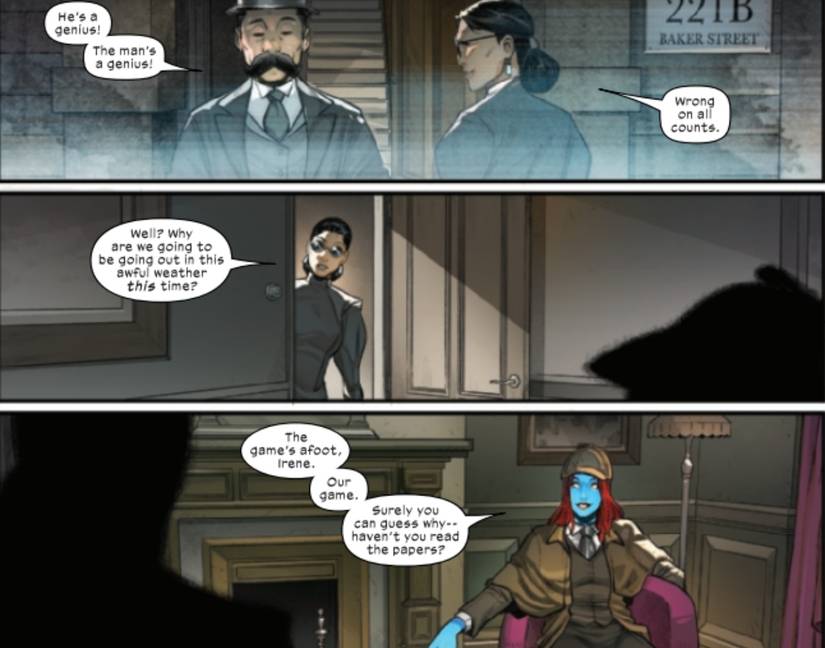
Long before becoming the blue-skinned mutant terrorist audiences know today, Raven adopted one of the most famous identities in detective fiction. By 1895, or possibly even earlier, she had taken on the identity of Sherlock Holmes, operating from 221B Baker Street in London alongside Irene Adler. In Marvel's continuity, the two were acquainted with Sir Arthur Conan Doyle, who recorded their adventures and eventually adapted them into the famous Sherlock Holmes stories known throughout the real world.
This version of Sherlock Holmes is therefore not simply a clever Easter egg. Mystique's extraordinary observational skills, memory, ability to impersonate virtually anyone and talent for reading people made her remarkably well suited to detective work. Working alongside Irene, she investigated a series of murders believed to be connected to Jack the Ripper.
Their investigation eventually led them to Milbury House, the residence of Dr. Nathaniel Essex. Essex had been discovered naked, battered and apparently suffering from amnesia after an attack. Raven went undercover as a prostitute to lure the murderer out, only for the investigation to uncover a far more sinister figure: Mr. Sinister. The pair followed him back to Essex's home and discovered that the apparently monstrous figure could revert to the frail form of Dr. Essex. He was arrested and sent to Bedlam, but the investigators soon learned that he had been murdered overnight.
This early encounter with Nathaniel Essex is particularly interesting in hindsight because Mystique and Mister Sinister would remain connected to some of the most important and disturbing chapters of mutant history more than a century later.
The Hound of the Baskervilles
Mystique's time as Sherlock Holmes also included a Marvel reinterpretation of one of the most famous detective mysteries ever written, The Hound of the Baskervilles. Under the identities of Sherlock Holmes and Dr. John Watson, Raven and Irene were called upon to investigate the apparent supernatural death of Sir Charles Baskerville and the terrifying legend of a monstrous dog said to haunt the Baskerville family.
Sir Henry Baskerville, Charles's heir, returned to England to claim the family estate, only to find himself surrounded by increasingly strange events. He received warnings not to visit the mansion, two of his shoes disappeared, and someone appeared to be following him. Raven suspected that the supposed supernatural mystery had a much more earthly explanation and eventually identified Jack Stapleton as the person behind the scheme.
The truth was considerably more complicated. "Jack Stapleton" was actually Henry's cousin Rodger Baskerville, who was attempting to claim the Baskerville fortune and estate. Beryl was his wife, and the supposedly supernatural hound was a real dog covered in glow-in-the-dark paint. Stapleton used Henry's stolen shoe to give the animal his scent and engineered the entire legend to frighten the Baskervilles.
The investigation culminated with Stapleton attempting to have Henry killed by the dog. Holmes shot the animal just in time and pursued Stapleton into a swamp filled with dangerous quicksand, where the criminal ultimately fell to his death.
First Betrayals
By 1921, Raven's life had already become a long sequence of identities, escapes and betrayals. In the Sonoran Desert in Mexico, she found herself tied to a post and facing execution by firing squad. Her blue appearance had led locals to believe that she was a witch. Beside her was another prisoner who, when asked whether he was a murderer, casually replied that he was "worse" because he was a horse thief.
Raven managed to free herself moments before the firing squad opened fire. The other prisoner somehow survived the bullets and killed the guards, revealing himself to be Logan, the man who would eventually become Wolverine. Raven was intrigued by his resilience and invited him to meet her associates in Kansas City.
In Kansas City, Raven introduced Logan to her group, a collection of criminals who specialized in scams. She invited him to participate in a bank robbery, assuring him that they could become a family and that he could trust her. Logan, despite his reluctance to become attached to people, eventually agreed. They kissed and began a relationship.
Mystique, however, was already showing the quality that would become one of her most recognizable characteristics: betrayal when it served her interests. She alerted the police to the robbery, leaving her own associates to take the fall while she escaped with the money. When Logan confronted her aboard a train, Raven suggested that they should all simply start new lives. Once Logan turned away, she kicked him off the train and disappeared with her stolen fortune.
It was an early demonstration of something that would recur throughout Mystique's life. She could form genuine attachments, but genuine attachment did not necessarily prevent her from betraying someone when survival, money, information or a larger objective demanded it.
World War II
During World War II, Raven and Irene became involved with time-displaced members of the X-Men, including Shadowcat and Rachel Summers. The two future X-Men had travelled into the past in an attempt to stop a Nazi conspiracy involving Baron Wolfgang von Strucker, the Nazi intelligence operative Geist, and Amahl Farouk, the Shadow King.
The conspiracy involved undermining the British monarchy and replacing the British ruler with Oswald Mosley of the British Union of Fascists, potentially creating a government sympathetic to Nazi Germany. Raven and Irene reached out to their old acquaintance Logan for assistance.
The time travellers considered assassinating Adolf Hitler and other prominent Nazi figures, but Raven and Irene advised against it. Mystique's reasoning was remarkably pragmatic. She had learned throughout her long life that killing someone was not necessarily the same thing as preventing a catastrophe, and that knowing when not to kill could be just as important as knowing how to kill.
At some point after the war, Raven lost contact with Irene. She eventually tracked her down working as an archivist at the Alamogordo nuclear research facilities in New Mexico. Raven was uncertain about Irene's motives but trusted her sufficiently not to demand an explanation.
A Mother
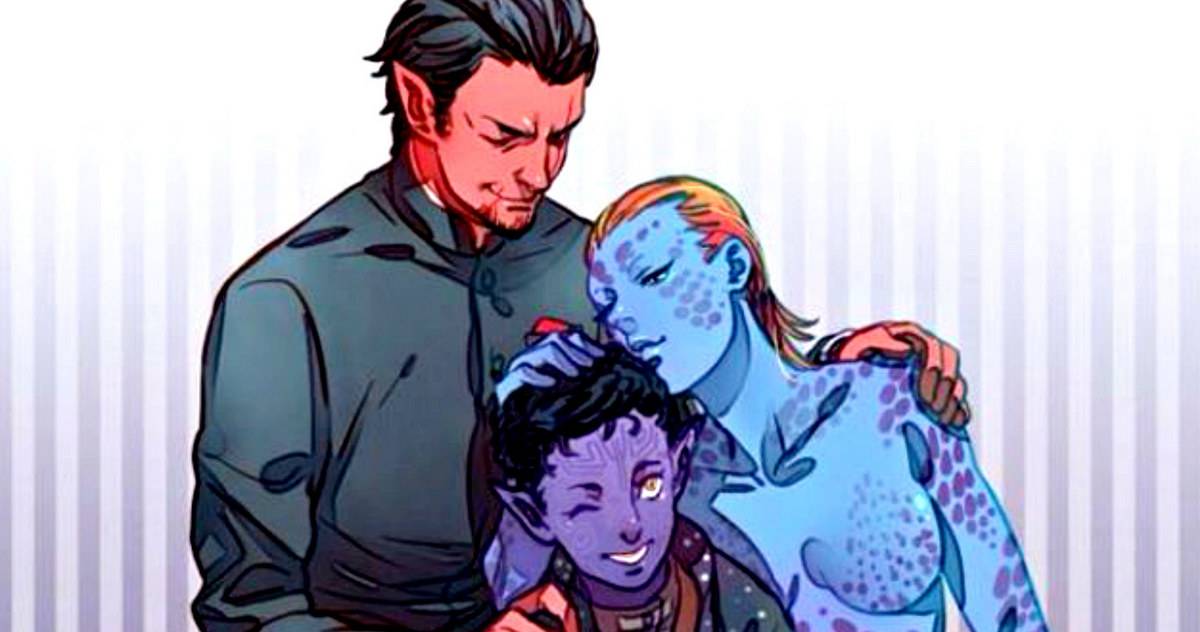
Mystique's complicated history as a mother began with Victor Creed, better known as Sabretooth. At the time, Raven was using the identity of Leni Zauber, a deceased German secret agent. Both Raven and Victor had been assigned to assassinate a scientist in East Berlin. Raven completed the mission in Leni's place, after which she and Victor spent several days hiding in a safe house. The two became lovers, but Raven eventually faked her own death and disappeared.
Their relationship produced Graydon Creed, Mystique's earliest known child. Raven showed little interest in conventional motherhood and arranged for Graydon to be raised away from her, although she continued monitoring him from a distance. Graydon spent much of his childhood in boarding school. Because both of his parents were mutants, Raven expected that he might eventually manifest mutant abilities. He did not.
Graydon remained human, and Raven's disappointment contributed to her abandonment of him. As he grew older, Graydon developed an intense hatred of his parents and eventually extended that hatred toward mutants as a whole. He became a leader of the anti-mutant organization Friends of Humanity and later entered politics. His political career ended when he was assassinated, although the identity of his killer was initially unknown.
The eventual revelation was even stranger: Graydon had been assassinated by a time-travelling version of Mystique herself as part of a complicated temporal paradox involving Jean Grey, Iceman, Toad and Juggernaut.
Raven's personal life became even more complicated when she married Baron Christian Wagner, a wealthy member of German nobility. Christian was loving but their marriage was unhappy, particularly because of his infertility. Raven secretly used her shapeshifting abilities to pursue other relationships and, at times, sought men who resembled Victor Creed. However, her most important relationship remained her affair with Irene, who had been hired as a maid by Wagner.
During this period, Raven also became involved with Azazel, a mysterious mutant who claimed to rule La Isla des Demonas, an island nation off the coast of Bermuda. Azazel possessed shapeshifting and teleportation abilities and later claimed immortality and a connection to the ancient mutant race known as the Neyaphem. He presented himself through numerous names associated with demonic mythology and claimed to have existed since antiquity. Raven was never particularly fond of him, but continued the relationship partly because Irene's precognitive abilities indicated that Azazel would play an important role in their future.
Raven eventually became pregnant with a child connected to Irene and Azazel. To conceal the pregnancy, she used her powers to make herself appear pregnant and allowed Azazel to believe that she was carrying his child. When Christian Wagner became suspicious and demanded a blood test, Raven killed him with a dagger and buried his body.
When Irene gave birth, Raven's true blue form was exposed. The child was a blue-skinned boy with black hair, yellow eyes and a pointed tail. The local population regarded mother and child as demons and attempted to kill them. Raven escaped but abandoned the infant, who was eventually found and raised by the Romany sorceress Margali Szardos. The boy grew up to become Kurt Wagner, Nightcrawler, inheriting his mother's blue appearance and his father's teleportation abilities.
The circumstances surrounding Nightcrawler's birth have undergone some of the most dramatic retcons in X-Men history. Marvel itself has acknowledged that decades of contradictory stories, rumours and deliberate deception surrounded Kurt's parentage before the 2023 story X-Men Blue: Origins finally revisited the mystery.
Meanwhile, Raven and Irene were devastated by what had happened to their son. Their relationship deteriorated, and the two eventually asked Charles Xavier to remove the pain associated with their actions. Xavier erased Raven's guilt over abandoning Kurt, while Irene lost her memory of giving birth to him.
Mystique later became adoptive mother to Anna Marie, the young runaway mutant who would become Rogue. Anna Marie had fled her home in rural Caldecott County, Mississippi, and was living alone in the woods, armed with a shotgun and unwilling to trust anyone. Destiny foresaw that the girl would be important to their future, so Mystique sought her out, gained her trust and took her into her care.
Raven and Destiny raised Rogue for roughly a decade, and despite all of Mystique's moral failures, she became fiercely protective of the girl. While raising Rogue, Raven maintained the identity of Mallory Brickman, the wife of U.S. Senator Ralph Brickman. The identity included an adopted daughter named Gloria, although it remains uncertain whether Mallory Brickman was originally a real person whom Raven replaced or an identity she created entirely.
Mystique was also extraordinarily successful at hiding her true nature from governments. Operating as Raven Darkhölme, she eventually climbed through the United States Civil Service and became Deputy Director of DARPA within the Department of Defense. This position gave her access to classified military information and advanced weapons, resources she subsequently exploited for criminal and subversive purposes.
Brotherhood of Mutants
Mystique eventually organized the third incarnation of the Brotherhood of Mutants, assembling a team that included herself, Avalanche, Blob, Destiny and Pyro. The organization deliberately adopted the name of the original Brotherhood founded by Magneto.
The new Brotherhood announced itself through an attempt to assassinate Senator Robert Kelly. Kelly was investigating what he believed to be the potential danger posed by superhuman beings and mutants, making him a major target for extremist mutant activists. In the infamous alternate future of Earth-811, the assassination succeeded and contributed to the dystopian future depicted in Days of Future Past. A time-travelling Kate Pryde therefore helped ensure that the X-Men prevented the assassination and stopped that future from coming to pass.
Rogue became an important member of Mystique's Brotherhood. Raven trained the young mutant, whose powers allowed her to absorb the memories, personalities, strengths, skills and abilities of people she touched. Under Mystique's guidance, Rogue became a formidable combatant and the Brotherhood came dangerously close to defeating the Avengers.
One of the most consequential moments in Rogue's early history came when she fought Carol Danvers, then known as Ms. Marvel. Rogue attempted to absorb Carol's abilities, but the encounter went disastrously far. Rogue permanently absorbed Carol's memories and powers, leaving Danvers an empty shell. Xavier eventually restored Carol's memories, although the associated emotional components did not return immediately.
Rogue became terrified that Carol Danvers' psyche was overwhelming her own identity. She fled Mystique and sought help from the X-Men, hoping Professor Xavier could help her regain control. Although many X-Men were initially reluctant to accept their former enemy, Xavier welcomed Rogue and offered her a place on the team.
Mystique, believing Xavier had manipulated or brainwashed Rogue, attacked the X-Men in an attempt to retrieve her. Rogue stopped her and explained that she had left voluntarily because Xavier might be the only person capable of helping her. Mystique eventually accepted Rogue's decision, although she never truly forgave Xavier and continued to maintain a complicated relationship with Rogue.
Freedom Force
As anti-mutant sentiment intensified, the U.S. government created the covert anti-mutant program known as Project Wideawake. Mystique concluded that the Brotherhood's continued existence as a criminal organization had become increasingly dangerous and approached Dr. Valerie Cooper, a special assistant to the head of the National Security Council, with an offer. She proposed that the Brotherhood work for the government.
Cooper agreed to present the proposal to the President on one condition: the Brotherhood had to capture Magneto. The team succeeded, although largely because Magneto voluntarily surrendered. The Brotherhood was subsequently renamed Freedom Force, and Mystique became its leader. In exchange for her cooperation, the government granted her a presidential pardon for her previous crimes, although the pardon could be revoked if any Freedom Force member committed another crime.
Freedom Force brought Mystique into conflict with a wide range of enemies, including the Grip and the West Coast Avengers. The team eventually found itself fighting the Reavers on Muir Island. During that confrontation, teammate Stonewall was killed. Mystique ordered Forge to protect Destiny, but when Destiny was later killed by a mind-controlled Legion, Raven blamed Forge for leaving her vulnerable and swore revenge.
Destiny's death was arguably the single greatest emotional blow of Mystique's extraordinarily long life. She took time away from active operations to mourn and scattered Destiny's ashes into the ocean during a cruise.
The loss also left Mystique vulnerable to the Shadow King. He considered Raven a threat and manipulated Valerie Cooper into attempting to kill her. When Cooper briefly regained control, she shot herself, allowing Mystique to contact Nick Fury and develop a plan against the Shadow King. Raven subsequently allowed herself to be brainwashed into believing that she was Valerie Cooper, infiltrated the Shadow King's forces and ultimately used the trigger word "Rogue" to regain her identity during the Muir Island Saga. She then helped prevent Xavier from being murdered.
Freedom Force's final collapse came during a disastrous mission to Kuwait during the Gulf War. Several members were killed, wounded or captured, and the team was officially disbanded.
Breakdown
Mystique's psychological state deteriorated further after former Freedom Force teammate Spiral marked her for death and pursued her around the world. Wolverine eventually rescued Raven and brought her to the X-Mansion, hoping Professor Xavier could help her. Mystique appeared to suffer a complete mental breakdown, although later stories suggested that at least some of it may have been an elaborate performance. Forge eventually took her to Dallas.
While there, Raven discovered that Graydon Creed had become the leader of a successful anti-mutant hate group. Graydon later hired Sabretooth to kill Mystique, but when Raven revealed that Graydon was his son, Sabretooth decided to pursue Graydon instead.
When a senior U.S. general connected to Graydon was found dead, Forge realized that Mystique was responsible. Raven was attempting to kill her own son before he could continue his anti-mutant campaign. Rogue and Nightcrawler attempted to stop her, and during the confrontation Kurt finally learned that Mystique was his biological mother. Raven ultimately failed to kill Graydon and was presumed dead after saving Nightcrawler from an attempt by Graydon to murder his newly discovered half-brother.
X-Factor

Mystique resurfaced several months later after attempting to kill Legion in revenge for Destiny's death. Forge had implanted a tracking device in her skull so that the government could monitor her, and she was eventually forced into the government-sponsored X-Factor after being arrested for attempting to destroy a dam.
The apparent sabotage was actually intended to save the dam. Mystique had discovered that the U.S. government planned to destroy it and blame the destruction on mutants. Her involvement in X-Factor therefore placed her in the bizarre position of working for the same government she suspected of conspiring against mutantkind.
The situation became even more dangerous when Sabretooth joined the team as a sleeper agent whose real mission was to kill Mystique before she could uncover the conspiracy. During this period, Raven developed a romantic relationship with Forge, although he eventually suspected that she was manipulating him.
Graydon Creed's presidential campaign became increasingly central to the conspiracy. He was running on an openly anti-mutant platform, while Raven and Destiny were also dealing with the revelation that Irene had married and had children during one of their separations. Irene's descendants eventually included a mutant teenager whom Graydon's Friends of Humanity brutally attacked as a warning to Mystique.
Mystique wanted to kill Graydon but was warned that his political backers intended to turn him into a martyr if she murdered him. She therefore attempted to save him from his own allies. Her efforts failed, and Graydon was eventually killed by her future self as part of the time paradox surrounding his assassination. His death triggered another wave of anti-mutant violence.
When Operation Zero Tolerance was activated, Sabretooth was ordered to eliminate the members of X-Factor. Mystique could have escaped and left her teammates behind, but instead attacked Sabretooth, buying enough time for the wounded members of the team to survive. She subsequently arranged emergency medical assistance for them before disappearing.
Hiding as Mallory Brickman
Mystique went into hiding using the identity of Mallory Brickman, the wife of Senator Ralph Brickman. She exploited his political influence to turn the FBI against Sabretooth while continuing to investigate the circumstances surrounding Graydon's death. She also prevented Rogue from surrendering her mutant powers and became involved with another incarnation of the Brotherhood, assisting Toad in raiding a government facility. Machine Man defeated the Brotherhood and forced the group to flee.
Mystique eventually fled to Europe, where an extraordinary change in fortune awaited her. While disguised as a blonde woman on a beach, she was approached by a famous photographer who believed she could become a major fashion model. Raven accepted the offer and quickly became a successful model under the name Ronnie Lake. She used her newfound wealth to move into an expensive New York penthouse.
For a brief period, Raven seemed to have found something resembling peace. She bought a telescope and enjoyed the view of New York City from her apartment. Unfortunately, the telescope also allowed her to discover that a nearby building was being used by Skrulls loyal to Apocalypse to construct machinery for an upcoming scheme. When one of the Skrulls saw Mystique watching them, they assumed she had discovered their operation and framed her for the murder of a Japanese diplomat. With assistance from Shadowcat and Rogue, Mystique was cleared. Before leaving New York, Shadowcat discovered one of Destiny's diaries, which Destiny had left behind before her death.
Mystique eventually made a major breakthrough in her investigation into the government conspiracy against mutantkind, but suffered another devastating setback when she suddenly lost her shapeshifting powers while disguised as a man in a busy office.
The government exploited the opportunity. Raven was arrested, her alternate identities were dismantled and her access to the money she and Destiny had hidden over the years was blocked. Without her powers or freedom, Mystique became increasingly volatile. Rogue in particular bore the brunt of her anger and offered little sympathy for her adoptive mother's situation.
Their relationship deteriorated further when Rogue refused to tell Mystique that the X-Men were preparing to confront the High Evolutionary, who had depowered mutantkind. After the X-Men defeated the High Evolutionary and mutant powers were restored, Mystique escaped prison.
The Graydon Creed Time Paradox

Mystique's life became even more complicated when the sentient ship Prosh sent her back through time. Raven discovered that she was destined to participate in a paradox surrounding Graydon's assassination. She encountered a time-delay weapon she remembered setting up but never programming. After considering the implications, she activated it and became the person responsible for killing her own son.
Her psychological stability deteriorated even further when she discovered that Destiny herself had been connected to the anti-mutant conspiracy Mystique had spent years fighting. Destiny had also deliberately withheld medical treatment from mutant children that could have prevented deformities caused by their mutations. The revelation shattered Raven's already fragile sense of purpose.
Dream's End
Mystique became nihilistically obsessed with death and genocide, convinced that her decades of attempts to alter the future had accomplished nothing. She reformed the Brotherhood and once again targeted Senator Kelly. She also kidnapped Moira MacTaggert and impersonated her to gain access to research involving the Legacy Virus.
Although Mystique was not a scientist on Moira's level, her experience with biological weapons and her unstable perspective allowed her to extract insights from Moira's research that even Moira had overlooked. Raven used infected samples to create a biological weapon designed to target humans rather than mutants, while also developing a possible cure for the Legacy Virus.
Her assassination attempt against Senator Kelly failed when Pyro betrayed his teammates to save Kelly's life. Mystique destroyed Moira's research facility, leaving the doctor fatally injured, and then used a prototype of Forge's neutralizer gun to depower Wolfsbane.
Rogue confronted Mystique and realized that her adoptive mother was mentally ill. When Raven explained her plan to use a modified Legacy Virus against humans, Rogue attempted to help her. Mystique pretended to accept that help and then stabbed Rogue. Rogue survived because she had previously absorbed Wolverine's healing factor. She eventually recovered, attacked Mystique from behind using Wolverine's bone claws and left her seriously wounded.
After being hospitalized, Mystique explained her reasoning to the X-Men. Destiny had predicted a terrible future for mutantkind, and Raven believed that every attempt to prevent it merely allowed that future to unfold in another form. She concluded that humanity itself represented an existential threat and convinced herself that a world populated only by mutants might survive where a divided mutant population constantly persecuted by humans would not.
Mystique escaped prison and later joined forces with the daughter of the original Mastermind in an attempt to seize control of the X-Corps from Banshee. Equipped with technology that allowed her to generate electricity, she adopted another supervillain identity and infiltrated the organization. Mastermind's daughter used mind control against the other members while Mystique attacked Banshee and slit his throat, leaving him critically injured.
Double Agent
Eventually, Mystique entered into an uneasy arrangement with Professor Charles Xavier. Xavier needed a covert operative after Prudence Leighton died, and Mystique possessed precisely the combination of infiltration skills, ruthlessness and adaptability he required. Xavier disguised himself as Magneto to rescue Raven from the Department of Homeland Security and prevent her execution by Johnny Kitano, a Special Magistrate investigating crimes committed by Homo superior.
In exchange for protection from the authorities, Mystique agreed to work as Xavier's secret operative. Forge provided technological support while Shortpack served as her handler. The arrangement came with an obvious catch: if Mystique was captured, Xavier would deny ever employing her.
Raven claimed that an impostor had been framing her by controlling the Brotherhood and sending them on missions, including the assassination of Moira MacTaggert and the infiltration of X-Corps. Whether she was telling the truth remained uncertain. Xavier and Mystique never genuinely trusted one another, but both recognized that they could benefit from the arrangement.
The situation became even more complicated when the Quiet Man, who was actually Prudence Leighton inhabiting the body of her assassin, offered Mystique an interference transmitter in exchange for killing Xavier. Raven constructed an elaborate double-cross designed to free herself from both men. She appeared to attempt to assassinate Xavier while secretly working with Fantomex, who arranged for Forge to stop her at the last moment.
Rogue eventually confronted Mystique and finally rejected her adoptive mother. Rogue had tried to forgive Raven for stabbing her, but believed that her latest betrayal had gone too far. She told Mystique that she was not her mother but a monster. Raven apologized, but Rogue attacked her. Mystique escaped by destroying the house and changing her body to survive the fall.
Mystique subsequently confronted the Quiet Man, discovered that his interference transmitter was fake and killed him while saving Shortpack. Forge later caught her attempting to steal his transmitter. After an angry confrontation, Forge destroyed it and told Raven he never wanted to see her again. The two nevertheless shared a final kiss before she left. Forge later realized that Mystique had already switched his real transmitter with the fake one, ensuring that she escaped with the technology she needed.
Joining the X-Men
Mystique later infiltrated Xavier's Institute under the identity of Foxx, posing as a student associated with the Chevaliers. Her goal was to damage the relationship between Rogue and Gambit. She repeatedly attempted to seduce Gambit, although he resisted. Eventually, Raven revealed her true identity and claimed that she was trying to ease the tension between Gambit and Rogue.
Emma Frost eventually exposed Mystique's identity, after which Raven claimed that she wanted to join the X-Men and repair her relationship with Rogue. She also became associated with Pulse, whom she believed would be a more suitable romantic partner for Rogue. Her actual motivations remained unclear, reinforcing the central question that follows Mystique everywhere: when she says she wants to help, is she actually helping, or is she simply setting up her next move?
Mystique eventually fought alongside the X-Men against the Children of the Vault and proved extremely useful. She killed Sangre by firing thermite rounds into his aquatic body. However, her apparent allegiance collapsed when the Marauders attacked her home. Mystique shot Rogue, activated a Neural Inhibitor against Iceman and ultimately revealed herself as a traitor once again.
Messiah Complex

Mystique remained with the Marauders during the hunt for Hope Summers, the first new mutant baby born after M-Day. Her betrayal of the X-Men initially appeared to be genuine, but it was ultimately revealed to be part of a plan designed to save Rogue. She recruited Gambit into the scheme after Mister Sinister had rescued him from Apocalypse.
Rogue had become comatose after absorbing millions of psyches through the Hecatomb and becoming infected with Strain 88. Mystique and Gambit planned to kill Sinister and use Hope to save Rogue. Raven pushed Sinister onto Rogue, whose touch had become lethal, killing him instantly. She then placed Hope's face against Rogue's, believing Destiny's Diaries indicated that the baby would heal her.
When Rogue did not immediately awaken, Mystique broke down in tears. Eventually, Rogue regained consciousness. Hope's powers had purged the Legacy Strain and residual personalities from Rogue, including the Hecatomb, but Rogue was left carrying the memories and consciousness of Mystique herself.
The revelation horrified Rogue, who attempted to kill Mystique. Raven survived, but Rogue ultimately chose to leave and distance herself from the woman who had caused so much chaos throughout her life.
Mystique fled and Wolverine was ordered to find her. He tracked her through Iran and Afghanistan. After a brutal confrontation, Raven asked Logan to kill her. Wolverine refused. Instead, he told her that unlike her, he had friends who would always come looking for him. He left Mystique alone in the desert with a pistol, effectively forcing her to confront the isolation she had created for herself.
Manifest Destiny and the Dark X-Men

Mystique eventually resurfaced while impersonating Bobby Drake's former girlfriend, Opal Tanaka. She planted a bomb aboard Iceman's Blackbird, shot him and threw him from the aircraft. She later followed him to hospital and injected him with a lethal toxin created by Mister Sinister. Iceman managed to expel the poison, and their confrontation continued when Mystique attacked him inside a truck and set it on fire. Bobby emerged unharmed, but Mystique escaped by transforming her body into the shape of a child.
Mystique later impersonated Iceman and appeared on the Golden Gate Bridge with a bomb, threatening to destroy it. Bobby confronted her and discovered that her actions were partly motivated by Wolverine's earlier claim that she would die alone. Iceman froze the bomb, but Mystique punched him and jumped from the bridge into the water. Her body was not recovered.
Mystique soon returned and joined Norman Osborn's Dark X-Men, impersonating Professor Xavier for public-relations purposes. Osborn implanted nanites in her body and effectively held her hostage, with the ability to turn her into a human bomb if she disobeyed him.
Death and Return
Mystique played a role in sending Wolverine's soul to Hell. When Logan eventually returned, he decided to hunt her down. Although Raven had helped restore him and attempted to warn him that the Red Right Hand was manipulating events, Wolverine ultimately killed her. Her corpse was subsequently sold to the Hand.
The Hand resurrected Mystique and enhanced her already formidable powers. Raven reunited with the newly resurrected Sabretooth, and the two resumed their relationship while working for the Japanese branch of the Hand under Azuma Gōda. After Sabretooth betrayed Gōda and left him to Wolverine, he declared himself the invisible King of Asian crime, with Mystique at his side.
The New Brotherhood of Evil Mutants
Mystique later joined another Brotherhood, this time as part of a scheme to expose and destroy Wolverine's X-Force while claiming Genesis, the young mutant connected to Apocalypse, for themselves. The group also worked with the Shadow King, although Mystique and Sabretooth secretly intended to kill him once he was no longer useful, seeking revenge for his role in Destiny's death.
Although Daken appeared to lead the Brotherhood, Sabretooth was actually manipulating events from behind the scenes. The group's conflict with X-Force was designed partly to psychologically destroy Wolverine by forcing him into increasingly painful choices.
Mystique once again demonstrated the terrifying versatility of her powers by assuming Psylocke's form to seduce Fantomex. He eventually discovered the deception, but not before she poisoned him. When X-Force survived an attack by Ultimaton, Mystique was captured.
One of the most emotionally complicated moments followed when Raven encountered an alternate-universe version of Nightcrawler, Kurt Darkhölme from Earth-295. With her own son deceased at the time, seeing another version of Kurt understandably affected her. Mystique secured her freedom by offering this alternate Nightcrawler an opportunity to avenge himself against the alternate Blob, who had murdered his wife.
The Brotherhood ultimately lost control of Genesis, and most members were killed or captured. Yet their larger plan succeeded in breaking Wolverine emotionally by forcing him to kill his own son to save Genesis. Mystique and Sabretooth escaped.
After Professor X's Death
Following the conflict between the Avengers and X-Men, Mystique gathered Sabretooth and Lady Mastermind to form another Brotherhood. The group committed a series of heists and manipulated events to frame the original five X-Men, who had been brought forward in time by Beast. Raven also attempted to manipulate the young Cyclops by encouraging distrust of the adult X-Men.
When her scheme was exposed, Mystique incapacitated Dazzler and stole her identity, using the disguise to infiltrate S.H.I.E.L.D. She later used the money stolen during her heists to purchase Madripoor from Hydra, hoping to transform the island into a mutant sanctuary.
Raven, posing as Dazzler, attempted to bring Magneto to Madripoor and explain her plans. Magneto considered Mystique and her allies traitors because their operations had included allowing Mutant Growth Hormone to spread through Madripoor's streets. He attacked the Brotherhood, severely injuring Mystique and destroying their base.
AXIS
Despite their previous conflicts, Mystique was recruited by Magneto to fight the Red Onslaught in Genosha. Doctor Doom and Scarlet Witch attempted to stop Red Onslaught using an inversion spell intended to draw out the buried personality of Charles Xavier within the Red Skull's mind. Instead, the spell affected everyone on the island.
Mystique's moral alignment was inverted, transforming the normally ruthless shapeshifter into a noble and self-sacrificing figure. She attempted to convince the inverted X-Men to abandon their plan to conquer New York City. Although she failed, Steve Rogers recruited her into the Astonishing Avengers, a team composed of villains who had temporarily become heroes and were now attempting to stop both the inverted X-Men and the fascist Avengers.
Mystique fought knowing that victory would eventually restore her original personality and return her to her villainous ways. When the inversion spell was finally undone, Raven returned to her normal moral state.
The Wolverines
Mystique was later kidnapped by a mysterious group of Weapon X survivors alongside Daken, Sabretooth, Lady Deathstrike and X-23. Shortly before her abduction, she had attended an auction in Madripoor where Wolverine's remains were being sold. Daken, furious at the spectacle, killed everyone at the auction except Mystique, Viper and a Hydra agent named Kim.
Magneto's X-Men
Mystique was eventually recruited by Magneto to work with his X-Men. She infiltrated Someday Enterprises and helped expose an anti-mutant conspiracy. At another point, she attacked Psylocke, who subsequently repaired fractures in Raven's psyche caused by the constant physical and neurological strain of her shapeshifting.
After Magneto's X-Men disbanded, Mystique joined a team assembled by Psylocke to oppose the Shadow King. She initially impersonated Beast but eventually revealed her true identity. The group succeeded in stopping Farouk and helped bring Professor Xavier back. Before the team separated, Xavier removed their memories of his return and gave Mystique and Rogue a particularly meaningful gift: he repaired the fractured sense of identity they had developed after years of shapeshifting, trauma and psychic manipulation, reinforcing the idea that they could change externally without losing who they were internally.
House of X
Three months before the founding of the mutant nation of Krakoa, Mystique planted a Krakoan flower on the Blue Area of the Moon. Magneto and Xavier had recruited her with a promise that, if she helped them establish Krakoa, they would eventually resurrect Destiny.
Alongside Sabretooth and Toad, Mystique was sent to steal intelligence about Nimrod and Mother Mold from Damage Control. The mission succeeded, although Sabretooth was left behind after the intervention of the Fantastic Four.
The X-Men subsequently attacked the Orchis Forge to destroy Mother Mold and prevent the creation of Nimrod. Mystique was ejected into space by Dr. Alia Gregor and died in the vacuum. The mission nevertheless succeeded in destroying Mother Mold. Thanks to the resurrection technology developed by the Five, Mystique and the other deceased mutants were restored to life and hailed as heroes of Krakoa.
Mystique was later invited onto the Quiet Council of Krakoa, where she represented the Winter section alongside Exodus and Mister Sinister. This faction represented some of the most zealous, criminal and morally ambiguous elements of mutant society. One of the council's first major decisions involved judging Sabretooth for killing humans during a mission, with Mystique appearing impatient as the council debated his punishment.
Inferno
Destroying Mother Mold had not prevented Nimrod from eventually emerging, meaning Mystique's mission was incomplete. Xavier and Magneto therefore sent her back to destroy the Orchis Forge. Raven agreed only after receiving another promise that Destiny would be moved to the front of the resurrection queue if she succeeded.
Armed with a singularity bomb, Mystique infiltrated the station only to discover that Nimrod had already been activated. Nimrod prevented the destruction of the Forge and killed Mystique. Xavier and Magneto once again refused to resurrect Destiny. Raven responded by remembering one of Destiny's prophecies: one day, an island would appear that looked like a place of hope for mutantkind. When that happened, Destiny had instructed Raven to bring her back, and if the people in power refused, Raven was to burn the entire place down.
Mystique then began secretly manipulating events to resurrect Irene. She impersonated Xavier and Magneto to retrieve Cerebro and Destiny's genetic material from Mister Sinister. Posing as Xavier, she convinced the Five to resurrect Destiny in a younger body resembling the one Irene had possessed when the two first met. Sinister knew that Raven was deceiving everyone but allowed the scheme to continue because he had his own reasons for doing so.
After Destiny returned, Mystique spent weeks caring for her while Irene struggled with overwhelming visions. Raven also negotiated with Exodus, Sinister, Sebastian Shaw and Emma Frost to secure votes for Destiny's return to the Quiet Council. When Xavier and Magneto attempted to stop her, Mystique hijacked the council meeting by publicly revealing that Destiny had been resurrected and nominating her for the vacant seat formerly occupied by Apocalypse. Her political maneuvering succeeded by a 6–4 vote.
Mystique then began investigating Orchis. Disguised as Sage, she discovered an incident involving a Krakoan Gate in France that Xavier had redacted. She used the gate to infiltrate an Orchis facility and subsequently travelled to their main base to uncover their plans.
The resurrection of Destiny also revealed another devastating secret. Xavier and Magneto informed Emma Frost that Moira MacTaggert was alive and was actually a mutant capable of reincarnating and resetting her own timeline whenever she died. Moira had already lived nine previous lives and had manipulated countless people in her attempts to create Krakoa and unite mutantkind.
Emma revealed that in an earlier life, Mystique and Destiny had killed Moira and set her on the path that eventually led to Krakoa. Moira consequently held a grudge against both women. When Orchis captured Moira, Mystique infiltrated their base, killed the Orchis personnel and rescued her.
Raven used one of Forge's weapons to depower Moira. Mystique and Destiny intended to kill her permanently so that she could not die and reset the timeline. Moira revealed that she had lost faith in the current timeline and intended to depower mutantkind because she believed that was the only way to save them. Before Raven could kill her, Cypher intervened with the assistance of Krakoa, Warlock and Bei the Blood Moon. Moira escaped, and Mystique vowed to hunt her down.
The later Fall of X period brought another major upheaval to mutantkind and Krakoa. Marvel has specifically described Destiny as one of Krakoa's most important leaders and highlighted how her relationship with Mystique continued to shape the direction of mutant politics even as the nation approached its collapse.
Personality
Mystique is perhaps best understood as a character built around contradiction. She can be extraordinarily affectionate toward people she considers family while being utterly ruthless toward anyone she considers a threat. She can sacrifice herself for someone one day and betray them the next. Her shapeshifting has also made identity itself complicated for her. To Mystique, a face is not necessarily a person, a name is not necessarily an identity and loyalty is rarely unconditional.
Her worldview was shaped by centuries of persecution, secrecy and survival. Rather than expecting society to accept her, Raven learned to manipulate society before it could manipulate her. Governments became tools, relationships became potential alliances, identities became disguises and information became currency.
At the same time, reducing Mystique to a simple villain misses the emotional core of the character. Her devotion to Destiny is genuine. Her love for Rogue, however dysfunctional, is genuine. Her complicated relationship with Nightcrawler repeatedly demonstrates that she is capable of guilt and attachment. Even some of her most heroic actions come from the same obsessive need to control the future that drives her darkest decisions.
The tragedy of Mystique is that she often genuinely believes she is protecting mutantkind. The problem is that her definition of protection can become indistinguishable from domination.
Romantic Relationships
Mystique's romantic history is almost as complicated as her criminal record. Her longest and most important relationship is with Destiny, whom Marvel's modern stories explicitly identify as her wife. Their relationship spans centuries and has survived separation, death, resurrection and competing timelines.
Raven also had a serious relationship with Wolverine, and their history stretches back to their encounter in Mexico in 1921. Their relationship was complicated by mutual attraction, criminal activity, betrayal and their later lives as opposing members of the mutant community.
Her marriage to Christian Wagner was another significant relationship, although it was complicated by his infertility and Raven's dissatisfaction with their marriage. Her relationship with Azazel was brief but historically important because of its connection to Nightcrawler's origin.
Mystique also had serious relationships with Sabretooth and Forge. Her relationship with Sabretooth produced Graydon Creed, while her later relationship with Forge developed during her time with government-sponsored X-Factor.
She was also briefly married to Senator Ralph Brickman while using the identity of Mallory Brickman. Other relationships and encounters include a kiss with Shepard, an intermittent casual relationship with Fantomex, a serious relationship with Iceman, and a brief relationship with Daken. Her history even includes a marriage to Deadpool, another reminder that almost nothing in Mystique's romantic life is ever straightforward.
Attributes
Powers
Mystique's primary mutant ability is an extraordinary form of biological transformation. She can psionically alter the formation of her cells and use that control to reproduce the appearance and voice of other people with remarkable precision. Her ability is far more sophisticated than simply changing her face. She can replicate fingerprints, palm patterns, skin pores, retinal patterns, scent, heat signatures and even voice prints.
Her control over her body can extend to its internal composition and physiological functions. Doctor Nemesis has described her not merely as a shapeshifter but as a biological "gene-shaper," capable of rewriting the genetic instructions contained within her cells at extraordinary speed. The calculations required for her transformations have even been described as exceeding the capabilities of known computers.
Mystique's powers have evolved considerably throughout her history. At various points she has been able to create night vision, wings, talons, fangs, natural armour and a mermaid-like tail. She has also compressed her body into an almost two-dimensional state, allowing her to glide on air currents and survive situations that would be impossible for a normal human being.
Her post-resurrection abilities became even more impressive. After being resurrected by the Hand, Mystique's powers were enhanced enough to fool Wolverine's extraordinarily sensitive sense of smell, something she previously could not accomplish. She gained additional abilities including tentacle generation, animal transformations and partial liquefaction.
There has also been speculation that Mystique may possess the ability to reproduce the powers of some mutants she imitates. This possibility was dramatically demonstrated when Fabian Cortez temporarily amplified her abilities, allowing her to replicate aspects of Magneto's magnetic powers, Juggernaut's strength and durability, Cable's telekinesis and Marrow's bone manipulation. The exact limits of this ability remain uncertain.
Mystique's metamorphic adaptation allows her to camouflage herself against her environment, shift internal organs, reproduce textures such as glass and metal and even create hidden pouches within her body to conceal objects. She has explained that what appears to be clothing can actually be an extension of her own skin, which means she can make herself appear dressed without technically wearing conventional clothing.
She can also enhance her strength, speed, agility, durability, reflexes and senses. Her regenerative abilities allow her to recover from injuries far faster than an ordinary human, including severe wounds and even lost limbs. She can maintain a disguise while unconscious or under the influence of drugs.
Mystique also possesses significant resistance to toxins and diseases. Her unusual physiology allows her to adapt rapidly to biological threats, further contributing to her reputation as an exceptionally difficult opponent to kill.
Her shapeshifting abilities have dramatically slowed her aging, leaving her physically capable despite being more than a century old. She also possesses a natural resistance to telepathic intrusion, which is especially useful for someone whose entire life depends on keeping secrets.
Mystique's memory is equally formidable. She has claimed to know the locations of every security camera in major airports throughout the United States and roughly half of those in Canada, illustrating the level of preparation she brings to infiltration and covert operations.
In one particularly unusual incident, Mystique was reportedly able to divide herself into two separate individuals, posing as twins. The extent and mechanics of this ability remain unusual even by the standards of her already extraordinary shapeshifting.
Her threat assessment reflects the scale of her abilities. Nick Fury's intelligence classified Mystique at power level 8, while the Office of National Emergency designated her a severe threat. Prosh's Comparative Mutagenic Power Register gave her a rating of 8.3.
Abilities
Mystique's physical powers are only half of what makes her dangerous. She is a highly accomplished martial artist whose combat skills have been compared with those of Black Widow and Captain America. She is also a trained actress, expert marksman and experienced covert operative.
Her longevity has given her an enormous amount of practical experience. She has operated as a detective, spy, assassin, criminal strategist, government operative, terrorist and infiltrator across multiple eras. Few characters in Marvel possess the combination of historical knowledge and practical espionage experience that Raven has accumulated.
Mystique is also multilingual. She has stated that she knows at least eleven languages and has demonstrated fluency in German, English, Spanish, Portuguese, French, Farsi, Japanese, Korean, Swedish and Czech.
Perhaps most importantly, Raven is an exceptional strategist. Her greatest weapon is rarely her physical strength. It is her ability to understand what people want, determine what they fear and then become the person they are most willing to trust.
Weaknesses
Despite the near-limitless potential of her shapeshifting, Mystique's abilities have limitations. Traditionally, her powers allowed her to imitate appearance but did not automatically grant her the powers of the individual she copied. For example, transforming into Nightcrawler did not automatically give her Kurt's teleportation ability.
Her ability to replicate powers has therefore remained inconsistent and controversial within the comics. Doctor Nemesis himself has acknowledged that Mystique's limitations are not completely understood, and isolated instances suggest that under specific circumstances she can reproduce certain superhuman abilities.
Mass is another traditional limitation. Historically, Mystique could make herself look like someone considerably larger than herself without actually gaining the same body mass. This meant that a disguise resembling Sabretooth, for example, would not necessarily possess the same physical power as the real Victor Creed. Maintaining a form substantially larger than her natural body could also place considerable strain on her physiology. Later stories suggested that her enhanced powers might allow her to change her body mass, although, appropriately for Mystique, the truth remains uncertain.
Her shapeshifting has also historically affected her brain. Constant subtle changes to her neural tissue once contributed to severe psychological instability, including symptoms described as schizophrenia. Psylocke eventually stabilized her mind by repairing the neurological damage associated with her transformations.
Paraphernalia
Equipment
Mystique has never relied exclusively on her mutant abilities. Over the years she has used experimental weapons and advanced technology, including a power-draining device capable of disabling Iron Man. She has also used nanotechnology designed to fool Cerebro and related mutant-detection technology.
Her experience inside governments and military organizations has also given her access to technology far beyond what most criminals could acquire. Her years inside DARPA, Freedom Force, X-Factor and other covert operations have repeatedly allowed her to exploit sophisticated weapons and surveillance systems.
Weapons
Mystique has used conventional firearms, energy weapons and specialized explosives throughout her career. Her signature equipment has often included skull-shaped explosives carried on her belt, some of which she could manipulate through her shapeshifting abilities.
Transportation
During the Wolverines storyline, Mystique possessed an advanced stealth aircraft called the Changeling. The vessel could cloak itself, travel at extremely high speeds and operate with sophisticated surveillance and weapons systems. It also contained an onboard analysis computer and power-suppressing containment cells. The Changeling was eventually destroyed, and its replacement status remains unknown.
Notes
Mystique's age remains one of the enduring mysteries surrounding her character. She has explicitly stated that she was not born in the last century and has repeatedly described herself as being more than one hundred years old. Her known presence alongside Destiny by 1895 and her statement that solitude had been her natural state for a hundred years suggest that she may have been born before 1800.
There are, however, conflicting pieces of evidence. An earlier Uncanny X-Men story presented a dream in which Mystique appeared in 1783 and described that year as occurring 170 years before her birth, implying an age of approximately thirty in the story's 1983 publication period. That interpretation has since effectively been retconned.
Mystique may also have been born in September. At one point, she was given a sapphire necklace because sapphire is traditionally associated with September birthdays. Raven's reaction suggested that the giver somehow knew her birth month, although her exact birthday remains unknown.
Mystique's relationship with clothing is another unusual aspect of her physiology. Because she can make her skin resemble fabric and other materials, she rarely needs conventional clothing. She has even admitted that what appears to be clothing is simply part of her transformed body.
Despite being able to become almost anyone, Raven reportedly dislikes her own natural appearance and avoids looking at herself in mirrors. That detail adds an unexpectedly vulnerable dimension to a character whose entire existence revolves around changing how others see her.
There is also an amusing possible connection between Mystique's Sherlock Holmes identity and Clive Reston. Reston has been hinted to be related to Sherlock Holmes and is described as inheriting deductive skills and a smoking habit from a great-uncle who was a private detective. The connection between that great-uncle and Holmes has never been explicitly confirmed and was apparently intended as a joke or Easter egg.
Mystique has also been called the "Sapphic Sapphire" by Bling!, a reference to her significance within the lesbian community.
Trivia
One of the biggest misconceptions about comic-book Mystique comes from adaptations that portray her as Magneto's second-in-command. In the main Earth-616 comics, Mystique is not traditionally Magneto's lieutenant. Before the fourth volume of Uncanny X-Men, the two characters had relatively few encounters and were not particularly close. The association between them became much stronger in other adaptations and later comic stories.
Mystique's complicated relationship with Magneto therefore differs substantially from how she is often presented in film and television. Her comic-book identity has always been more independent, with her loyalties generally revolving around her own agenda, Destiny, Rogue, mutant survival and whatever larger objective she believes she must accomplish.
Another major piece of X-Men history concerns Nightcrawler's parentage. Veteran writer Chris Claremont has stated that he originally intended Mystique and Destiny to be Nightcrawler's biological parents, with Mystique assuming a male form for conception. Marvel rejected the idea at the time because of restrictions surrounding the portrayal of gay and bisexual characters. Decades later, the basic concept was finally incorporated into continuity in X-Men Blue: Origins #1, published in 2023.
Marvel itself promoted X-Men Blue: Origins #1 as the story that would finally clear away decades of conflicting accounts surrounding Nightcrawler's birth and reveal the truth about Raven Darkhölme and Kurt Wagner.
Mystique's cultural impact has extended beyond comics as well. In celebration of Marvel's 80th anniversary, she was featured alongside Dark Phoenix and Storm in a special line of Marvel-themed Barbie fashion dolls produced in collaboration with Mattel.
And, in a suitably chaotic twist even by Mystique's standards, she has also been married to Deadpool. Given the character's history of disguises, secret identities, complicated romances and unconventional alliances, a marriage to Wade Wilson somehow feels less surprising than it should.
Mystique's Enduring Legacy in Marvel
Mystique remains one of Marvel's most distinctive mutants because her power is about much more than changing her appearance. Her true superpower is identity itself. She can become a stranger, a friend, a government official, an enemy, a celebrity, a fellow mutant or even another superhero. She can disappear into a crowd without leaving behind a trace and infiltrate organizations that would normally be impossible for an enemy to penetrate.
That ability has made her uniquely important to the X-Men mythos. The X-Men have always explored questions of identity, prejudice, belonging and what it means to live as someone society considers different. Mystique takes those questions to their logical extreme. She can literally change the person everyone else sees, yet she remains trapped inside a life defined by the fear that nobody will ever truly see Raven Darkhölme.
Her history also demonstrates why she has remained such a dangerous opponent for the X-Men. Mystique does not need to overpower an enemy physically. She can undermine their relationships, steal their identities, manipulate their institutions, exploit their weaknesses and make them question whether the person standing beside them is really who they claim to be.
Her relationship with Rogue remains one of the most emotionally important parts of her mythology, while her relationship with Destiny provides the ideological backbone of her story. Her connection to Nightcrawler adds another layer of tragedy, particularly because Kurt's compassion and heroism stand in such stark contrast to many of Raven's choices. Marvel's modern stories have continued to revisit those relationships, proving that Mystique's family history is not merely background information but a central part of the X-Men's ongoing mythology.
Even her powers have evolved alongside the character. What began as a relatively straightforward ability to change appearance has developed into an astonishing biological transformation system involving cellular manipulation, enhanced physical characteristics, regeneration, adaptive physiology, camouflage and potentially even limited power mimicry.
Ultimately, Mystique's greatest strength and greatest weakness are the same thing: she can become anyone, but she can never completely escape herself.
That is what makes Raven Darkhölme so compelling after decades of X-Men stories. She is not simply the woman in blue who can steal someone's face. She is a survivor who has spent centuries reinventing herself, a mother who has failed her children and sometimes sacrificed herself for them, a lover whose devotion to Destiny has changed mutant history, a criminal who has occasionally become a hero, and a mutant who has repeatedly tried to control a future that refuses to be controlled.
From her mysterious early life and her days as Sherlock Holmes to the Brotherhood of Mutants, Freedom Force, X-Factor, the X-Men, Krakoa and the Fall of X, Mystique's journey has remained one of the most unpredictable stories in Marvel Comics. And perhaps that is exactly how Raven Darkhölme would want it. After all, if there is one thing readers have learned after decades of following Mystique, it is that you should never assume you know who she really is.
Frequently Asked Questions About Mystique
1. Who is Mystique in Marvel?
Mystique, whose real name is Raven Darkhölme, is a powerful mutant and shapeshifter in Marvel Comics. She is one of the most prominent X-Men characters and has been portrayed as both a villain and an antihero.
2. What are Mystique’s powers in Marvel?
Mystique’s primary power is shapeshifting. She can alter her appearance, voice, fingerprints and other physical characteristics to impersonate other people. Her abilities also include enhanced physical adaptability, camouflage and an unusually long lifespan.
3. What is Mystique’s real name?
Mystique’s real name is Raven Darkhölme. She commonly operates under the codename Mystique and is one of Marvel’s most famous mutant characters.
4. Is Mystique a villain or a hero?
Mystique is neither simply a hero nor a villain. Her loyalties frequently change depending on her goals, relationships and circumstances. She has worked against the X-Men, alongside them, and as part of various mutant organizations.
5. Who is Mystique’s partner in Marvel Comics?
Mystique’s most important romantic partner is Destiny, whose real name is Irene Adler. Their relationship spans decades and plays a major role in Mystique’s character history and the broader X-Men mythology.
6. Is Mystique Nightcrawler’s mother?
Yes. Mystique is the biological mother of Kurt Wagner, better known as Nightcrawler. Marvel has explored and revised the details of Nightcrawler’s parentage across different X-Men stories, making their relationship one of the franchise’s most complicated family histories.
7. Who is Nightcrawler’s father?
Nightcrawler’s parentage has been complicated by multiple versions of his origin. Modern Marvel storytelling establishes Mystique and Destiny as his biological parents, adding another layer to Mystique’s relationship with Kurt Wagner.
8. Is Mystique the mother of Rogue?
Mystique is not Rogue’s biological mother, but she becomes one of the most important parental figures in Rogue’s life. Mystique took Rogue in and raised her, creating a complicated relationship that has remained central to both characters.
9. Why does Mystique have blue skin?
Mystique naturally has blue skin and red hair in her mutant form. Because she is a shapeshifter, however, she can transform her appearance to resemble other people or adopt entirely different forms.
10. Can Mystique copy other mutants’ powers?
No. Mystique can imitate another person's physical appearance, but traditionally she does not automatically gain that person's mutant powers. Her greatest advantage comes from deception, infiltration and using her shapeshifting strategically.
11. Can Mystique shapeshift into anyone?
Mystique can transform herself to closely resemble other people, including their facial features, voice and identifying physical characteristics. Her shapeshifting makes her exceptionally effective at espionage and infiltration.
12. How powerful is Mystique?
Mystique is extremely dangerous because her greatest strength is not raw physical power but adaptability, intelligence and deception. Her shapeshifting, combat ability, strategic thinking and espionage skills have allowed her to challenge far more powerful opponents.
13. How old is Mystique in Marvel Comics?
Mystique is significantly older than she appears. Her mutant physiology gives her slowed aging, allowing her to remain active across multiple generations of Marvel history.
14. What is Mystique’s relationship with Destiny?
Mystique and Destiny are deeply connected romantic partners and longtime allies. Destiny’s prophetic abilities and Mystique’s shapeshifting have made them one of Marvel’s most influential mutant partnerships.
15. What is Mystique’s connection to the Brotherhood of Mutants?
Mystique has been closely associated with the Brotherhood of Mutants, using the organization to pursue her goals and fight for mutant interests. Her leadership and shifting alliances have made her a recurring force in X-Men conflicts.
16. Has Mystique ever worked with the X-Men?
Yes. Although Mystique is best known for opposing the X-Men, she has also worked alongside them and assisted mutant causes when her interests aligned with theirs. Her shifting alliances are a defining part of her character.
17. What happened to Mystique during the Krakoa era?
During the Krakoa era, Mystique became involved in major mutant political and resurrection storylines. Her relationship with Destiny and her attempts to manipulate Krakoa's leadership became particularly important to her character arc.
18. Why is Mystique important to X-Men history?
Mystique is important because her story connects several major parts of X-Men mythology, including the Brotherhood of Mutants, Destiny, Rogue, Nightcrawler, mutant politics, espionage and the Krakoa era. Few X-Men characters have had such complicated relationships with both heroes and villains.
19. What is Mystique’s greatest weakness?
Mystique’s greatest weakness is arguably the complexity of her loyalties and relationships. Her desire to protect the people she cares about can lead her into dangerous alliances and morally questionable decisions.
20. Why is Mystique one of Marvel’s most popular X-Men characters?
Mystique stands out because she combines shapeshifting powers, espionage, intelligence, mystery and complicated relationships. Her ability to change identities also makes her a character whose true motives are rarely obvious.
21. What is Mystique’s connection to Raven Darkhölme?
Raven Darkhölme is Mystique. Raven is her real name, while Mystique is the identity and codename she uses throughout much of her Marvel history.
22. Is Mystique an X-Men character?
Yes. Mystique is one of the most recognizable characters associated with the X-Men and Marvel's mutant universe. Although she has frequently been an antagonist, her story is deeply intertwined with the X-Men.
23. What is Mystique’s role in Marvel Comics?
Mystique is primarily an infiltrator, spy, strategist and mutant shapeshifter. Her role changes throughout Marvel history, allowing her to function as a villain, antihero, revolutionary, ally and political operator.
24. What makes Mystique’s shapeshifting different from other Marvel shapeshifters?
Mystique's shapeshifting is exceptionally versatile. She can reproduce highly specific physical characteristics and use her ability for espionage, disguise, combat, infiltration and escape, rather than simply changing her face.
25. What is the complete history of Mystique?
Mystique's history stretches from her early life as Raven Darkhölme through her relationship with Destiny, involvement with the Brotherhood, connection to Rogue and Nightcrawler, conflicts with the X-Men and her major role in the Krakoa era. Her constantly changing alliances make her one of Marvel's most complex mutant characters.
And if Mystique’s story has reminded you why Marvel characters are so much fun to collect, there is plenty more waiting for you. Calling all collectors and fans: explore an exciting range of collectibles inspired by Disney, Pixar, DC, Marvel, Anime, Transformers, Mortal Kombat and more, with selected collectibles available for up to 40% OFF. Whether you are looking for a striking centrepiece for your collection, a gift for a fellow fandom enthusiast or the perfect figure to celebrate your favourite character, now is a great time to discover something worthy of your shelf.