India’s Official Distributor and Retailer for Licensed Action Figures, Statues and Anime Collectibles

0

Your Cart is Empty

March 23, 2026 27 min read

Sonya Blade has always been more than just a soldier—she’s the kind of person who carries the weight of responsibility like it’s second nature. As the General of Earthrealm’s Special Forces in the Mortal Kombat universe, Sonya isn’t just defined by rank or discipline—she’s defined by resilience. There’s a sharpness to her, a no-nonsense edge that comes from years of fighting battles most people wouldn’t even survive, let alone lead. Beautiful, yes—but that’s never been her defining trait. What truly stands out is her toughness, her unwavering sense of duty, and the way she refuses to bend, no matter how impossible the situation becomes. She represents a fiercely independent, emancipated woman—someone who doesn’t wait for orders when lives are on the line. And yet, beneath that steel exterior, there’s a deeply human core. For all her stubbornness and pride, Sonya cares—deeply—for the people around her. Her friends, her teammates, her soldiers… they’re not just part of the mission. They’re family.

That sense of loyalty is also what fuels one of the most personal rivalries in Mortal Kombat lore—her long-standing hatred for Kano, the ruthless leader of the Black Dragon. This isn’t just professional conflict. It’s personal. Kano murdered a former partner of hers, leaving a scar that never really healed. Since then, he’s come to embody everything Sonya stands against—chaos, greed, cruelty without consequence. And it doesn’t stop with him. Her clashes extend to other Black Dragon members like Jarek, reinforcing her role as one of Earthrealm’s fiercest defenders against organized crime and corruption that spills far beyond ordinary boundaries.

Her life, however, isn’t defined only by war. In the rebooted timeline introduced in Mortal Kombat (2011), Sonya’s story takes a more personal turn after the Netherrealm War and the defeat of Shinnok. It’s during this period that her relationship with Johnny Cage deepens—something that begins almost unexpectedly, given how different they are. Over time, that bond grows into marriage, and together they have a daughter, Cassandra Carlton Cage—better known as Cassie. But even that relationship, built on shared battles and mutual respect, doesn’t last forever. They eventually divorce, a reminder that even warriors who can face gods and monsters aren’t immune to the complexities of real life.

By the time we reach Mortal Kombat 11, Sonya is still at the front lines—only now, she’s also a mother watching her daughter step into the same dangerous world. Early in the story, she spars with Cassie during a military promotion match—a moment that feels less like competition and more like a passing of the torch. Soon after, Raiden gathers Sonya, Cassie, and Johnny to discuss a critical mission: an assault on the Netherrealm. What follows is one of the most defining moments of her character. During the operation, Liu Kang—now the corrupted Dark Emperor—intervenes, trapping Sonya beneath the collapsing structure of Shinnok’s Bone Temple. Faced with no escape and a mission that cannot fail, Sonya makes the ultimate decision. She detonates herself, sacrificing her life to destroy the temple and ensure the mission’s success. It’s not dramatic for the sake of spectacle—it’s calculated, deliberate, and entirely in character. Duty above all else.

But Mortal Kombat’s timelines are never that simple. Due to Kronika’s manipulation of time, younger versions of Sonya, Johnny, and Jax Briggs are pulled into the present, allowing Sonya’s story to continue in a different form—one that reflects both who she was and who she has become.

Interestingly, Sonya’s journey across the franchise mirrors a broader evolution in storytelling. Like many early characters in fighting games, she initially fit a familiar archetype—the “damsel in distress.” In the early days of the series, she was frequently captured or placed in situations where she needed rescuing. But that version of Sonya didn’t last. As the series grew, so did she. Over time, she broke out of that mold completely, becoming not just a survivor, but a leader—a general, a strategist, and one of Earthrealm’s most dependable protectors.

Because Sonya Blade isn’t defined by the times she needed saving.


Appearance
Mortal Kombat Sonya Blade GIF - Mortal Kombat Sonya Blade Nevermind -  Discover & Share GIFs

Sonya Blade’s evolution isn’t just written in her story—it’s stitched into every version of her appearance. From the very beginning of the Mortal Kombat, her look has always reflected who she is in that moment: a fighter, a soldier, a leader… and someone constantly adapting to the battlefield around her.

In her very first appearance, Sonya steps into the arena with a design that feels raw, athletic, and unmistakably iconic. She wears a green sports bra paired with matching pants, grounded by simple white socks. There’s a utilitarian edge to it—the holster strapped to her pants and the groin area are black, hinting at her combat readiness even in these early stages. Her arms are lined with upper arm bands and chunky forearm bands, giving her silhouette a distinct, almost militaristic sharpness. Her blonde hair is cut into a bob, held back with a headband—practical, no-nonsense, and perfectly in line with the fast-paced, close-quarters fights she’s thrown into.

By the time Ultimate Mortal Kombat 3 and Mortal Kombat Trilogy roll around, her look evolves into something more refined but still unmistakably hers. The green remains, now blended with black and white in a sports bra and tights set that feels more streamlined and combat-ready. She adds black biker gloves, keeps the upper arm bands, and grounds the outfit with white sneakers and socks. Her hair grows longer, tied back into a ponytail—less rigid than before, but still controlled, still practical. It’s a subtle shift, but one that mirrors her growing experience as a fighter.

When the series transitions into 3D with Mortal Kombat 4 and Mortal Kombat Gold, Sonya’s design leans further into her Special Forces identity. She swaps out the athletic gear for a halter-style crop top and jogger set, paired with a bullet belt strapped to her right leg—a detail that immediately reinforces her military background. Calf-high boots replace the earlier sneakers, and her upper arm bands remain, now complemented by forearm guards that give her a more armored, tactical presence.

That identity becomes even more defined in Mortal Kombat: Deadly Alliance, Deception, Unchained, and Armageddon. Here, Sonya looks every bit like a Special Forces operative. She wears a white crop top beneath a short military jacket, paired with dark jeans and black boots—practical, grounded, and unmistakably modern. Her alternate outfit shifts into a tight, grey-colored jumpsuit, emphasizing mobility and efficiency. In Mortal Kombat vs. DC Universe, the jacket is replaced with a beret, and she adds long, fingerless sap gloves—small changes, but ones that continue to reinforce her role as a disciplined soldier rather than just a tournament fighter.

By the time Mortal Kombat (2011) arrives, Sonya’s look blends classic elements with a sharper, more tactical edge. She wears a tight Special Forces vest that cuts just above her midriff, secured with two buckled straps and marked by her I.D. badge—a clear statement of rank and identity. Around her neck hang dog tags, a subtle but powerful symbol of her military life. Her upper arms are wrapped in bands, some forming X-shapes across her biceps and triceps, adding both visual detail and a sense of reinforced protection. Her lower half consists of dark green-and-black leather pants, complete with a holster, knee pads, and high-heeled combat-style boots—an interesting blend of style and combat readiness. Her alternate outfit leans more into a relaxed, field-ready look: a white low-cut crop top, green short shorts, tan hiking boots, green-and-black gloves, a hat, dog tags, and single arm bands just above her elbows.

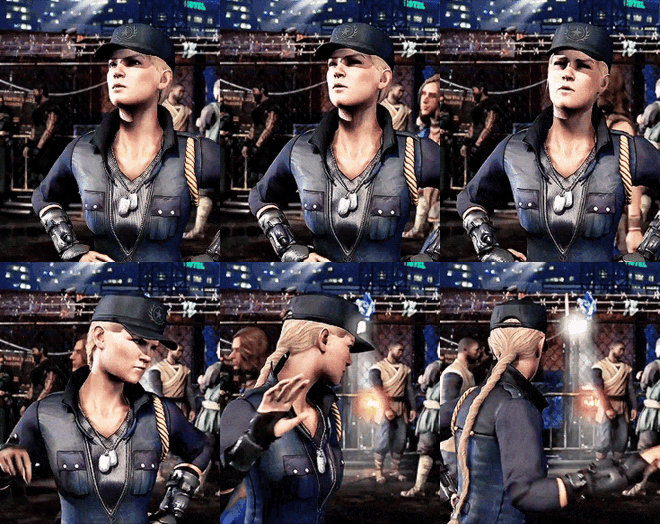
In Mortal Kombat X, Sonya’s design fully embraces her role as a commanding officer. She wears a hat bearing the Special Forces logo—though early leaked images and even the tower statue show a Green Beret, with the word “ARMY” visible on her hat. Her outfit consists of a two-toned blue and black leather jacket over a grey shirt, paired with black pants featuring blue leather accents. She carries a firearm on her right side, supported by multiple belts and pockets, emphasizing her readiness for modern combat scenarios. Around her neck, she wears two separate necklaces—one with her dog tags, and another holding her wedding band, the latter being thicker and shorter. Interestingly, in her final in-game model, the ring itself is removed, leaving only the suggestion of that personal history. Her arms are equipped with black gauntlets that enable abilities like the Ring Toss and drone deployment, and she finishes the look with black leather boots reminiscent of her earlier military designs.

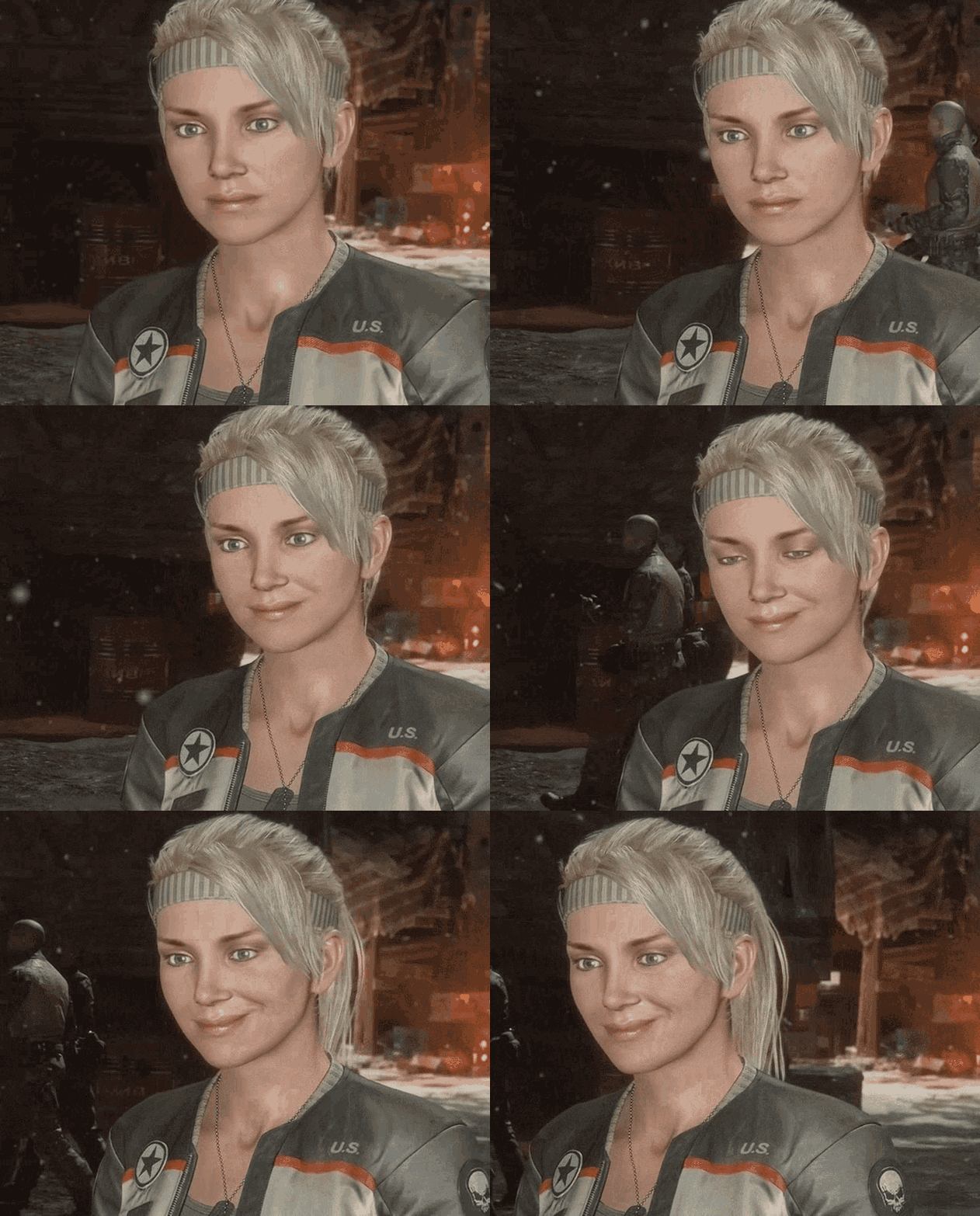
In Mortal Kombat 11, her design carries forward much of what MKX established, but with more saturated blue tones that make her stand out visually. At the same time, the game introduces a younger version of Sonya—one that feels like a bridge back to her origins. This younger Sonya wears a grey-and-white jacket with matching trousers, a grey sports bra, and a headband to keep her hair in place, along with skull patches on her sleeves that add a subtle edge to her look.

And then, in Mortal Kombat 1, Sonya returns to where it all began—bringing back her classic outfit from the very first game. It’s more than just a design choice. It’s a full-circle moment. A reminder that no matter how much she evolves, no matter how many battles she fights or ranks she earns…

there’s always a part of Sonya Blade that stays rooted in who she was the first time she stepped into the arena.


Powers and Abilities
Sonya Wins Power GIF - Sonya Wins Power Video Game - Discover & Share GIFs

Sonya Blade’s strength has never come from just one place—it’s a fusion of discipline, instinct, and a kind of relentless adaptability that few fighters in the Mortal Kombat can match. At her core, she’s a Special Forces soldier—but over time, she’s become something far more than that. Sonya possesses the ability to generate and manipulate projectiles made of pink-colored energy—an ability that, depending on the timeline, feels almost supernatural. However, in Mortal Kombat (2011), this power is grounded in technology rather than mysticism, appearing to originate from advanced high-tech weaponry mounted on her wrists. It’s a subtle shift, but one that reflects her character perfectly—where others rely on magic, Sonya adapts, evolves, and weaponizes innovation.

Beyond her energy projection, she also demonstrates the ability to gain temporary flight—or at the very least, an exceptional level of aerial maneuverability that allows her to control the battlefield from angles most opponents can’t anticipate. But what truly defines Sonya isn’t just what she can do—it’s how she does it. Her combat style is built on speed, precision, and efficiency. Every movement feels calculated, every strike purposeful. She’s incredibly fast in combat, chaining together kicks and blows with a fluidity that makes it difficult for opponents to keep up. And woven into that style is her use of gymnastics—turning agility into a weapon. Moves like her Cartwheel Kick or the devastating Scissor Split Fatality aren’t just flashy—they’re extensions of her physical mastery, blending athleticism with lethal intent.

Her skill set is further elevated by her status among Raiden’s Chosen Warriors—a group that includes names like Liu Kang, Nightwolf, Johnny Cage, Jax Briggs, Sub-Zero, Smoke, Kabal, and Stryker. Among them, she stands out—not just as one of the strongest defenders of Earthrealm, but historically as the only female Earthrealm warrior to hold that title until later fighters joined the ranks. That distinction alone speaks volumes about her capability and resilience.

By the time we reach Mortal Kombat X, Sonya’s combat style becomes even more layered through her distinct variations. Her Covert Ops variation leans heavily into close-quarters combat, emphasizing hand-to-hand efficiency while bringing back several of her classic techniques. The Demolition variation shifts her into a more tactical role, equipping her with frag and stun grenades that can be deployed in multiple ways to control space and pressure opponents. However, she’s limited to carrying three at a time, requiring her to call in a drone to resupply—introducing a strategic rhythm to her offense. Then there’s the Special Forces variation, where Sonya fully embraces battlefield command. Here, she can summon a drone and direct it to attack using an impressive arsenal—ranging from a fully automatic machine gun and flamethrower to a self-destruct system, grenade launcher, rocket launcher, electroshock weapon, and even laser cannons. It’s less about brute force and more about control—turning the fight into something she orchestrates from multiple angles.

In Mortal Kombat 11, that technological edge evolves into something more refined with the introduction of her mobile sentry unit, BUD-E—referred to as KAT in the move list. Armed with a cannon chambered in .50 caliber rounds, the drone can switch between semi-automatic and fully automatic firing modes, adapting to different combat situations. While it doesn’t carry the same variety of weaponry as her previous drone, it compensates with versatility in execution. BUD-E functions almost like a battlefield partner—it can move, shoot, and even physically engage opponents by leaping forward and tackling them to the ground. It also opens up more creative tactics, such as being deployed from above in a sudden airdrop, crashing down onto unsuspecting enemies with enough force to crush them under its weight and accumulated kinetic energy. And true to form, it retains the ability to self-destruct, turning itself into a final, explosive option when the situation calls for it.

What makes all of this so compelling is that Sonya doesn’t rely on any one advantage. She blends technology with physical skill, discipline with instinct, and strategy with raw execution.

Because in a world filled with gods, sorcerers, and monsters…
Sonya Blade proves that sometimes, the most dangerous weapon is a human being who refuses to lose.


Sonya Blade’s Signature Moves: Precision, Power, and Pure Control
a woman blowing a kiss in front of a purple background

Sonya Blade’s fighting style isn’t just a collection of moves—it’s a carefully honed system built from years of Special Forces discipline, battlefield experience, and sheer willpower. Across the evolving timelines of Mortal Kombat, her signature techniques have remained iconic, constantly refined but never losing the sharp edge that makes her one of Earthrealm’s most dangerous warriors.

At the heart of her arsenal lies the legendary Energy Rings. With a sharp clanging motion of her wrists, Sonya unleashes pink, ring-shaped projectiles from her Energy Bracelets, striking opponents from a distance. This move has been a constant since the earliest games—MK, MK3, UMK3, MKT, MK4, MKG, MKvsDCU, MK 2011, MKX, MK11, and MK1—evolving with each iteration. In Mortal Kombat (2011), the enhanced version, Rings of Justice, fires two rings at different heights, forcing opponents to rethink their defense. By Mortal Kombat X, this upgrade becomes Energy Blast, increasing damage and knocking enemies down. In Mortal Kombat 11, amplifying the move adds a second projectile capable of hitting crouching opponents, while defensive meter allows Sonya to cancel the move mid-action. If only the second ring connects, it triggers a brutal Krushing Blow, shattering the opponent’s ribcage for amplified damage. She can even delay the shot entirely using Energy Rings Charge, adding a psychological layer to her offense.

Then there’s Leg Grab, a move that perfectly captures Sonya’s athletic aggression. She flips into a handstand, snatches her opponent with her legs, and slams them behind her—a technique that has remained a staple across nearly every title. In MK 2011, the enhanced Krazy Legs adds a second slam for extra punishment, while MKX’s Leg Slam introduces armor, letting her power through incoming attacks. Its aerial counterpart, Air Leg Throw, sees her grab opponents mid-air and drive them into the ground, evolving into Air Strike in MKX, where she stomps on their arms after impact.

Her mobility shines in moves like Face Planter—later called Square Wave in MK1—where she rockets across the screen with a mid-air punch, intercepting airborne enemies with ruthless efficiency. Similarly, her Inverted Bicycle Kick channels the rapid-fire brutality often associated with Liu Kang, delivering a flurry of kicks that can transition into Bike Assault. Even when scaled back in MK 2011, the move still appears during her X-Ray and Babality, and in MK1, Kameo Sonya uses it as a follow-up to her Ricochet Kick.

Sonya’s agility also manifests in Kartwheel, where she flips forward into a striking kick. In MKX, this becomes part of her Military Stance as Double Kick, launching opponents into the air, while its enhanced version, Kartwheel Bash, increases damage. Meanwhile, her Flying Kick and Arc Kick expand her offensive reach—Arc Kick in particular gaining faster speed and increased damage in MK 2011’s Arc Wave, and armor plus multi-hit potential in MKX.

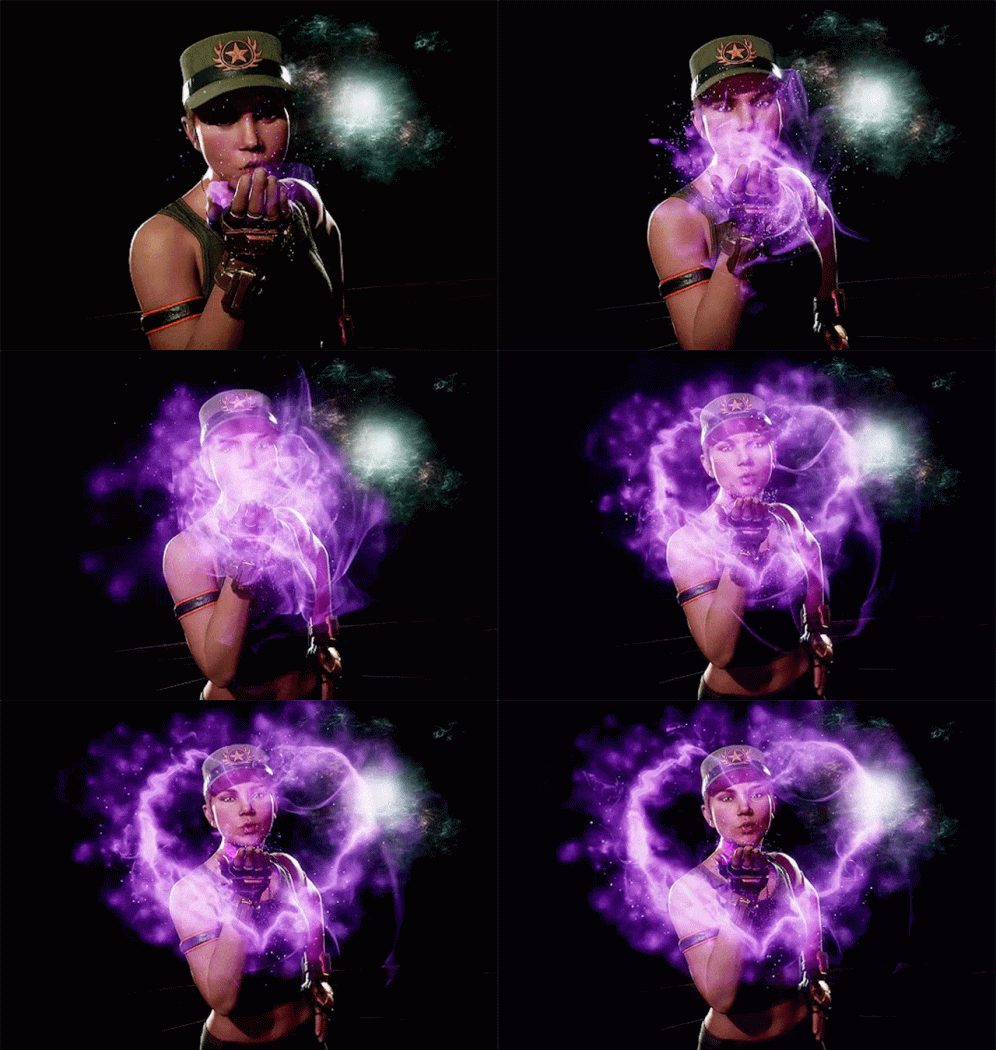
Not all of Sonya’s attacks rely on brute force. Her infamous Kiss move blinds opponents by irritating their eyes—a deceptively simple trick that won’t work on Kenshi due to his blindness. Its enhanced form, Deadly Kiss, extends its reach, and it even plays a role in initiating her X-Ray in MKX. Moves like Armed Forces and Air Drop further showcase her versatility, with the latter becoming a high-risk, high-reward dive attack that can lead into combos if it connects.

In her MKX Covert Ops Variation, Sonya introduces the Garrote Parry, using a garrote wire to counter high attacks and retaliate with punishing follow-ups like Eagle Strike and Freedom Strike, or enhanced versions like Garrote Punish. Techniques like Stiff Neck and Justice highlight her grappling precision, turning defense into offense seamlessly.

Her Demolition Variation shifts the battlefield entirely. With Frag Grenades and Stun Grenades, she controls space with timed explosions, adjustable distances, and manual detonation. Enhanced versions like Shrapnel and Flashbang unleash all remaining grenades in devastating arcs. The Drone Drop ensures she’s always stocked, while its enhanced version turns the drone into an active attacker.

Meanwhile, her Special Forces Variation introduces a fully functional drone companion. It can be positioned with Park Drone, attack with Heavy Blast or Homing Missile, or sacrifice itself in explosive kamikaze strikes—either high or low. It’s less about brute strength and more about battlefield orchestration.

In MK11, Sonya’s toolkit becomes even more refined. Moves like Ass Whooping deliver brutal close-range combos, while Air Energy Rings and their amplified versions expand her aerial dominance, capable of triggering Krushing Blows mid-combo. Leg Breaker, Air Control, and Ops Drop introduce devastating follow-ups and combo extensions, many of which can escalate into bone-crushing Krushing Blows under specific conditions.

Her defensive game evolves too, with Krushing Kounters allowing her to counter both high and low attacks, punishing opponents with arm-breaking or body-crushing retaliation. Soaring General lets her launch forward mid-air with armor-breaking properties, while her K.A.T. Turret system transforms the battlefield entirely—whether dropping it from above or summoning it to assist with attacks like K.A.T. Tantrum, Mortar Strike, or self-destructing via Detonate K.A.T.

And in Mortal Kombat 1, her presence extends even into Kameo mechanics with (Air) Ricochet Kick, where she dives in, rebounds off her partner, and crashes down with a second strike—proving that even when she’s not the main fighter, she’s still a force to be reckoned with.

Every move Sonya uses tells the same story—discipline sharpened into instinct, technique forged through war, and a fighter who doesn’t just react… she dictates the fight.
 

Sonya Blade’s X-Rays & Fatal Blows: Where Precision Turns Ruthless

two women are fighting in a video game with the numbers 78 and 78 on the screen

There’s something brutally honest about the way Sonya Blade finishes a fight. No theatrics for the sake of spectacle—every strike, every snap, every final blow feels like it was trained, drilled, and perfected long before it ever broke bones on-screen. Across the evolving timelines of Mortal Kombat, her X-Rays and Fatal Blows don’t just showcase power—they reveal the soldier beneath the fighter.

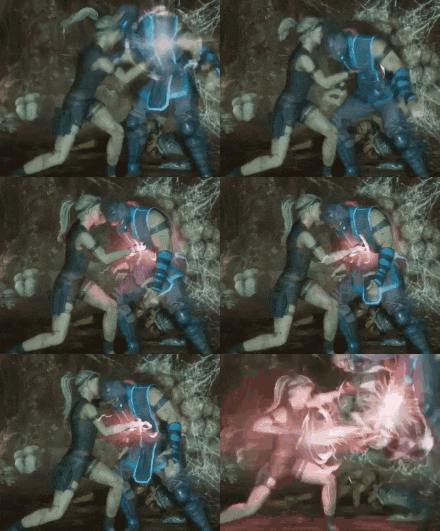
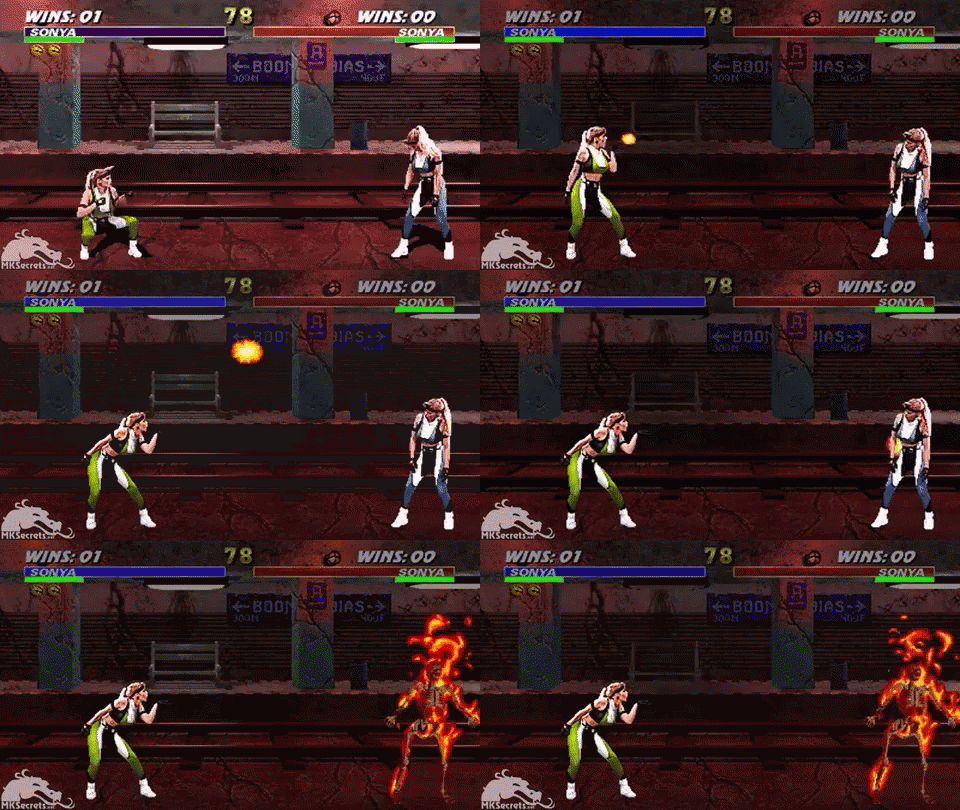
In Mortal Kombat (2011), her X-Ray – SF Beat Down begins with a relentless barrage—two punches, two kicks—delivered with military precision. If even one of those strikes connects (and in some cases, all of them land), she transitions seamlessly into a leg grab, locking her opponent’s neck between her legs before snapping it with chilling efficiency. But she doesn’t stop there. Flowing straight into an inverted bicycle kick, she drives them head-first into the ground, crushing both skull and neck in a single, decisive finish. It’s not just violence—it’s controlled execution.

By the time we reach Mortal Kombat X, Sonya’s approach evolves into something even more tactical with X-Ray – Special Forces. It starts deceptively—she throws a cloud of pink dust, blinding her opponent just as they attempt to strike. In that split-second of confusion, she wraps her garrote around them and yanks them down hard onto their back, snapping their spine in a motion reminiscent of her Kut-Throat Fatality. Then comes the reverse headbutt—sharp, punishing—cracking the back of their skull before she hurls them forward, head-first, finishing with a neck-breaking impact. It’s calculated, methodical… and terrifyingly efficient.

In Mortal Kombat 11, her Fatal Blow – Die Already blends her classic abilities with cutting-edge tech. It begins with a punch enhanced by her signature Energy Rings, setting the tone immediately. She follows it up by shattering the opponent’s shin, then drives punches into their face and stomach with escalating force. Turning them around, she drags them toward her BUD-E sentry gun—a piece of Special Forces hardware that doesn’t hesitate. The turret unloads round after round into the target before delivering a final, devastating shot straight through their head. As they collapse, Sonya steps in and ends it with a cold, deliberate stomp to the face. It’s not just a finishing move—it’s a statement.

Even in Mortal Kombat 1, where mechanics shift and timelines reset, her brutality remains intact. Her Kameo Fatal Blow sees her rush in with a barrage of knee strikes, then pivot into a crushing maneuver where her legs snap the opponent’s ribs before she finishes the sequence by firing her gauntlets point-blank. Quick. Efficient. Devastating.

Beyond these cinematic finishers, Sonya’s toolkit is filled with equally punishing techniques. In Mortal Kombat vs. DC Universe, her Free-Fall Super Move combines her signature bicycle kick with a powerful Energy Ring blast, sending opponents crashing back to the ground. The same game’s Klose Kombat Mode strips things down to raw, up-close brutality—Double Slap, Arm Breaker, High Knee, and Nose Breaker—each one a reminder that she doesn’t need distance or gadgets to dismantle someone.

Her throws have always carried that same edge. In MK 2011, she grabs opponents by the shoulders, drives a knee into their stomach, then either elbows them forward or flips them over her shoulder. By MKX, she evolves this into a more dynamic maneuver—climbing onto her opponent’s back and using her full body weight to hurl them into the air. In MK11, her forward throw becomes even more vicious: she knees the opponent in the back, wraps a garrote around their neck, and drops into a seated position, snapping their spine. Her backward throw? A grenade is planted mid-motion—she trips her opponent onto it, then blasts them away with Energy Rings as the explosion launches them skyward.

Her stance-based combat adds another layer. Military Stance allows her to pause—not out of hesitation, but preparation—ready to transition into a variety of attacks depending on the moment. Moves like Knockdown and Tackle reflect her Special Forces training: direct, efficient, and designed to end a fight quickly. The Tackle, in particular, is brutal—she leaps onto her opponent, pins them, lands a couple of punches, then finishes with a kick to the crotch that sends them sliding across the ground.

Even her recovery tools are weaponized. In MKX’s Demolition Variation, Bake ‘n’ Wake turns a vulnerable knockdown into an opportunity—she detonates a grenade to blast her opponent back while propelling herself to safety, ready to re-engage.

By MK11, her mobility and pressure increase even further. Marching Orders lets her strike downward twice mid-air, setting up combos on landing, while Boot Kamp adds armor-breaking properties, allowing her to cut through even the most defensive opponents. And in MK1, her Blade Kutter forward throw delivers a clean, brutal sequence—punch to the face, kick to the gut, and a diamond cutter-style slam that drives the opponent into the ground.

What ties all of these together isn’t just damage—it’s identity.

Sonya Blade doesn’t fight like a warrior born into power.
She fights like someone who earned every ounce of it.

And when her X-Ray hits…
it’s not just a move—it’s the moment the fight was already over.


Sonya Blade’s Fatalities: Beauty, Brutality, and Battlefield Precision

a woman wearing a headband and a jacket that says u.s. on it

There’s a strange contrast at the core of Sonya Blade’s Fatalities—something almost poetic in how elegance and destruction collide. Across the long, blood-soaked history of Mortal Kombat, her finishing moves have never just been about ending a fight… they’ve been about making a statement. And no move defines that better than her most iconic one.

The Fire Kiss is, without question, Sonya’s signature—her calling card since the very first Mortal Kombat. With a calm, almost teasing gesture, she blows a kiss toward her opponent… except this one ignites into flame mid-air, engulfing them and burning them alive. It’s simple, unforgettable, and has remained a constant through MK, MK3, UMK3, MKT, MKvsDCU, MKX, and MK1. In Mortal Kombat X, it evolves into Kiss of Death, but the essence remains unchanged: beauty weaponized into something lethal.

That same idea takes different forms over time. In Crush Kiss—introduced in MK3—the kiss transforms into something heavier, more surreal. Instead of flame, Sonya launches a glowing purple orb that slams into her opponent with crushing force, reducing them to nothing more than a pile of blood and bones. Then there’s Slice Kiss from MK4, where the energy becomes more refined, forming a concentrated blast that obliterates the opponent’s upper torso on impact. Each variation builds on the same foundation, proving that even a single gesture in Sonya’s arsenal can evolve into multiple forms of devastation.

But Sonya isn’t just about ranged finishers—she’s just as lethal up close. Scissor Split is one of her most physically brutal Fatalities. She hoists her opponent up using her legs, holds them there for a brief, suspended moment… and then tears them apart completely by splitting her legs in opposite directions. It’s raw strength, precision, and control all at once—a move that’s appeared in MK4, MKG, and MK 2011.

Then there’s Poison Kiss from Mortal Kombat: Deadly Alliance, where things take a darker, almost sadistic turn. This time, the kiss carries a mystical toxic mist—decorated with deceptively playful Valentine hearts—that forces the opponent into violent convulsions. They choke, vomit food twice, then blood. And just when they’re at their weakest, distracted and disoriented, Sonya leaps into the air and stomps down on their back, causing their head to explode. In the Game Boy Advance version, the brutality shifts slightly—the stomp instead forces their organs to burst outward instead of the head.

Her grappling finishers are just as precise. Airborne Blade sees her grab the opponent by the neck, flip upside down mid-motion, and snap it cleanly. Interestingly, in Mortal Kombat 4, this same motion exists as a standard grab rather than a Fatality—showing how naturally lethal her basic techniques already are. In MK 2011, Kut-Throat brings in her Special Forces gear, as she uses a garrote wire—looping it around her opponent’s throat, flipping over them, and decapitating them with a sharp, forward pull. It’s efficient, silent, and chillingly realistic.

By the time we reach modern entries, Sonya’s Fatalities begin to reflect her integration of military technology. In Target Marked (MKX), she forces a smoke grenade into her opponent’s mouth, marking them as a target. With a simple command from her wrist device, a drone appears—cutting off their arms with precision laser strikes before launching a rocket that homes in on the smoke signal, obliterating their head. The body collapses in pieces, as if the entire execution had been pre-planned… because it was.

Head Hunter, also from MKX, feels almost ritualistic. She wraps her garrote wire around her opponent’s neck, drives a knee upward to sever the head, and as it flies into the air, a drone riddles it with gunfire until only a bloodied skull remains. Sonya catches it mid-fall and casually attaches it to her belt—turning victory into a trophy.

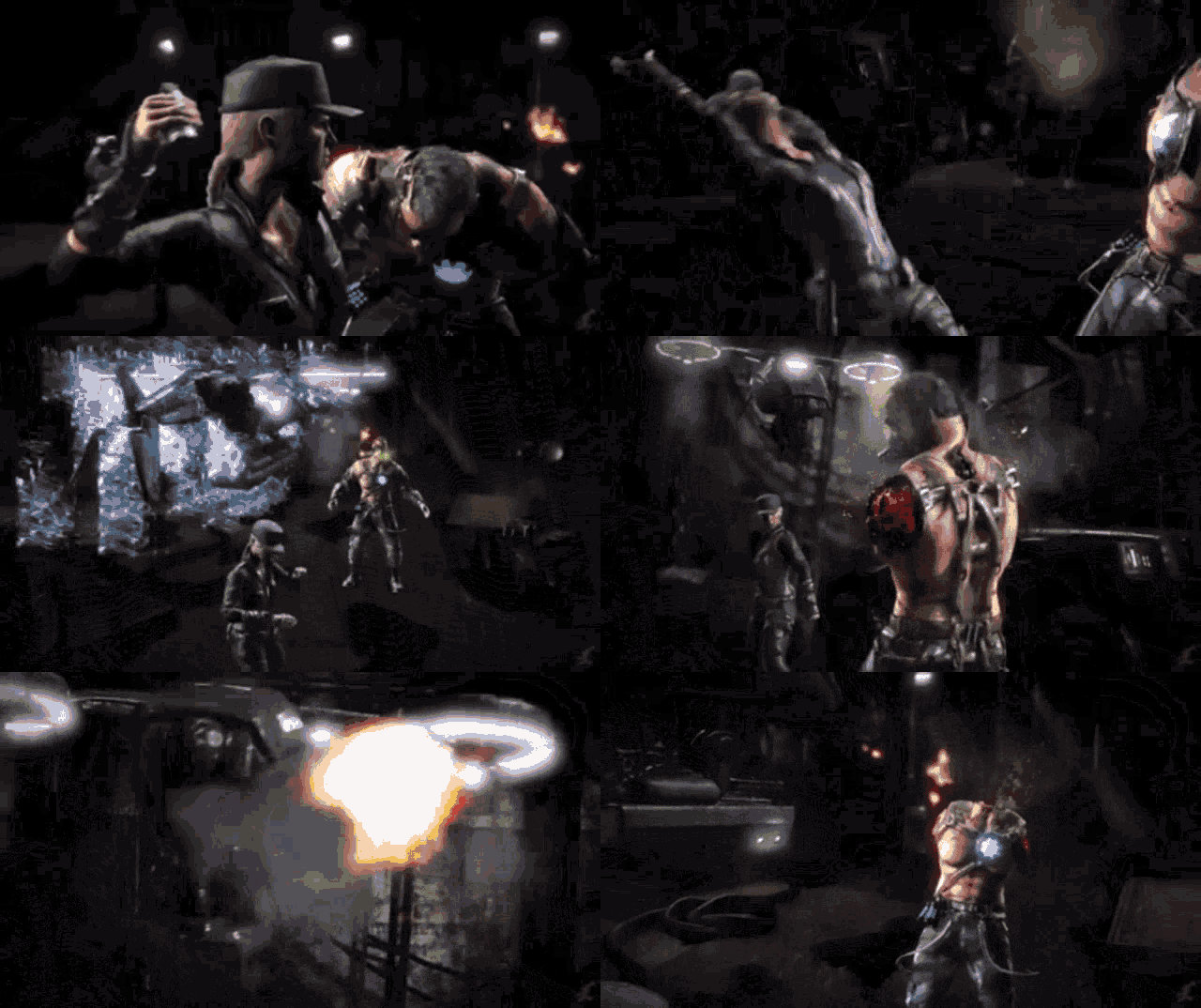
In Mortal Kombat 11, her Fatalities become even more cinematic. To the Choppa is pure chaos executed with control. She calls in a helicopter, its spotlight locking onto her opponent. Grabbing them by the legs, she tosses them upward, firing her hand cannons as they rise—tearing off an arm before their body collides with the spinning rotor blades. What remains—head, limbs, fragments—scatters violently through the air.

And then there’s Supply Drop, which feels like the ultimate expression of Sonya’s dual identity as soldier and commander. She starts by breaking her opponent down physically—snapping their elbow with a strike, then crushing their nose with another. As they fall, she calls in BUD-E, her sentry unit. It descends like a supply drop… except instead of aid, it lands with enough force to bisect the opponent’s torso, separating their legs entirely. As the remains attempt to crawl, BUD-E finishes the job with a shot to the face, leaving behind nothing but a gaping void where it once was.

What makes all of these Fatalities stand out isn’t just their brutality—it’s their intention.

Sonya Blade doesn’t revel in chaos the way many fighters do.
She executes. Every move is deliberate. Every finish is controlled.
And when she ends a fight… it’s not personal. It’s protocol.


Sonya Blade’s Brutalities: When Control Becomes Carnage

a man with a beard is holding a gun in his hand in a dark room .

There’s a different kind of finality to a Brutality. It isn’t theatrical like a Fatality, nor as cinematic as an X-Ray—it’s sudden, sharp, and unforgiving. And for Sonya Blade, Brutalities feel almost instinctive… like the moment her training takes over completely. Across Mortal Kombat, these finishes capture her at her most efficient—no hesitation, no wasted motion, just decisive force.

In Mortal Kombat X, Sonya’s Brutalities lean heavily into her physicality and tactical versatility. Thigh Master takes her classic Leg Grab and turns it into something far more violent—she splits the opponent’s legs clean from their body and slams what remains into the ground with such force that their face is literally scraped off on impact. To trigger it, the opponent must already be softened up—hit a few times beforehand—almost as if the move demands momentum to reach that level of destruction.

Then there’s Boot to Head, a perfect example of Sonya’s ability to turn defense into offense. She baits the opponent into grabbing her leg, only to spin out of it and deliver a counter kick so precise and powerful that it cleanly decapitates them. It’s not just a move—it’s a trap executed flawlessly.

Her Covert Ops variation introduces Garro-That, where she parries an incoming attack and transitions into Stiff Neck, wrapping her garrote around the opponent before severing their head entirely. It’s quick, controlled, and chillingly surgical. Meanwhile, her Demolition variation shifts things into explosive territory with Time Bomb—a frag grenade that detonates with enough force to obliterate the opponent’s torso, sending their limbs scattering in different directions.

With her Special Forces variation, technology steps in. Kamikaze calls in her drone for a direct suicide strike, and the explosion is so intense it strips the opponent down to a skeletal frame in the head and torso. And then there’s the hidden brutality, Pain and Agony, where she executes her X-Ray move—but this time, the final neck snap doesn’t just break… it fully decapitates.

By the time we move into Mortal Kombat 11, Sonya’s Brutalities become even more layered, blending her classic techniques with advanced military hardware. The Klassic is shared across the roster, but it still feels personal—an uppercut so powerful it tears the opponent’s head off, spine still attached. To achieve it, she must go the entire final round without blocking, and a button must be held—discipline rewarded with brutality.

Up Up and Away builds on her aerial dominance. She performs an amplified Air Control, slamming the opponent down before looping her garrote around their neck and pulling with enough force to rip the head clean off. Like many of her MK11 Brutalities, it requires precise input—holding a button at the right moment to let the finish fully unfold.

Popping Heads takes her forward throw and amplifies its impact—she drops down with such force that the opponent is decapitated instantly, though it only triggers if she’s within a specific health threshold. Meanwhile, Grenade Jumper transforms her backward throw into a chaotic explosion, scattering the opponent’s limbs and head through the air, requiring rapid button presses to activate.

Her partnership with BUD-E, her sentry unit, becomes even more lethal here. In Kill Shot, she commands the turret to perform a K.A.T. Tantrum, tackling the opponent and unloading a barrage of bullets into their head until it’s reduced to a gory ruin—then continuing to fire, long after there’s nothing left to destroy. To unlock it, she must have summoned BUD-E multiple times beforehand. In Bullseye, the turret executes a Leaping .50 Kal, firing a single shot that punches a clean hole through the opponent’s head. They turn toward the screen—almost aware of what just happened—before collapsing lifelessly. This one requires the use of Detonate K.A.T., along with holding a button.

Her close-range brutality remains just as devastating. Busted sees her amplify Leg Breaker, finishing with a knee strike that crushes the opponent’s head entirely. Kisses pays homage to her iconic Fire Kiss Fatality—she blasts the opponent with Energy Rings before delivering the flaming kiss, reducing them to a charred skeleton that drops to its knees. To trigger it, a Mercy must have been performed earlier, and she must not be too close—almost like granting false hope before taking it away.

The One Two Knockout showcases her countering ability, as she performs a Standing Kounter—snapping the opponent’s arm before stomping down on their jaw. Here Comes The Boom builds off Ops Drop, where after the double axe-handle strike, the opponent’s head violently pops free from their body. And finally, What Did You Say? transforms her Ass Whooping into something even more brutal—she delivers a series of punches in slowed, almost deliberate motion before finishing with a knee that crushes the opponent’s skull.


Sonya Blade in Mortal Kombat 1: Brutality, Balance… and a Hint of Humanity

Even in a reimagined timeline like Mortal Kombat 1, Sonya Blade remains exactly what she’s always been—disciplined, relentless, and devastating when it counts. But what makes her stand out in this era isn’t just how she fights… it’s how her finishers reflect every side of her character, from ruthless efficiency to unexpected moments of levity.

Her Brutalities in MK1 carry that same sharp, no-nonsense energy. Popping Heads is as direct as it sounds—Sonya executes her Forward Throw and transitions seamlessly into a diamond cutter-style slam that tears her opponent’s head clean off. It’s quick, precise, and brutally effective… the kind of finish that feels like it was over before the opponent even realized what happened.

Then there’s Forgot Something?, which builds on her classic Leg Grab. She flips into position, locks onto her opponent, and in one violent motion separates their legs from their body entirely. It’s not just a callback to one of her oldest moves—it’s an evolution of it, pushing the brutality even further. To trigger it, a button must be held, reinforcing that sense of control she has even in the most chaotic moments.

And then comes Surprise!—a move that perfectly captures her speed and aggression. She launches forward with Square Wave, striking her opponent mid-air, only to follow it up instantly with another pass that completely obliterates them into gore. It’s fast, relentless, and leaves no room for recovery—just impact, and then nothing.

But Sonya’s finishers have never been only about destruction. Across the history of Mortal Kombat, there’s always been this strange, almost human contrast woven into her character—and it shows up in her Friendships.

In Friendship #1 from MK3, she simply breaks into an exercise routine—no violence, no chaos, just a soldier keeping herself in peak condition. It’s oddly fitting. Friendship #2 in UMK3 and MKT shifts the tone even further—she salutes, and flowers bloom across the ground, replacing destruction with something unexpectedly peaceful. And then in Mortal Kombat 11, Friendship #3: Fetch, Good Drone brings in her modern edge—she plays fetch with her turret drone, which dutifully returns… carrying a Tarkatan body. It’s playful, but still unmistakably Sonya.

Her Animality, Hawk Rip, taps into a more primal side. Transforming into a giant hawk, she lifts her opponent high into the air and tears them apart mid-flight. Introduced in MK3, UMK3, and MKT, it’s a reminder that beneath all the discipline and structure, there’s still something wild in the way she fights.

And then there’s the oddly iconic Babality from MK 2011. In a rare moment of vulnerability—or at least something resembling it—Sonya performs her Inverted Bicycle Kick, only to lose balance, land awkwardly, and spin around crying in pain. It’s absurd, almost comedic… but in a franchise known for extremes, it fits perfectly.


Sonya Blade on Screen: From Soldier to Screen Legend

When Sonya Blade stepped beyond the pixelated arenas of Mortal Kombat and into film and television, she carried with her more than just her combat skills—she brought the weight of her story, her losses, and that unshakable sense of duty that defines her. Across multiple adaptations, Sonya has been reimagined, reinterpreted, and reshaped… but at her core, she has always remained the same: relentless, principled, and unbreakable.

In the original Mortal Kombat, Sonya is portrayed by Bridgette Wilson, introduced as Lieutenant Sonya Blade, a determined officer driven by a personal mission. Her pursuit of Kano leads her straight onto Shang Tsung’s mysterious ship—an entry point into a world far larger than she anticipated. It’s here that she crosses paths with Liu Kang and Johnny Cage, and together, they are chosen by Raiden to represent Earthrealm in the legendary tournament. For Sonya, this isn’t just about survival—it’s personal. When she finally confronts Kano, she defeats him, avenging the murder of her former partner. But her journey doesn’t end there. Captured by Shang Tsung and forced into a deadly challenge, she is ultimately saved by Liu Kang, Johnny Cage, and Kitana. Liu Kang steps in to fight in her place and defeats Shang Tsung, securing victory for Earthrealm.

That same core trio returns in the animated prequel Mortal Kombat: The Journey Begins, where Sonya is voiced by Jennifer Hale. Here, she stands once again alongside Liu Kang and Johnny Cage as one of the central protagonists, reinforcing her importance as one of Earthrealm’s key defenders even in animated form.

Her presence extends into television with Mortal Kombat: Defenders of the Realm, where she is voiced by Olivia d'Abo. In this series, Sonya continues her fight to protect Earthrealm, embodying the same leadership and resilience that define her across all mediums.

In Mortal Kombat: Annihilation, Sonya is portrayed by Sandra Hess, and her story takes a darker, more emotionally charged turn. Right from the opening sequence, she’s overpowered and captured by Shao Kahn, only to be saved at the last second by Johnny Cage—who is then killed in her place when Kahn snaps his neck. It’s a moment that defines her arc in the film. Despite the grief and guilt that follow, Sonya doesn’t break—she pushes forward. She continues to aid her allies and Raiden in their mission to stop Shao Kahn’s invasion. Along the way, she rescues her partner and friend Jax Briggs from an extermination squad led by Cyrax, survives an assassination attempt by Mileena, and is later saved by Jax from one of Shao Kahn’s monstrous creations. In the final battle, she faces off against Ermac and defeats him, playing a crucial role in Earthrealm’s eventual victory and restoration.

A more grounded, modern reinterpretation appears in Mortal Kombat: Rebirth, directed by Kevin Tancharoen, where Sonya is portrayed by Jeri Ryan. In this version, she operates in a darker, more realistic world, briefing Hanzo Hasashi about Sub-Zero and Shang Tsung’s underground tournament—hinting at a deeper conspiracy beneath the surface.

Jeri Ryan reprises her role in the web series Mortal Kombat: Legacy, where Sonya’s story is expanded significantly. In this continuity, she’s no longer Special Forces, but a member of the Deacon City Police Department, working under Jax and alongside Kurtis Stryker. Her motivation remains deeply personal—her former partner was killed by Kano and the Black Dragon, fueling her relentless pursuit.

In the first episode, Sonya tracks down a Black Dragon weapons warehouse, recording intel and relaying it to Jax—including details about a shipment tied to the “Cyber Initiative.” Armed and focused, she moves in to confirm her findings, only to discover that Kano himself is present. Before she can act, she’s captured, chained in the basement, and tortured for days. When Kano visits her, he taunts her, mocks her, even threatens to kill her the same way he killed her partner. Sonya’s response? Defiance. She spits in his face. But Kano isn’t just playing games—he reveals he’s using the information she sent to lure Jax and Stryker into a trap.

What follows is chaos. As a massive firefight erupts above, Sonya struggles against her restraints, calling out to Jax. Eventually, an explosion loosens the chains, and she forces herself free—hands still bound, but determination outweighing pain. She frees her legs and charges upward to join the fight.

In the second episode, she proves exactly why she’s feared. She takes down three Black Dragon members using a mix of hand-to-hand combat and gunfire—even shooting one behind her without turning to look. She tracks Jax through the warehouse, finds him after he’s defeated Kano in a brutal fight, and saves him by shooting a Black Dragon member mid-grenade throw. Their reunion is cut short by the explosion.

Sonya wakes up later in a hospital, injured but alive. Stryker tells her she’s been unconscious for nearly a week. Kano escaped. Jax survived—but barely. He had shielded her from the blast, taking severe injuries to his back and arms. When she asks to see him, she learns he’s already in surgery at another location. Even then, her instinct isn’t to rest—it’s to get back up, to keep going.

If Sonya Blade’s journey fired you up, it’s time to bring that energy into your collection ⚡

Explore a massive range of collectibles featuring Mortal Kombat, He-Man and Masters of the Universe, Anime, Marvel, DC, Transformers, LEGO, and MORE — now available at up to 40% OFF!

From action figures to premium statues, this is your chance to own a piece of the worlds you love. Click Here to Avail!