


Skeletor Explained: Origins, Powers & Every Masters of the Universe Era
Skeletor stands as the central antagonist of the Masters of the Universe saga—and without question, the single most catastrophic threat ever to stalk the land of Eternia. Everything about him revolves around power. Not wealth. Not conquest for its own sake. Power in its purest, absolute form. To Skeletor, the universe is a locked vault, and the key lies within the ancient secrets of Castle Grayskull. Once those secrets are his, Skeletor believes nothing—no kingdom, no god, no force of destiny—will stand above him again.
That hunger for dominion places him in inevitable collision with the one being capable of stopping him: He-Man. Their conflict is more than hero versus villain—it is ideology versus destiny. He-Man represents balance, restraint, and protection. Skeletor represents ambition unchained, power pursued without consequence. Eternia itself trembles between them.
In his earliest incarnations, Skeletor was portrayed less as a man and more as a nightmare given form—an evil demon from another dimension whose past barely mattered. His cruelty needed no explanation; his motives were self-evident. He wanted power, and he would scorch worlds to obtain it. This deliberate vagueness made him feel ancient and unknowable, as though he had always existed, lurking in the shadows long before heroes rose to oppose him.
That mystery began to fracture with the introduction of Hordak, revealed as Skeletor’s former master. For the first time, audiences were offered a glimpse behind the skull façade—a suggestion that Skeletor was not born evil, but shaped by it. By the later years of the original franchise, an even more provocative idea emerged: the possibility that Skeletor was once Keldor, the ambitious brother of King Randor, and uncle to Prince Adam himself.
This revelation transformed Skeletor from a simple tyrant into a tragic figure—a fallen noble whose thirst for power cost him his humanity, his family, and ultimately his face. The 2002 reboot of Masters of the Universe leaned heavily into this interpretation, portraying Skeletor as a once-charismatic, cunning, and dangerously intelligent villain. He wasn’t just loud and cruel—he was strategic, wounded, and deeply personal in his hatred, especially toward He-Man, who represented everything he lost.
Despite multiple reboots and reimaginings, Skeletor remained one of the few characters deemed essential enough to survive the franchise’s most radical shift: The New Adventures of He-Man. In this futuristic continuation, He-Man is thrust far into the future to aid the Galactic Guardians in defending the last remnants of humanity against the Evil Mutants. Skeletor follows—not out of loyalty to any cause, but because the universe itself feels wrong so long as He-Man exists within it.
In a move that perfectly encapsulates his character, Skeletor allies himself with the Mutants not out of belief or shared goals, but sheer obsession. His vendetta transcends time, space, and logic. If He-Man lives, Skeletor cannot rest. Even at the edge of the universe, even in an era not his own, his singular purpose remains unchanged: eliminate his greatest rival, claim ultimate power, and bend reality to his will.
Across every era, every timeline, and every incarnation, Skeletor endures not just as He-Man’s enemy—but as the embodiment of ambition taken too far. A villain who reminds Eternia, again and again, that the most dangerous monsters are not born… they are forged by desire, loss, and an unrelenting hunger to rule everything that exists.
History – Minicomics Era
In the earliest Masters of the Universe minicomics, Skeletor was imagined as something far more alien than the skull-faced sorcerer fans would later come to know. He was not born on Eternia at all. Instead, he hailed from an entirely different dimension—one inhabited by others of his own kind, beings shaped by war, ambition, and conquest.
According to these early stories, a catastrophic period known only as the Great Wars tore through realities themselves. During this chaos, a dimensional rupture opened, violently ripping Skeletor from his homeworld and casting him onto Eternia. Stranded in a strange land, his earliest goal was not domination, but return. Skeletor initially sought to reopen a portal to his original dimension—one that would allow his people to pour into Eternia and conquer it at his side. In those first moments, he was less a tyrant-in-waiting and more an exiled warlord plotting reclamation.
That objective did not last. As Skeletor learned more about Eternia, his attention was inevitably drawn to Castle Grayskull. The ancient stronghold promised power far greater than any army—power that could make him unstoppable not just on Eternia, but across dimensions themselves. Gradually, the idea of returning home faded. Why reclaim a lost world when he could rule all worlds instead?
As the minicomics evolved, so too did Skeletor’s mythology. Later installments largely set aside his original extradimensional origin, taking inspiration from the animated series and shifting focus toward a more personal, tragic past. It was here that the seeds of one of Masters of the Universe’ most enduring revelations were planted: the suggestion that Skeletor might actually be Keldor, the long-lost brother of King Randor. Keldor was said to have vanished years earlier, lost in another dimension—an echo that eerily mirrored Skeletor’s earliest origin.
Within this framework, Skeletor’s obsession with secrecy took on terrifying importance. If the truth of Keldor were ever revealed, it would not merely expose his past—it would destroy him. His authority, his fearsome reputation, and perhaps even his very existence depended on the lie remaining intact. Knowledge, in this case, was more dangerous than any sword.
These later minicomics also deepened Skeletor’s political and personal struggles. He was forced to confront the return of his former master, Hordak, a figure whose shadow loomed large over his rise to power. Their relationship was anything but stable—rooted in resentment, manipulation, and unfinished dominance. At the same time, Skeletor entered into an uneasy alliance with King Hiss, ruler of the Snake Men. This partnership was born not of trust, but necessity—two conquerors bound together by ambition, each waiting for the perfect moment to betray the other.
Taken together, the minicomics present Skeletor as a character in flux—part cosmic exile, part fallen royal, part master schemer. Whether he is a demon cast from another reality or a lost prince consumed by his own hunger for power, one truth remains constant across every version: Skeletor’s story is defined by ambition, secrecy, and the belief that ultimate power is not something inherited—but something taken, no matter the cost.
DC Comic Books (1982 Era)
When Masters of the Universe crossed into the pages of DC Comics in 1982, Skeletor’s presence remained every bit as menacing—rooted firmly in the darker, more ruthless portrayal established by the early minicomics. Under the pen of Paul Kupperberg, Skeletor was written not as a cartoonish villain, but as a calculating warlord whose confidence bordered on divine arrogance.
In these stories, Skeletor often referred to himself as “The Dark Lord”—a title that wasn’t mere theatrics, but a declaration of how he viewed his place in the cosmic order. He was not a usurper in his own mind; he believed rulership was his destiny, delayed only by circumstance and interference.
Crucially, this version of Skeletor was already in possession of one half of the Power Sword, placing him dangerously close to unlocking the full might of Castle Grayskull. Unlike later tellings where the sword halves are evenly split between hero and villain, the DC Comics narrative gave Skeletor a clear edge—he wasn’t chasing power blindly, he was methodically assembling it.
The hunt for the second half of the Power Sword took the story into darker and more surreal territory. With the help of Mer-Man, Skeletor was guided through an underwater dimensional portal hidden deep within Eternia’s ocean floor. This gateway bridged worlds, leading not to another realm of magic, but to Earth itself, where the missing half of the sword had somehow found its way.
This plotline was especially significant for early Masters of the Universe lore. It reinforced the idea that Eternia was not isolated—that its magic, artifacts, and wars could spill across dimensions and into other worlds. Skeletor’s willingness to cross realities underscored his adaptability; no environment was foreign to him, no realm beyond his reach if power waited on the other side.
The DC Comics portrayal leaned heavily into Skeletor’s intelligence and long-game strategy. He was not merely reacting to He-Man—he was planning several moves ahead, exploiting allies like Mer-Man when useful, and discarding them just as easily. His claim to the Power Sword was symbolic: Skeletor did not want chaos, he wanted control, legitimacy, and supremacy backed by ancient law and overwhelming force.
Taken together, the 1982 DC Comics stories present Skeletor as a Dark Lord in the truest sense—already armed with forbidden power, willing to traverse dimensions, and utterly convinced that the universe itself was something meant to be claimed. Not through chance. Not through mercy. But through conquest, intellect, and an unshakable belief that he was born to rule.
Golden Books (1985 Era)
The 1985 Golden Books hardcover The Horde offered one of the most striking and emotionally charged reinterpretations of Skeletor’s past—one that reframed him not as an outsider to destiny, but as someone who chose the path that ruined him.
In this version of the mythos, Skeletor was originally a native of Etheria, a world that would eventually fall under the iron grip of Hordak and his terrifying Horde. When the Horde seized control of Etheria, Skeletor did not resist. Instead, driven by ambition and fascination with power, he willingly became Hordak’s student. This choice is crucial—it paints Skeletor not as a victim of conquest, but as an eager apprentice drawn to darkness long before it consumed him.
Under Hordak’s tutelage, Skeletor was introduced to the universe’s most powerful and dangerous substance: Etheramite. This rare mineral was said to amplify magical abilities to godlike levels, but only when wielded with absolute discipline and mastery. Together, master and student studied its secrets, learning how Etheramite could reshape worlds, topple empires, and bend reality itself.
But Skeletor was impatient.
Too young, too reckless, and far too hungry for power, he attempted to use Etheramite before his body and mind were ready. The result was catastrophic. The raw energy burned him from within, permanently scarring his face and leaving him with the skeletal visage that would become his defining horror. In one moment of arrogance, he lost not only his former identity—but any chance of returning to it.
Rather than submit to Hordak after this failure, Skeletor stole a supply of Etheramite and fled Etheria. He abandoned his master and his home, setting out across the stars in search of a world he could truly dominate. That journey eventually led him to Eternia, where he claimed Snake Mountain as his base of operations and began building his own empire of fear.
Years passed. Through obsession, experimentation, and sheer willpower, Skeletor finally succeeded where he once failed—he mastered the use of Etheramite. With that mastery came a dramatic surge in power, elevating him beyond a rogue sorcerer into a true cosmic threat. His ambitions expanded accordingly. No longer content with ruling a single world, Skeletor began plotting the conquest of both Eternia and Etheria, believing himself powerful enough to eclipse even his former master.
That confidence proved to be his undoing.
The use of Etheramite acted like a beacon across space, revealing Skeletor’s location to Hordak. Enraged by the betrayal and determined to punish his wayward student, Hordak traveled to Eternia to confront him personally. What followed was not merely a clash of villains, but a reckoning—master versus apprentice, discipline versus ambition, control versus hunger.
The Golden Books portrayal of Skeletor is especially haunting because it frames his fate as self-inflicted. He was not cursed. He was not tricked. He chose power before wisdom—and paid for it with his face, his soul, and a lifetime spent chasing domination to justify that single, irreversible mistake.
Filmation Series
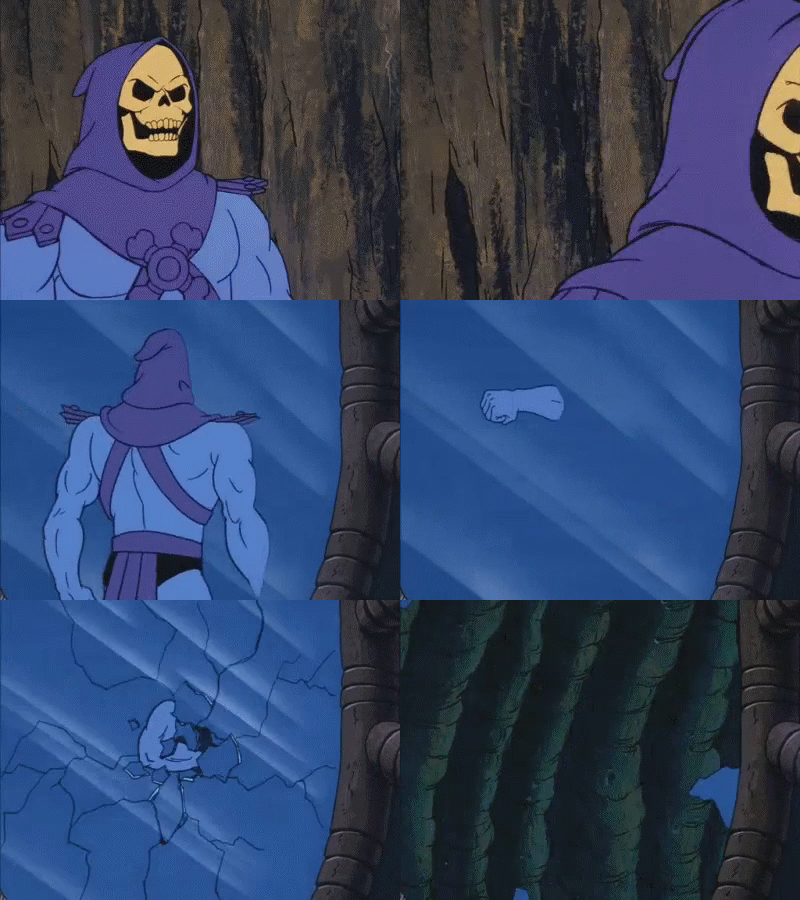
In the iconic Filmation era, Skeletor stood firmly at the center of He-Man and the Masters of the Universe as its primary villain, while also serving as a looming, secondary antagonist in She-Ra: Princess of Power. This version of Skeletor defined an entire generation’s understanding of evil—equal parts theatrical menace, dark sorcery, and relentless obsession.
According to the Sorceress of Castle Grayskull, Skeletor was a demon from another dimension, a being who did not truly belong to Eternia at all. He ruled with cruelty and absolute disregard for life, commanding a fearsome army of warriors from his volcanic stronghold, Snake Mountain. His past remained deliberately obscured, reinforcing the idea that Skeletor was less a man and more a force—ancient, hateful, and dangerous.
Yet fragments of his history slowly surfaced. It was revealed that Skeletor had once been a member of the Evil Horde, trained personally by Hordak, who regarded him as his most promising pupil. When Hordak and the Horde invaded Eternia, they attempted to kidnap the infant children of King Randor and Queen Marlena—twins whose destinies would one day reshape the universe.
The plan failed catastrophically. In the chaos, Hordak abandoned Skeletor and fled Eternia with only one child—the baby princess Adora. Captured by Man-At-Arms and the palace guards, Skeletor turned his humiliation into vengeance. He betrayed Hordak, revealing the location of the Horde’s secret base at Snake Mountain.
With Hordak gone and Adora lost to another world, Skeletor seized the opportunity. He claimed Snake Mountain as his own, assembled a new legion of henchmen, and set his sights on conquering Eternia itself—chief among his goals, the capture of Castle Grayskull. It was during this rise that he became the sworn arch-enemy of He-Man, devising endless schemes to destroy him. Fate would later reunite Skeletor with Hordak once more, while also placing him in direct conflict with Adora’s true identity—She-Ra.
UK Masters of the Universe Comics (1986–1990)

The UK comics took Skeletor’s legend to a far grander—and far darker—scale. Here, he was known as “the Living Skeleton,” a terrifying entity originating from the planet Infinita. His atrocities across the cosmos eventually drew the attention of Horde Prime, who summoned Skeletor to the world of Academia to serve in his private army.
On Academia, Skeletor once again studied under Hordak. To test his pupil’s worth, Hordak ordered him to conquer a nearby world. Skeletor exceeded expectations in the most catastrophic way imaginable—not only conquering the planet, but subjugating the entire solar system. This act enraged Hordak, who had intended to claim the system for himself. The two clashed in a brutal confrontation, master and student locked in a battle that ended in stalemate, interrupted only by Horde Prime himself.
Rather than punish Skeletor, Horde Prime was impressed. As a reward, he granted Skeletor access to the Dark Dimension, a realm of forbidden knowledge where the black arts were mastered at terrible cost. Skeletor remained there for an extended period, forging a new suit of armor and emerging more powerful than ever before. At this point, he was feared across the universe—ranked as the third most terrifying tyrant in existence, surpassed only by Horde Prime and Hordak.
Consumed by hatred for his former master, Skeletor plotted betrayal. He lured Hordak to a desolate moon under the false promise of conquering a dimension of science. Once there, Skeletor attacked without mercy, leaving Hordak for dead among the ruins.
Horde Prime then dispatched Skeletor to conquer Eternia, a world protected by a powerful magical barrier. Skeletor eventually shattered this mystic wall and resumed his obsession with Castle Grayskull. His ambitions were once again complicated by Hordak’s return, as the former master sought to claim Eternia for himself.
Ultimately, Skeletor abandoned Eternia altogether, journeying to the distant Triax Star System, where he recruited the Mutants of Denebria. With a new army at his command and the universe once again within reach, Skeletor continued his endless pursuit of domination—forever evolving, forever betraying, and forever driven by the belief that all reality was meant to kneel before him.
Masters of the Universe – The Live-Action Film (1987)
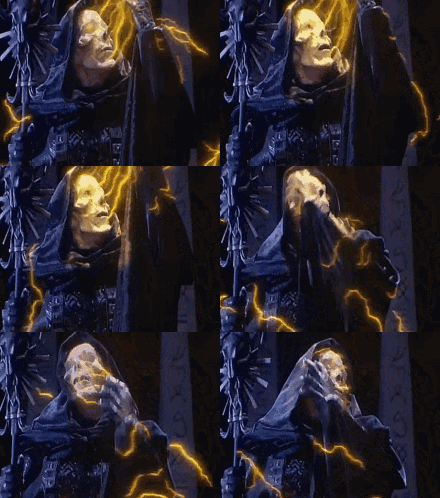
In the 1987 live-action Masters of the Universe, Skeletor once again emerged as the central antagonist—but this time, he was reimagined as something far more imposing, disciplined, and genuinely terrifying. Gone was the theatrical buffoonery seen in some animated portrayals. This Skeletor was cold, focused, and baleful—a conqueror who felt frighteningly close to victory from the very first act.
Clad in regal black robes and wielding an ornate metallic staff, Skeletor carried himself like a dark emperor rather than a mad sorcerer. Using the Cosmic Key, a powerful dimensional device capable of manipulating space and reality, he launched a sudden and devastating assault on Castle Grayskull. The attack was swift and overwhelming. Skeletor achieved what few versions of the character ever managed—an outright victory. Grayskull fell, and The Sorceress was captured.
Though He-Man narrowly escaped during the invasion, Skeletor’s triumph was only delayed, not denied. He tracked his ancient enemy across dimensions all the way to Earth, captured him, and dragged him back to Eternia in chains—an act that symbolically reversed the power dynamic between hero and villain.
At the height of his conquest, Skeletor finally achieved his lifelong obsession. He absorbed the power of Grayskull itself, transforming into a radiant, golden, god-like being—less a skeleton and more a living deity of dark energy. Though He-Man ultimately defeated him, Skeletor’s end was left deliberately ambiguous. After plunging into a deep pit beneath Grayskull, he resurfaced, alive and defiant, vowing that he would return.
Skeletor was portrayed by Frank Langella, whose performance is widely regarded as one of the film’s strongest elements. Langella himself cited Skeletor as one of his favorite roles across his long career, embracing the character with theatrical gravitas. He even contributed by writing portions of Skeletor’s dialogue, lending the villain a Shakespearean weight that continues to be praised decades later.
The New Adventures of He-Man (1988–1992)

Following the film, Skeletor carried over into one of the franchise’s most radical evolutions: The New Adventures of He-Man. Alongside He-Man and the Sorceress, Skeletor was one of the very few characters to survive the transition into this futuristic era, appearing across the toyline, animated series, and accompanying Mini-Comics.
Visually, this version of Skeletor underwent a dramatic redesign. He now wore an armored chest plate, cybernetic implants, and a flowing cape paired with a helmet—blending sorcery with science. His iconic Havoc Staff was replaced by the Skull Staff, reflecting the series’ heavier emphasis on advanced technology. In the Mini-Comics packaged with the toys, Skeletor was forced to undergo these cybernetic enhancements after being gravely injured while witnessing He-Man’s transformation—his body reforged through machinery as much as magic.
The eternal conflict was no longer confined to Eternia. Skeletor traveled far into the future, aligning himself with the Evil Mutants of Denebria and their ruthless leader Flogg. In response, He-Man also journeyed forward in time, becoming an ally of the Galactic Guardians and the defender of the peaceful planet Primus. Their rivalry followed them across the stars, transforming a mythic fantasy feud into a sprawling space opera.
Throughout the animated series, Skeletor cycled through multiple visual looks, with his armor evolving to match different action-figure variants in the toyline—a hallmark of late-’80s franchise design. He was voiced by Campbell Lane, who portrayed him as sharper, more calculating, and far more manipulative than earlier incarnations. This Skeletor possessed a sardonic, biting sense of humor, masking intelligence behind mockery and strategic patience.
The series concluded with one final confrontation. In the end, Skeletor was defeated not through brute force, but containment—trapped inside a Shuttle Pod by He-Man and exiled into the farthest reaches of space. It was a fitting conclusion for a villain who had chased power across dimensions, timelines, and galaxies, only to be cast adrift by the very obsession that defined him.
Across both the live-action film and The New Adventures of He-Man, Skeletor evolved from dark sorcerer to cosmic tyrant—a villain who could adapt to any era, any world, and any form, so long as there was power left to claim.
He-Man and the Masters of the Universe (2002–2004): The Fall of Keldor

The 2002 revival of He-Man and the Masters of the Universe finally did what decades of lore had only hinted at—it gave Skeletor a name, a face, and a tragic beginning. In this incarnation, Skeletor was revealed to have once been Keldor, a ruthless but brilliant warlord who had trained under the dark tutelage of Hordak.
Keldor gathered a loyal band of warriors and launched a direct assault on the Hall of Wisdom, believing power should be taken, not debated. There, his forces were met by Captain Randor and his officers. The confrontation culminated in a brutal duel between the two brothers. Despite his ferocity, Keldor was disarmed. Refusing to accept defeat, he revealed a hidden vial of acid concealed within his armor and hurled it at Randor. At the final moment, Randor deflected the attack—causing the corrosive liquid to splash back onto Keldor’s own face.
As Keldor screamed and his flesh began to melt away, Hordak intervened. In a chilling act of salvation, he transformed Keldor’s ruined visage into a floating skull—preserving his life, but erasing the last trace of the man he once was. Thus, Skeletor was born.
Skeletor and his followers were imprisoned behind a Mystic Wall in Eternia’s dark hemisphere, where they remained for many years. During that time, Skeletor did not rot—he planned. Eventually, using a device of his own creation, he shattered the wall and returned to Eternia seeking vengeance against the now King Randor. He searched for the Council of Elders, only to discover they had vanished. His attention soon turned to Castle Grayskull, a structure that appeared harmless on the surface but secretly housed the Elders’ power. In pursuing it, Skeletor crossed paths with He-Man, igniting a rivalry that would define Eternia’s fate.
DC Comics (2012 – New 52): Bloodlines and Betrayal

In DC Comics’ New 52 continuity, Skeletor’s origin was reshaped into a deeply political and familial tragedy. Keldor was initially the heir to the throne of Eternia, the eldest son of King Miro. However, Miro chose Randor as king instead, deeming Keldor unfit because he was a half-blood—his lineage tainted by Gar heritage. This rejection planted the seeds of bitterness that would eventually consume him.
Though cast aside, Keldor remained close to power, serving as Randor’s advisor while secretly plotting his downfall. On the brink of death due to a powerful curse, Keldor made his final move. He stabbed Randor and used his brother’s blood in a dark ritual to transform himself into Skeletor—with Hordak once again acting as the guiding hand behind the transformation. In this version, Skeletor is not merely created by magic, but by resentment, bloodshed, and a lifetime of being denied what he believed was rightfully his.
Masters of the Universe: Revelation – Memory as a Weapon
Netflix’s Masters of the Universe: Revelation pushed Skeletor’s tragedy even further, layering identity loss atop betrayal. Here, Skeletor was once Prince Keldor, the illegitimate son of King Miro and a Gar woman. Despite being Miro’s eldest child, Keldor was removed from the line of succession when he was sent to the isolationist island of Anwat-Gar, effectively exiling him from the throne of Eternos.
When the Horde attacked the Gar people, Hordak took Keldor as his acolyte, teaching him the ways of magic. The turning point came when Hordak presented him with the Havoc Staff. Upon touching it, the staff burned the flesh from Keldor’s face, transforming him into Skeletor. But the physical transformation was only half the horror.
Hordak erased Keldor’s memories and replaced them with fabricated ones, convincing Skeletor that he was not a fallen prince at all—but a demon from the dimension of Apollyos. In doing so, Hordak didn’t just create a servant; he erased a man’s past to forge a weapon that would never question its purpose.
Powers and Abilities
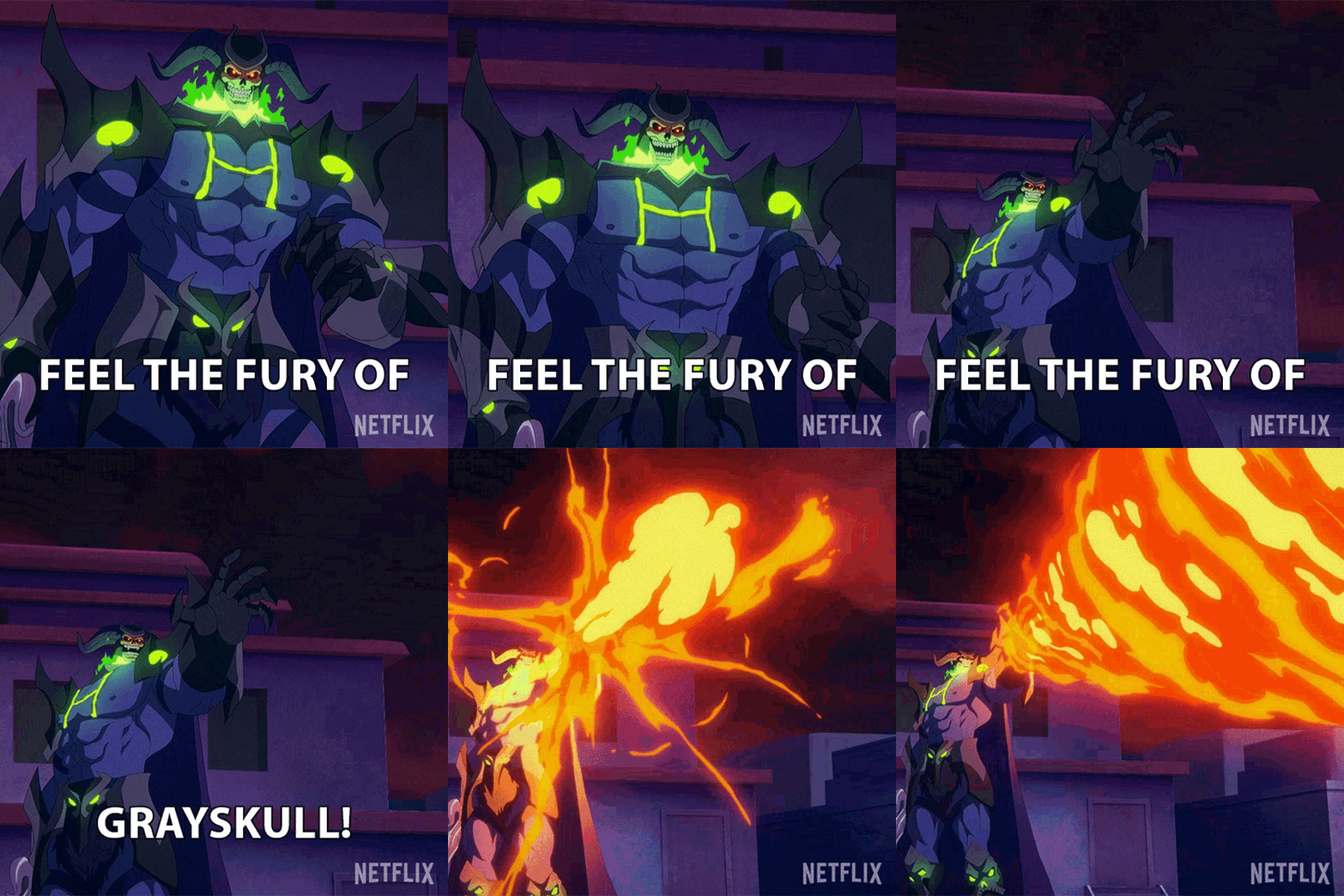
Across every era of Masters of the Universe, Skeletor has been portrayed as one of the most dangerous beings in existence—not because his power is neatly defined, but because it isn’t. His abilities shift and evolve depending on the storyteller, yet one truth remains constant: Skeletor is an extraordinarily powerful sorcerer, commanding a vast spectrum of dark mystic forces that place him leagues above ordinary spellcasters.
At his core, Skeletor is a master of black magic. He wields destructive sorcery, reality-warping spells, dimensional manipulation, and arcane energies drawn from sources most beings were never meant to touch. Alongside his magical prowess, Skeletor also possesses formidable scientific intelligence. In the He-Man and the Masters of the Universe and The New Adventures of He-Man, he is repeatedly shown designing advanced machines, traps, weapons, and reality-bending devices—blurring the line between dark wizard and mad technologist.
One of his most iconic abilities in the Filmation series was his instantaneous escape to Snake Mountain. With the utterance of his infamous phrase—“I’m going back to Snake Mountain!”—Skeletor could vanish from danger in a flash of sorcery, reinforcing his reputation as a villain who always lived to fight another day.
Skeletor is most often armed with his signature weapon, the Havoc Staff—a long magical pole crowned with a ram’s skull and embedded with a glowing crystal orb. Through the staff, he can unleash bolts of raw mystic force, channel massive spellwork, or amplify his already considerable magical output. In many incarnations, the Havoc Staff functions less like a weapon and more like an extension of Skeletor’s will.
At times, Skeletor does not even require a focus. He has demonstrated the ability to discharge energy directly from his own body. In the Masters of the Universe, he casts crackling lightning from his hands, while in the original animated series he projects destructive energy from his fingertips—and even from his hollow eye sockets, a visual reminder that the power sustaining him runs deeper than flesh.
The 2002 animated series offered a more restrained take on his innate abilities. On his own, Skeletor appeared more limited—but when wielding the Havoc Staff, his power became terrifyingly vast, nearly limitless in scope and devastating in raw output. This version emphasized preparation, artifacts, and knowledge over constant displays of godlike force.
In the earliest mini-comics, Skeletor was sometimes depicted as possessing one half of the Power Sword, allowing him to channel additional magical energies through the weapon itself. Beyond this, his skill set expanded even further. He has demonstrated the ability to teleport himself and others across immense distances, issue telepathic commands to his minions, open gateways between dimensions, and perform remote viewing—spying on enemies from afar. He is also shown to be a capable swordsman, proving that his menace does not vanish when magic is stripped away.
Though primarily a sorcerer, Skeletor is far from physically helpless. He possesses above-average physical strength and combat ability, having held his own in direct confrontations with He-Man on multiple occasions. While he cannot match He-Man’s raw power, Skeletor’s combination of strength, magic, and cunning makes him a lethal opponent in any form of battle.
As a master of the mystic arts, Skeletor also commands immense forbidden knowledge. He understands ancient secrets of the universe, long-lost spells, extradimensional lore, and cosmic truths hidden even from Eternia’s greatest scholars. Power, for Skeletor, is as much about knowing as it is about wielding.
Toys – Masters of the Universe Classics (2008)
The Masters of the Universe Classics toyline introduced a richly unified continuity through its packaging bios and accompanying mini-comics, blending elements from nearly every version of the franchise while adding entirely new lore. Over more than eleven years, Skeletor’s story underwent dramatic evolution—arguably more than any other character in the line.
In this continuity, Skeletor was once Keldor, the half-brother of Captain Randor. Mortally wounded in battle with his sibling, Keldor turned to Hordak in desperation. Hordak saved his life by merging him with an extradimensional entity known as Demo-Man—a being from the dimension of Despondos, and notably the original planned name for the Skeletor character during early development.
This fusion forever transformed Keldor into Skeletor, Overlord of Evil.
Embracing his new identity, Skeletor gathered the greatest outcasts, monsters, and villains of Eternia, forging an army dedicated to one singular goal: breaching Castle Grayskull and claiming what he believed to be the universe’s ultimate power source.
As the Classics storyline progressed, it explored Skeletor’s many transformations into alternate forms, revealed that he and Evil-Lyn had a son, chronicled Skeletor’s death and grotesque return as a zombie, and eventually followed his true resurrection—restoring him briefly to his Keldor form. Most chilling of all was his choice to willingly become Skeletor once again, not out of necessity, but ambition.
His endgame was nothing less than godhood.
That final plan—to ascend beyond mortal and demon alike—was ultimately thwarted by his eternal nemesis, He-Man. Yet even in defeat, the Classics continuity reinforced what has always defined Skeletor: power is never simply taken from him—it is something he continually chooses, no matter the cost.
Across magic, science, muscle, and mind, Skeletor endures as one of fantasy’s most complete villains—a being whose greatest weapon is not his staff or spells, but his refusal to ever stop reaching for more.
Skeletor endures because he is more than just He-Man’s enemy—he is a reflection of ambition unchecked, power pursued at any cost, and identity shattered by obsession. Across dimensions, timelines, reboots, comics, films, and toys, Skeletor evolves, adapts, and returns stronger every time. Whether he is a fallen prince named Keldor, a dark sorcerer commanding Snake Mountain, or a cosmic tyrant reaching for godhood, his story is one of tragedy sharpened into terror.
What makes Skeletor timeless isn’t just his magic or his mastery of science—it’s his refusal to accept defeat, fate, or limitation. Every version adds another scar, another secret, another layer to a villain who refuses to fade. And as long as Castle Grayskull stands, Skeletor’s shadow will never truly leave Eternia.
Dive deeper into the worlds you love with officially licensed collectibles from He-Man and Masters of the Universe, Anime, Marvel, DC, Transformers, LEGO, and MORE — now available at up to 40% OFF. From iconic villains to legendary heroes, this is the perfect time to power up your collection.