


Silvermane Explained: Origins, Powers & Marvel Legacy
Silvermane is one of Marvel Comics’ most enduring crime lords — a supervillain whose power was never rooted in flashy abilities, but in control, corruption, and survival at any cost. A towering figure within the Maggia, Marvel’s Mafia-inspired organized crime syndicate, Silvermane represents old-world criminal ambition colliding with modern superhuman chaos.
Publication History

Silvermane made his first appearance in The Amazing Spider-Man #73, created by Stan Lee and John Buscema. His presence immediately set him apart from street-level mobsters, introducing a villain who blended organized crime with mysticism, science, and ruthless longevity.
In 1975, writer Gerry Conway and artists Don Heck and Vince Colletta expanded Silvermane’s legacy by introducing his son, Joseph Manfredi, cementing Silvermane as a generational crime figure rather than a one-off villain.
Fictional Character Biography
Born Silvio Manfredi in Corleone, Sicily, Silvermane earned his nickname from his near-white hair — a visual marker of age, authority, and experience. From the beginning, he was a professional criminal, rising through the ranks of the Maggia from racketeer to master strategist. Over time, he became one of Spider-Man’s longest-standing criminal nemeses, not because he was physically dominant, but because he outlived nearly everyone else.
In his very first appearance, Silvermane forced Curt Connors to translate an ancient clay tablet and create a mystical youth potion. This scheme brought him into direct conflict with Spider-Man and Lizard. When Silvermane drank the serum, it worked — too well. He grew younger, then regressed into childhood, then infancy, and ultimately vanished entirely, aging backward past birth itself.
Silvermane later reappeared, revealing that he had mystically stabilized his age at roughly forty. Reclaiming his position, he climbed back to the top of the criminal hierarchy and eventually became head of his crime family. His ambition escalated further when he allied himself with HYDRA, rising to the position of Supreme Hydra. This global power play ended when he was defeated by Daredevil, Nick Fury, and S.H.I.E.L.D..
Returning to New York, Silvermane attempted to unite the city’s criminal gangs under his rule. However, his plans were disrupted by the return of the Green Goblin, who openly opposed him. During a three-way confrontation involving the Goblin and Spider-Man, Silvermane fell from a great height — but survived, reinforcing his reputation as a man who simply refused to die.
Throughout his criminal career, Silvermane employed and manipulated countless villains, including Hammerhead, and frequently clashed with Kingpin. At one point, Silvermane even attempted to assassinate an amnesiac Kingpin. His former partner Dominic Tyrone, betrayed and discarded, reinvented himself as Rapier and sought vengeance against Silvermane.
A flashback one-shot later revealed the full scope of Silvermane’s corruption, framed through an investigation by reporter Ben Urich. The story established Silvermane as a near-mythic Mafia figure — so infamous that mothers warned misbehaving children that “One-Eye” would get them.
In his advanced age, Silvermane’s injuries began undoing the effects of the rejuvenation serum. Though bedridden, he continued to rule his empire remotely until nearly killed by Dagger. Refusing to accept death, Silvermane transformed himself into a cyborg, only to have control of that body seized by the Kingpin. Dagger later restored his life energy, returning him to autonomy. His cyborg form was severely damaged during a gang war between Hammerhead and Kingpin by Jack O'Lantern.
Undeterred, Silvermane deployed a remote-controlled android duplicate to battle Spider-Man, part of a twisted plan to harvest Spider-Man’s superhuman biology. By draining Peter’s radioactive blood, Silvermane intended to power a new, stronger cyborg body. He later clashed with Deathlok and Punisher while running a major drug operation near a grammar school. Despite everything, Silvermane remained an active Maggia leader.
During a period when Wilson Fisk had fallen from power, Silvermane attended a meeting of criminal warlords hoping to divide Fisk’s resources. The meeting collapsed into chaos when Secret Empire forces and the Punisher clashed nearby. By sheer coincidence, Silvermane was staying at the same motel as the Punisher. Using resources hidden within his semi-truck — including stored cyborg bodies — Silvermane fought his way free and escaped.
Eventually, it was revealed that Silvermane had been killed in a shootout with Owl’s gang at a New York City scrapyard. He was lifted by a magnet and dropped into a garbage compactor, crushed to death, leaving the Maggia fractured and leaderless. Months later, Silvermane appeared to return alongside other deceased Maggia members during their conflict with Mister Negative — only for it to be revealed as a deception orchestrated by Maggia member Carmine. This “Silvermane” was actually a robot, controlled by a hired Mysterio. The scheme backfired when Mysterio turned the robot on Carmine and murdered him, apparently as part of his own attempt to seize control of the Maggia.
Why Silvermane Endures
Silvermane is not terrifying because of raw power — he is terrifying because he always adapts. Mystic youth, organized crime, cyborg bodies, android doubles — every era of Marvel finds Silvermane reinventing himself. He is the embodiment of criminal legacy, proof that in Marvel Comics, evil doesn’t always die — sometimes it just upgrades.
Powers and abilities

Silvermane did not begin his criminal career with superhuman powers. For much of his life, he was a normal human being, relying not on mutation or mysticism, but on discipline, experience, and ruthless intelligence. Even without enhancements, Silvermane was a superb hand-to-hand combatant, capable of holding his own against trained opponents, and an excellent marksman with firearms. More dangerous than his physical skills, however, was his mind. Silvermane was a brilliant strategist and organizer, able to plan large-scale criminal operations, manipulate rival factions, and maintain control over the Maggia through fear, loyalty, and calculated violence. In combat situations, he was typically armed with various handguns and, when intimidation or firepower was required, a Thompson .50-caliber machine gun, reinforcing his image as an old-school mob boss who preferred overwhelming force.
As age and injury began to catch up with him, Silvermane took his obsession with survival to its extreme conclusion. His brain, head, and vital organs were transplanted into a cyborg body, a drastic transformation that elevated him beyond his former human limits. This mechanical form granted Silvermane superhuman strength, along with enhanced senses raised to superhuman levels, allowing him to perceive threats and react with far greater speed and power than his original body ever could. In this state, he became physically capable of confronting super-powered enemies and surviving encounters that would have been fatal to an ordinary man.
Despite these upgrades, Silvermane’s condition was far from perfect. His organic components remained those of a frail eighty-year-old man, making them inherently vulnerable despite the armored cyborg shell surrounding them. Damage to his life-support systems, power supply, or exposed biological elements could prove catastrophic. This flaw perfectly encapsulates Silvermane’s core tragedy: no matter how much technology he grafted onto himself, he could never fully escape the decay of age, only delay it. His cyborg form was not a symbol of evolution, but of desperation — a criminal mastermind literally held together by machinery, fighting time itself as much as his enemies.
Other versions
Ultimate Marvel
In the Ultimate Marvel universe, Silvermane appears briefly but memorably, reimagined in a more grounded, brutal crime-world setting. During his cameo in Ultimate Spider-Man, the criminal underworld is in flux. With Wilson Fisk lying low due to mounting legal troubles, Silvermane sees an opportunity to reclaim influence and decides to work alongside Hammerhead to pry Fisk out of his seat of power.
Silvermane confidently tells Hammerhead that all he truly needs to rule is a little more “up here”—gesturing to his intelligence and experience rather than brute force. Hammerhead, however, has no interest in sharing power or deferring to Silvermane’s strategic mind. In a cold, violent moment that perfectly captures the Ultimate Universe’s ruthless tone, Hammerhead smashes Silvermane’s head, dismissing him with the line, “I think I got enough up here already.” The scene underscores how, in this reality, brains alone are no protection against raw ambition and brutality.
Silvermane is also referenced in Ultimate X-Men, where he is mentioned as the leader of a mob that includes Hammerhead among its ranks. It is further revealed that he owes a debt to Nathaniel Essex, better known as Mister Sinister, a detail that elevates Silvermane’s importance beyond street crime and hints at deeper entanglements with powerful and dangerous figures operating behind the scenes.
Naming inconsistencies further complicate Silvermane’s identity in the Ultimate Universe. A Daily Bugle report lists his real name as Allan Silvermane, while later in the same storyline Wilson Fisk refers to him as Silvio Manfredi. Given Silvermane’s status as a high-ranking crime lord, it is strongly implied that one or both names are aliases, reinforcing his long-standing habit of obscuring his true identity to maintain power and avoid accountability.
House of M
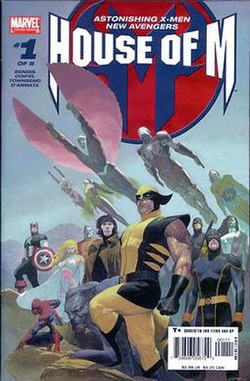
In the alternate reality of House of M, Silvermane appears once again, this time depicted as a younger crime boss. In this world, he is one of the many leaders of criminal families captured by the Brotherhood, reflecting a reality reshaped by Magneto’s rule where power structures—both heroic and criminal—are forcibly reorganized. Though his appearance is brief, it reinforces Silvermane’s multiversal consistency: regardless of age or reality, he remains a figure of organized crime, ambition, and survival.
What These Versions Reveal
Across alternate realities, Silvermane’s role shifts in scale but not in essence. Whether crushed under Hammerhead’s ambition, indebted to Mister Sinister, or imprisoned by the Brotherhood, Silvermane is always portrayed as a crime lord navigating a world more violent than himself. These versions strip away his mysticism and cyborg trappings, exposing the core truth of the character: Silvermane’s greatest weapon has never been power or technology, but his belief that intelligence and legacy should place him above everyone else—a belief that alternate universes are all too eager to punish.
In other media
Television
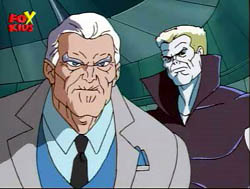
Silvermane has appeared across multiple Spider-Man animated adaptations, each version reinterpreting him to reflect the tone of its era while preserving his core identity as a calculating, old-world crime lord obsessed with power, control, and longevity.
Silvermane first appeared in animated form in the 1981 Spider-Man cartoon, where he was voiced by Paul Winchell. In the episode “Wrath of the Sub-Mariner,” Silvermane arrives in New York alongside Man Mountain Marko to negotiate a truce with Kingpin. The urgency behind this meeting stems from Kingpin’s scientist, Dr. Everett, who has developed a devastating dissolvent fluid capable of eating through anything. Prior to the meeting, Spider-Man intercepts Silvermane, but cannot legally detain him since most of Silvermane’s crimes were committed on the West Coast. The confrontation ultimately ends with Silvermane being webbed up by Spider-Man.
Silvermane received his most elaborate animated portrayal in Spider-Man: The Animated Series, where the character is voiced by Jeff Corey as an old man, Townsend Coleman as an adult, Matthew McCurley as a child, and Cannon Young as a baby. Although firmly established as an enemy of Spider-Man, this version of Silvermane does not fully align himself with Spidey’s other villains and is portrayed as a bitter rival of Wilson Fisk, whom he deeply despises.
In this continuity, Silvermane is also revealed to be the father of Alisha Silvers, who uses the alias “Alisha Silvers” to infiltrate the research of Curt Connors. Silvermane first appears during the Insidious Six storyline, where he hires Hammerhead to capture Spider-Man. During the Battle of the Insidious Six, Silvermane is ultimately rescued by Spider-Man after Kingpin attempts to kidnap him.
This version of Silvermane is defined by his lifelong obsession with youth and immortality. Having never experienced a normal childhood, his fear of aging becomes all-consuming. He learns of the Tablet of Time, an ancient artifact rumored to contain a formula capable of restoring youth. When the tablet is unearthed and brought to the United States, Silvermane arranges for Tombstone to steal it and abduct Curt Connors, who is studying its properties. Despite Spider-Man’s interference, Silvermane kidnaps Connors’ wife and forces him to activate the tablet.
In the comics, the tablet’s power manifests as a potion, but in the animated series, the artifact instead focuses the sun’s rays into greenish energy lasers. Silvermane is initially rejuvenated into a younger man, briefly fights Lizard, and then regresses further—transforming into a baby. During the process, the Lizard is bombarded by the rays and reverts to human form. Connors theorizes that the tablet might stabilize Spider-Man’s mutations, but Hammerhead—now working for Kingpin—steals it. Kingpin, distraught over his wife leaving him, orders Hammerhead to dispose of the tablet. Hammerhead sells it to an elderly man, implied to be Vulture, who uses it to temporarily restore his youth but is unable to maintain it, oscillating uncontrollably between ages.
In the later episode “Partners,” baby Silvermane is revealed to have retained his adult intellect. Alongside Alisha, he recruits the cyborg Alistair Smythe to kidnap Black Cat and blackmail Spider-Man into capturing Scorpion. Silvermane believes Scorpion—created through Neogenic technology—can be used to swap genetic structures with Spider-Man, allowing Silvermane to reclaim a powerful adult body. At the time, Scorpion is attempting to reform and is living with the Vulture. The Vulture, one of the creators of Neogenic technology, intervenes during the transfer, disrupting the process. The resulting energy exchange allows the Vulture to regain youth semi-permanently while reverting Silvermane back into an old man.
Silvermane later appears in The Spectacular Spider-Man episode “Gangland,” voiced by Miguel Ferrer. In this incarnation, he is portrayed as a rival mob boss to Doctor Octopus and Tombstone. In “Accomplices,” it is revealed that Silvermane was arrested and imprisoned twelve years earlier after Frederick Foswell exposed his criminal empire. During his absence, his territory was overtaken by Tombstone, also known as the Big Man. In this continuity, Silvermane’s daughter is Silver Sable, who has been managing what remains of his empire.
When Hammerhead sabotages a criminal summit between Silvermane, Tombstone, and Doctor Octopus by drugging Silver Sable, Silvermane reveals a hidden hydraulic exoskeleton that grants him superhuman strength and energy blasts. He engages in combat until Spider-Man intervenes. Silvermane attempts to crush Spider-Man, but the web-slinger rips out the suit’s hydraulic cables, leaving Silvermane helpless. He is arrested and later appears in “Opening Night” as an inmate of the Vault, released during the Green Goblin’s prison takeover. Silvermane rallies the Enforcers, a robotic duplicate of Mysterio, and other inmates to hunt Spider-Man, but they are ultimately subdued by knockout gas released by Walter Hardy.
Legacy in Animation
Across animated series, Silvermane is consistently portrayed as the crime lord who refuses to fade away—whether as an aging mob boss, a cyborg, or even a baby with the mind of a tyrant. His obsession with youth, power, and legacy makes him one of Spider-Man’s most unsettling adversaries, proving that the greatest monsters aren’t always born—they’re built, piece by piece, by fear of time itself.
Video games
Silvermane 2099

Silvermane 2099 appears as an exclusive villain in the Nintendo DS version of Spider-Man: Shattered Dimensions, where he is voiced by Steven Blum. This incarnation places the classic crime lord deep into Marvel’s dystopian future, pitting him against Spider-Man 2099, also known as Miguel O'Hara.
In this timeline, it is revealed—through exposition by Madame Web—that Silvermane’s continued existence in the year 2099 is the direct result of his cyborg nature. Long after any normal human lifespan should have ended, Silvermane has endured by replacing failing organic components with machinery, perfectly aligning with his long-established obsession with survival at any cost. However, longevity is not enough for him. Silvermane intends to use his fragment of the Tablet of Order and Chaos to finally achieve true immortality, transcending even the limitations of his cybernetic body.
The confrontation between Silvermane 2099 and Miguel O’Hara is less about raw power and more about strategy and endurance. Silvermane relies heavily on missile barrages and bomb-based attacks, attempting to overwhelm Spider-Man 2099 with superior firepower. Miguel ultimately defeats him not by brute force, but by outmaneuvering his weapons, carefully avoiding the explosives and systematically wearing Silvermane down until the cyborg crime lord is brought to defeat.
This appearance reinforces a recurring truth across every version of the character: whether in the present, the past, or a cyberpunk future, Silvermane is always chasing the same goal—to outlive everyone else. In Shattered Dimensions, that obsession carries him into 2099 itself, proving that for Silvermane, crime isn’t just about power or money—it’s about refusing to die, no matter the century.
Silvermane’s story is not about superpowers — it’s about obsession. Across comics, animation, and video games, Silvio Manfredi embodies the criminal who refuses to fade, reinventing himself through mysticism, technology, and sheer will. From Maggia mastermind to cyborg survivor and even a future tyrant in 2099, Silvermane proves that power in the Marvel Universe isn’t always loud — sometimes it’s patient, calculating, and terrifyingly persistent.
What makes Silvermane unforgettable is not how he fights Spider-Man, but why he keeps fighting time itself. In a world of gods and monsters, Silvermane reminds us that humanity’s greatest fear isn’t defeat — it’s irrelevance. And that fear can build empires… or destroy them.
Explore an incredible range of Anime, Marvel, DC, Transformers, LEGO, and more collectibles — including action figures, statues, exclusives, and display pieces — now available at up to 40% OFF.
Whether you’re upgrading your Spider-Man shelf or expanding your multiverse, now’s the perfect time to collect.