


Shao Kahn Explained: Powers, Lore & Mortal Kombat Legacy
Shao—known formally as General Shao, but far more widely feared and remembered as Shao Kahn—isn’t just a character in the Mortal Kombat universe; he’s a presence that looms over it. A conqueror, a tyrant, and the iron-fisted ruler of Outworld, Shao Kahn represents power in its most brutal, unapologetic form. For decades, he has stood as one of the most iconic villains not just within the fighting game genre, but across video games as a whole. His legacy is built on domination—worlds conquered, warriors broken, and empires forged through sheer force of will. Within the mythology of Mortal Kombat, he stands shoulder to shoulder with Shang Tsung and Shinnok as one of the three central antagonistic forces that define the franchise’s darkest conflicts.
Shao Kahn’s arrival into the series dates back to Mortal Kombat II, where he made his debut as the final boss and primary antagonist—a role that immediately cemented him as a figure players would both fear and remember. Towering, relentless, and almost mythic in his presence, he wasn’t just another opponent; he was the wall you had to break through. That same commanding role carried forward into Mortal Kombat 3 and continued to echo throughout later entries in the series, reinforcing his place as the ultimate embodiment of Outworld’s tyranny. Years later, in Mortal Kombat (2011), he returned once again as the non-playable final boss, serving as the central antagonist of the game’s Story Mode. Here, his presence felt even heavier, as the narrative revisited and reimagined the franchise’s timeline, placing Shao Kahn at the heart of its most devastating turning points.
His influence didn’t fade with time—it evolved. In Mortal Kombat 11, Shao Kahn re-emerged as a pre-order bonus character and a secondary antagonist within both the main Story Mode and the Aftermath expansion. This version of him carried the weight of legacy, a reminder that even when dethroned or challenged, figures like Shao Kahn never truly disappear—they endure, waiting for the right moment to reclaim power. Beyond gameplay, his character has been defined by more than just brute strength; his signature war hammer, his commanding voice, and his infamous taunts—especially the chilling “You suck!”—have become part of gaming culture itself, embedding him deeper into the collective memory of players.
And then, with Mortal Kombat 1, the story reshapes him once again. A new version of Shao Kahn steps into the timeline as a playable character, this time serving as the tertiary antagonist in the game’s Story Mode. While the universe around him may shift, one thing remains constant—his nature. Whether as emperor or general, conqueror or challenger, Shao Kahn is defined by ambition, dominance, and an unyielding belief that power is meant to be taken, not given.
About Shao Kahn

Shao Kahn—often hailed as “The Konqueror”—is more than just the former Emperor of Outworld; he is the embodiment of domination itself within the Mortal Kombat universe. For most of the series, he has stood as its central, looming antagonist, a ruler whose presence feels less like leadership and more like oppression carved into reality. Visually, he carries the imposing aura of a massive, battle-hardened warrior, often evoking the image of an ancient conqueror forged through endless war. But what truly defines him is his overwhelming, almost god-like strength—power that rivals, and at times even surpasses, beings like Raiden and other divine entities. That strength, however, is only one part of who he is. Shao Kahn is equally known for his chilling brutality, his callous disregard for life, and his ferocity in battle, often relishing personal executions as a display of dominance. Yet, beneath that cruelty lies a twisted sense of recognition—he has, on occasion, spared subordinates who prove their worth, and even extended that warped mercy to figures like Sindel and Kitana, raising Kitana as his own daughter and treating Sindel as his queen, even if those relationships were built on manipulation and control rather than genuine compassion.
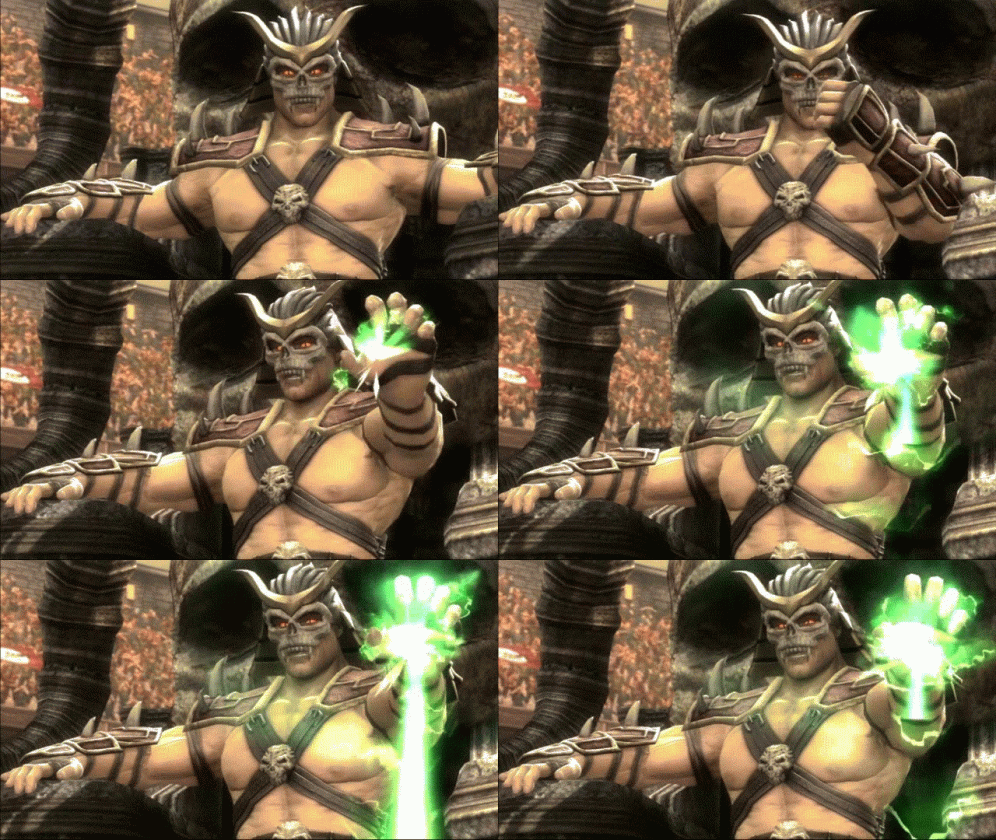
What truly elevates Shao Kahn beyond the image of a mere warlord is his intellect. He is not just a brute force tyrant—he is calculating, patient, and deeply versed in the dark arts. His mastery of forbidden magic allows him to consume and manipulate souls, a power he wields even more efficiently than his long-time subordinate, Shang Tsung. This command over soul magic doesn’t just empower him—it allows him to create. Some of Outworld’s most dangerous beings, like Ermac, a fusion of countless souls, and Skarlet, forged through Blood Magik, are direct results of his knowledge and ambition. In Mortal Kombat: Deception, it is revealed that Shao Kahn once served as an advisor to Outworld, much like Raiden serves Earthrealm, hinting at something even more profound—that he may have once held a divine or protector-like role during the reign of Onaga. That possibility becomes even more terrifying when you consider his later feats. In the original timeline, Shao Kahn defeats Blaze, ascends to godhood by absorbing Blaze’s power, kills Raiden, and ultimately emerges as the final victor of Armageddon—the last kombatant standing in a world reduced to ruin.
Yet for all his power, Shao Kahn is not without flaws—flaws that have, time and again, shaped his downfall. Perhaps his greatest strength lies in his relentless drive, his ability to pursue conquest with unmatched tenacity and organize vast forces under his command. But that same ambition is poisoned by arrogance. Shao Kahn has consistently underestimated humanity, believing Earthrealm to be easily conquerable, and has launched countless invasions—often with or without a consort—only to fail. His hunger for conquest blinds him, making him vulnerable to manipulation by those clever enough to exploit it. This arrogance and occasional naivety have led to betrayals from within his own ranks, particularly in the original timeline leading up to Armageddon. In the alternate timeline, his overreach proves fatal when the Elder Gods themselves intervene, killing him for violating the sacred rules of Mortal Kombat during his invasion of Earthrealm. Ironically, his actions create an even greater threat, paving the way for the Netherrealm’s invasion led by Quan Chi and Shinnok, with Quan Chi having initially aided Shao Kahn only as part of a larger scheme to weaken both Earthrealm and Outworld for his own conquest.
Even death doesn’t free Shao Kahn from betrayal. In the altered timeline, his past self is brought forward into the present, only to be used and ultimately betrayed by Shang Tsung after the sorcerer ascends as the Keeper of Time. Manipulating Shao Kahn into attacking Kronika’s Keep, Shang Tsung seizes the Hourglass and, in a final act of treachery, defeats and absorbs the souls of both Shao Kahn and Sindel, consolidating power for himself. In the new timeline, the cycle continues—Shao Kahn once again falls prey to manipulation, persuaded by Shang Tsung, who himself is unknowingly being deceived by an alternate version of himself. This chain of deception leads to Shao Kahn seizing the Outworld throne briefly, only to be imprisoned for his betrayal, a reminder that even the mightiest conquerors can be undone by their own ambition.
Throughout his reign, Shao Kahn has forged both powerful alliances and bitter rivalries. Shang Tsung has long served as his most loyal subordinate, a sorcerer whose own ambitions often simmer beneath the surface. Through Shang Tsung’s experiments, the hybrid warrior Mileena was created—engineered to replace Kitana, whom Shao Kahn deemed inferior, and embraced instead as his “true” daughter. He later adopts Skarlet in a similar fashion, empowering her with Blood Magik and molding her into another extension of his will. His conquests often relied on alliances with Outworld races like the Tarkata and Shokan, but these allegiances proved fragile. Following his first death in the alternate timeline, Outworld descended into civil unrest, and many of these alliances dissolved—particularly during the reign of Kotal Kahn. Even when Shao Kahn briefly reclaimed the throne, the fractures remained. The Shokan refused to stand with him, and the Tarkata instead aligned with Kotal Kahn and Kitana, seeking unity in a realm long divided by his rule.
At the heart of Shao Kahn’s story lies his enduring rivalry with Raiden. The two stand as opposites—protectors of their respective realms, yet fundamentally different in philosophy. Where Raiden defends, Shao Kahn conquers. This rivalry extends beyond the divine, drawing in warriors like Liu Kang and Kung Lao, as well as organizations like the Special Forces, all of whom have stood against his repeated attempts to claim Earthrealm. His alliances have also brought him into conflict with figures like Kuai Liang, the second Sub-Zero, particularly due to his dealings with the Cyber Lin Kuei and Sektor in the alternate timeline.
In the current timeline introduced in Mortal Kombat 1, Shao Kahn is reimagined as General Shao—a formidable soldier within Outworld’s military rather than its emperor. This version of him carries a more personal history, one rooted in transformation. Born weak, he was physically reshaped and hardened by his father into a warrior built for conquest, a living weapon forged through discipline and brutality. His tactical brilliance and battlefield prowess quickly elevate him, allowing him to lead Outworld to numerous victories and cement his status as its most feared general. Yet even in this new timeline, his defining trait remains unchanged—his insatiable desire for conquest. That ambition brings him into conflict with Empress Sindel, whose rule he views not as authority, but as limitation. Believing he knows what is best for Outworld, Shao attempts to seize the throne for himself. The attempt fails, leading to his imprisonment—but not his end. He escapes, gathers forces, and once again sets his sights on overthrowing Mileena’s more benevolent rule.
Because no matter the timeline, no matter the title—Emperor or General—Shao Kahn remains the same at his core.
Shao Kahn’s Appearance
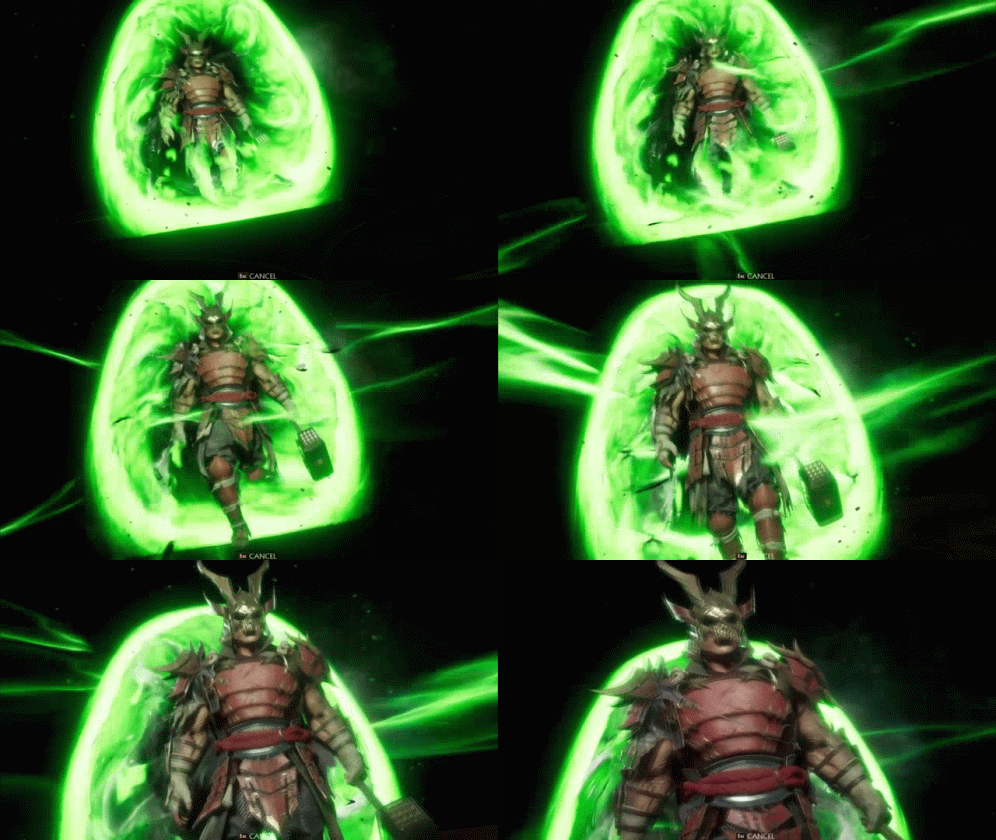
Shao Kahn’s appearance is one of those rare constants in the ever-evolving world of Mortal Kombat—a visual identity so strong, so unmistakable, that even as timelines shift and designs evolve, his presence remains instantly recognizable. Unlike many characters who undergo drastic redesigns over the years, Shao Kahn has held onto a core silhouette that feels almost timeless. The first thing anyone notices is his sheer size. His height may vary slightly depending on the game, but he is always portrayed as towering over others, a physical manifestation of dominance. He doesn’t just enter a scene—he looms over it. That sense of scale alone sets him apart, reinforcing the idea that he isn’t meant to stand alongside other fighters, but above them.
And then there’s the helmet—the crown of a conqueror. Shao Kahn is almost never seen without his iconic warlord helmet, a piece of armor that has become synonymous with his identity. Designed with a skull-like visage and a long, pronounced crest stretching across the forehead, it doesn’t just conceal his face—it amplifies his menace. It turns him into something more than a ruler; it makes him feel mythic, almost otherworldly. Paired with this are his signature armor elements: spiked shoulder pads that exaggerate his already imposing frame, matching knee guards and gauntlets that feel forged for war rather than protection, and the unmistakable skull medallion strapped across his chest, held in place by intersecting bands that give his entire design a ritualistic, almost ceremonial edge. Every piece of his armor tells the same story—this is not a king who inherited power, but one who took it.
On the rare occasions when the helmet comes off, what lies beneath only deepens that unease. Shao Kahn is typically depicted as bald, his face carrying subtle demonic traits—glowing red eyes, hardened features, and small spikes emerging from his head, hinting that whatever he is, he’s far removed from anything human. It’s a face that reflects centuries of conquest, a being shaped by war and dark power rather than time.
By the time we reach Mortal Kombat 11, his design evolves in a way that feels less like a change and more like a revelation. While all the core elements of his look remain intact, there’s a deliberate effort to distinguish him from a typical Outworlder. This version of Shao Kahn leans into something more ancient, more primal—something draconic. Subtle at first glance, but unmistakable upon closer inspection, his body begins to reflect traits that tie back to his connection with Onaga, the Dragon King. In fact, even within the game’s Arcade narratives, other characters acknowledge that he now wields power linked to Onaga. Without his armor, this transformation becomes even clearer. His arms and legs are lined with dragon-like scales, his physiology shifting into something far more beast-like. Spikes protrude from the back of his head, echoing the form of a creature rather than a man. His eyes—particularly the irises—mirror those of Sheeva, a Shokan warrior whose race is known for its half-dragon lineage, further reinforcing this connection. Even his body becomes more weaponized—his left arm is covered in large, jagged spikes, while his left hand develops elongated claws that extend across each finger, transforming his very limbs into instruments of destruction.
Then comes Mortal Kombat 1, where Shao Kahn—now General Shao—retains much of this evolved, draconic form but refines it further. The most striking addition is the emergence of large black horns, curving outward from his head and immediately altering his silhouette into something even more imposing. These horns necessitate a redesign of his iconic helmet, which now resembles more of a steel face guard while still preserving the signature skull motif that defines him. His face, too, undergoes subtle changes, becoming slightly more human in structure. A smaller nose, the removal of some of the smaller cranial spikes, and the addition of eyebrows lend him a more expressive, grounded appearance—yet none of it diminishes his intimidation. If anything, it makes him more unsettling. Because now, there’s just enough humanity in his face to remind you that beneath all that power… there’s still a mind choosing to wield it.
Characteristics, Powers, and Abilities
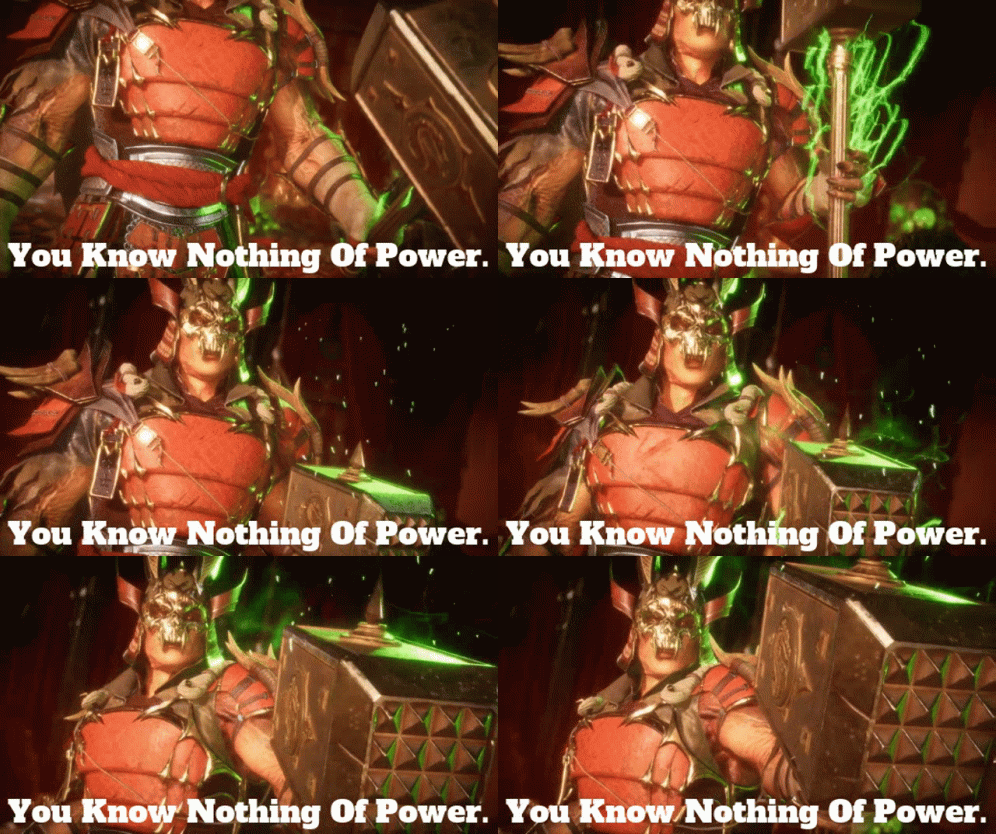
When it comes to raw, overwhelming power in the world of Mortal Kombat, Shao Kahn doesn’t just stand near the top—he defines what that top even looks like. Across the series, he is consistently portrayed as an immensely powerful being, one whose capabilities blur the line between warlord and god. His strength alone is staggering, backed by superhuman durability and stamina that allow him to endure and outlast even the most elite fighters. Add to that his longevity, and you’re looking at a conqueror who hasn’t just survived countless battles—he’s thrived in them. But what makes Shao Kahn truly dangerous is how effortlessly he combines brute force with magic. He doesn’t rely on one or the other; he wields both in tandem, turning every encounter into something brutally one-sided. Even his movement reflects that dominance—when he charges at an opponent, it isn’t just speed, it’s impact, a force of nature crashing forward with intent to overwhelm.
His combat prowess is made painfully clear during the events of Mortal Kombat 3, where he defeats Kung Lao with relative ease, a moment that reinforces just how wide the gap between him and most warriors truly is. And then there’s his weapon of choice—the iconic Wrath Hammer. In Shao Kahn’s hands, it isn’t just a tool; it’s an extension of his will. A single swing is enough to send opponents flying across the battlefield, shattering both defense and morale in one motion. During the chaos of Armageddon, that same hammer proves its destructive capability when he smashes through Mileena’s magical barrier, tearing through defenses that would stop most others in their tracks.
But physical strength is only part of the story. Much like his long-time subordinate Shang Tsung, Shao Kahn possesses the terrifying ability to absorb souls—but where Shang Tsung refines it, Shao Kahn weaponizes it on a far greater scale. Through devastating techniques like Soulnados, he can siphon power directly from others, growing stronger with every soul he claims. And this isn’t limited to individuals. At his peak, Shao Kahn can strip billions of souls from an entire realm with a mere motion of his hand, often using portals to reach across dimensions and harvest them without ever stepping foot there. The souls he absorbs don’t simply vanish—they remain within him, carrying their memories, their combat experience, their knowledge. Every victory doesn’t just make him stronger—it makes him wiser, turning him into a living archive of countless warriors.
Among his many abilities, one of the more unique is his command over a mysterious green energy—a power shared by only a select few, including Johnny Cage, Cassie Cage, Nightwolf, and Jade. Yet even among them, Shao Kahn stands out as one of its most versatile users. He can shape this energy into weapons, forming constructs like spears, or bend it into protective forcefields capable of reflecting incoming attacks. It flows through him in devastating ways—firing beams from his eyes, unleashing blasts from his hands, and even enhancing his physical strikes to amplify their impact. With it, he can increase his attack speed dramatically, much like Johnny Cage does in his more advanced techniques, and even use it to propel himself across great distances, turning mobility into another weapon in his arsenal.
His mastery of magic goes even deeper. Beyond raw destruction, Shao Kahn’s knowledge extends into more intricate and strategic forms of sorcery. He has demonstrated the ability to create clones of himself, a tactic he once used to avoid assassination at the hands of the Deadly Alliance. After retreating into the wilderness, he proved his resilience and power by healing and reviving a mortally wounded Goro, bringing the Shokan warrior back into his ranks. His magic has even allowed him to reconstruct life itself—creating a new physical body for Shang Tsung after the sorcerer’s original form was vaporized by Raiden’s sacrificial attack in Mortal Kombat: Deadly Alliance. And resurrection is not beyond him either. In Mortal Kombat Trilogy, he brings Mileena back from death after she is killed by Kitana, bending mortality itself to his will.
Beyond the physical and the mystical, Shao Kahn’s power also reaches into the mind. His psychic abilities allow him to exert control over others, most notably demonstrated when he enslaves the thousands of souls that make up the entity Ermac, dominating them through sheer mental force. He can also wield telekinesis, lifting opponents effortlessly and tossing them around like ragdolls, reinforcing the idea that resistance against him is often futile.
His understanding of magic continues to reveal new layers. In Mortal Kombat 11, an interaction between Scorpion and Skarlet confirms that Shao Kahn himself taught her the art of Blood Magik, further cementing his role not just as a user of dark power, but as a mentor and architect of it.
In Mortal Kombat 1, his abilities are reframed through a slightly different lens, but they lose none of their intensity. His bio reveals that he was born a frail, sickly child, only to be transformed through an extreme and unforgiving regimen imposed by his father. That transformation—painful, relentless, and absolute—turned him into Outworld’s strongest champion, a warrior forged through adversity rather than born into power. In this timeline, he trades his iconic war hammer for an ornate battle axe, a weapon designed not just to strike, but to cleave and crush with brutal efficiency. More than that, he can control the axe telekinetically, wielding it as if it were an extension of his own body. Infused with dark magic, his attacks become even more devastating, each swing carrying not just force, but intent.
Because with Shao Kahn, power is never just about strength.
Signature Moves

Shao Kahn’s arsenal of signature moves across the Mortal Kombat isn’t just a collection of attacks—it’s a reflection of who he is as a conqueror. Every move carries weight, intent, and a kind of brutal efficiency that makes it clear he isn’t fighting to win—he’s fighting to dominate. Take his Light Spear, for instance. There’s something almost ritualistic about the way he drops to one knee before launching a long spear of light straight at his opponent. It’s precise, deliberate, and deceptively dangerous. In Mortal Kombat 11, this evolves into Merciless Spear, taking on a physical form while still being summoned through energy. The attack’s extended hitbox allows it to catch even ducking opponents—something most projectiles fail to do—though its unpredictability means it can still miss, especially at close range. There’s also a strange quirk to it: if Shao Kahn is struck at the exact moment he throws it, the opponent can still fall into hitstun, leaving them vulnerable as if the spear had landed cleanly. In Mortal Kombat (2011), the move even grants him armor on startup, reinforcing its aggressive utility.

Then there’s Charging Spikes—Shao Kahn lowering his shoulder and barreling forward like an unstoppable force, leaving a trail of shadow energy behind him. Across different games, those shadows have shifted in color—white in earlier titles like Mortal Kombat II and 3, green in Trilogy, even blue in the N64 version—but the intent remains the same: close distance and hit hard. In MK11, this becomes Shoulder Charger, knocking opponents away on impact, with the added depth of amplification. When enhanced, the attack can branch into multiple follow-ups depending on input, chaining additional strikes and increasing damage. Timing becomes everything here—delays can be introduced for mix-ups, but only if the initial hit lands, as blocked attempts shut down any amplification entirely. From there, Shao Kahn can follow up with devastating options like uppercuts that juggle opponents mid-air or overhead green-energy slams that not only deal more damage but recover faster than the opponent. These overhead strikes even break armor, bypassing defensive mechanics like Fatal Blows or Breakaways, sometimes bouncing opponents into extended juggles that hurt even more than the initial hit.
His iconic Wrath Hammer remains central to his identity. Whether he’s summoning it to crush an opponent’s skull or launching himself into the air with a Hammer Lunge in MK11, the weapon feels less like equipment and more like an extension of his dominance. The attack can be used at varying distances—close or full-screen—and when it connects, it bounces opponents off the ground for juggle opportunities. There’s risk involved, though; Shao Kahn is vulnerable mid-leap, leaving openings for counterattacks, though skilled timing can even allow him to evade incoming projectiles. Amplifying the move adds another layer—impaling the opponent with a spear after impact, launching them away for increased damage and creating significant pushback. Still, even this power has limits, as the amplified version can be Flawless Blocked, turning his aggression into vulnerability.
Shao Kahn’s ranged abilities are equally intimidating. His Explosive Ball—a green, star-like projectile fired from his mouth or eyes—embodies his connection to dark energy, while moves like Uplifting Knee and Hammer Dance showcase his ability to chain relentless offense with fluid brutality. But perhaps nothing defines him more than Ridicule. Unlike traditional attacks, this move taps into his personality—his arrogance, his need to demean. He mocks, laughs, and taunts his opponent, and in doing so, gains tangible advantages. In earlier games like Deception and Armageddon, Ridicule could even heal him, albeit under specific conditions. In MK11, it evolves into two distinct variations: one that weakens opponents by engulfing them in green flames that reduce their damage output, and another—Humiliate—that boosts Shao Kahn’s own damage. Both effects can coexist, creating a terrifying synergy where he becomes stronger while his opponent grows weaker, though both can be interrupted or prematurely ended by powerful counterattacks.
His grappling and control-based moves further emphasize his dominance. With Grab and Punch, he lifts opponents by the throat and hurls them aside like they’re nothing, while abilities like Emperor’s Shield allow him to reflect attacks or shatter opponents outright. Mystic Choke showcases his telekinetic strength, suspending enemies in a force field before crushing them, while Hammer Throw adds a strategic layer—launching his weapon to stun opponents, though only specific abilities like Nightwolf’s Absorb or Kenshi’s Blade Absorb can counter it. In MK11, this evolves into Wrath Hammer, a faster, more aggressive version that knocks opponents away and can trigger devastating Krushing Blows if landed consecutively, shattering ribs and dealing massive damage.
Even his basic hammer techniques—Hammer Swing and Hammer Cut—carry nuance. What once were armored, heavy-hitting moves in MK (2011) become faster, more fluid attacks in MK11, trading brute resilience for speed and combo potential. Moves like Upward Shoulder and Scum Grab further expand his toolkit, with the latter allowing him to snatch opponents mid-air and slam them down, even breaking armor in the process. Amplifying Scum Grab adds a brutal hammer strike follow-up, increasing damage and reinforcing his relentless pressure.
His more advanced abilities in MK11 push his versatility even further. Up Wrath Hammer introduces teleportation mechanics, dropping his hammer from above while leaving him briefly vulnerable, while Seeking Wrath Hammer loops his weapon off-screen to strike opponents from behind, creating unpredictable angles of attack. Dark Priest enhances his hammer with a green glow, boosting damage and even altering attack properties in certain modes, though the buff can be interrupted if he’s struck too early. Ground Shatter adds a low, destabilizing attack that can re-stand opponents or create juggle opportunities, with an amplified version delivering a second slam that increases damage but introduces new risks.
And then there’s Annihilation—a move that perfectly encapsulates Shao Kahn’s brutality. He forces his opponent down, only to bring them back up just to crush them again. Amplified, it shifts into a spear impalement followed by a full-screen knockback, while under Dark Priest, it can trigger Krushing Blows that shatter skulls and launch opponents into devastating follow-ups. Moves like Skewered and Spear Charge continue this theme, offering armor-breaking properties and combo extensions, with amplified versions adding even more damage and control.
By the time we reach Mortal Kombat 1, his moveset evolves alongside his weaponry. Trading his hammer for a battle axe, Shao Kahn gains abilities like Dark Energy, which enhances his axe attacks, and Power Strike, which shifts him into No Axe Stance while creating new juggle opportunities. Devastator, Death Quake, and Axe Quake introduce shockwaves, aerial impalements, and arena-wide pressure, while abilities like Axe Recall and Smoldering Wrath add layers of stance management and combo potential. Even moves like Klassic Kahn and Treechopper adapt based on whether he’s wielding his weapon, ensuring that every moment in combat feels dynamic and intentional.
Across every iteration, one thing remains clear—Shao Kahn doesn’t just fight.
X-Rays and Fatal Blows
When Shao Kahn steps into the final moments of a fight in the Mortal Kombat universe, it stops feeling like combat and starts feeling like a verdict. His X-Rays and Fatal Blows aren’t just attacks—they’re statements, brutal declarations of dominance that leave no doubt about who stands at the top. In Mortal Kombat (2011), his X-Ray, fittingly titled It’s Official, captures that energy perfectly. He begins by hammering his opponent into the ground with overwhelming force before grabbing their arm, as if claiming ownership of what’s left. Then comes the cruelty—he stomps down on their head, shattering the entire skull in a moment that feels both savage and calculated. But he doesn’t stop there. He lifts the opponent back up by their arm, only to deliver a devastating headbutt that cracks through bone again, reinforcing the idea that for Shao Kahn, victory isn’t enough—he needs to break his opponent.
By the time we reach Mortal Kombat 11, that brutality evolves into his Fatal Blow, You Suck—a move that doesn’t just deal damage, it humiliates. True to his personality, it begins with a spear impalement, followed by two vicious slashes across the chest, carving through his opponent as if they’re nothing more than an obstacle. He launches them upward with a vertical strike, then follows through with an Upward Shoulder, slamming into them mid-air before grabbing their leg and violently throwing them back to the ground. Just when it feels like it might be over, Shao Kahn drives his spear through them again, pinning them down, only to summon his Wrath Hammer and bring it crashing down onto their head with finality. It’s excessive, relentless—and unmistakably him.
In Mortal Kombat 1, now reimagined as General Shao, his Fatal Blow, War God, trades the hammer for his axe but keeps the same overwhelming energy. He begins by hurling his axe into the air, letting it crash down onto the opponent and stun them in place. Then he closes the distance instantly, uppercutting them skyward with the axe before driving a knee into their face mid-air. The sequence crescendos as he slams the axe directly into their chest, shattering their ribcage and sending them crashing down—only for him to land on top of them, sealing the moment with sheer dominance.
Even his standard throws feel like miniature executions. In MK (2011), his forward throw sees him grab the opponent, slam his fist into their head to force them to their knees, mock them, and then summon his hammer for a golf swing that sends them flying. The backward version mirrors this brutality, stepping behind the stunned opponent and smashing the back of their head instead. Both versions come with armor on startup, reinforcing his unstoppable presence. In MK11, these throws evolve—his forward throw now involves hammer strikes to the stomach and head before launching the opponent across the arena. If used as a Reversal Punish or Getup Punish, it transforms into a Krushing Blow, shattering the opponent’s skull and launching them high into the air for a juggle, dealing nearly double damage. That damage can climb even higher if Dark Priest or Humiliate are active. His backward throw in this version is just as punishing, striking the opponent’s stomach before spinning around them and smashing their skull from behind.
Moves like DIE push his brutality even further—striking with the hammer’s handle, backhanding the opponent, and then repeatedly stabbing them with his spear before kicking them away. If he has landed enough Merciless Spears beforehand, the move escalates into a Krushing Blow, with the final stab digging deeper, blood erupting, and damage doubling. His combo You Will Never Win adds layers of pressure, attacking the opponent’s knee and foot to open them up, though it carries risks if Flawless Blocked. Then there’s Last Breath, where he hoists his opponent overhead and slams them down head-first—a High Throw that cannot be blocked but can miss ducking opponents. Under the effects of Ridicule or Humiliate, it becomes even more devastating, shattering spines and ribcages with increased damage scaling depending on which effect is active.
In MK1, his throws and stances evolve alongside his axe-based combat. Might Makes Right sees him slam the side of his axe into the opponent’s face before tossing them aside, while in No Axe Stance, he relies purely on strength—punching them before effortlessly gorilla-press slamming them into the ground. His Axe Stance and No Axe Stance mechanics fundamentally change how he fights, unlocking entirely different combos and juggle opportunities. Moves like You’re Weak and Divide and Konquer reinforce his ruthless efficiency, combining impalement, stomps, and crushing follow-ups into sequences that feel less like combos and more like executions.
And then there are the Fatalities—the moments where Shao Kahn fully embraces what he is. From Head Crusher, where he literally hammers opponents into the ground until only their head remains before obliterating it, to Home Run, where he smashes airborne opponents into pieces, his finishers are as theatrical as they are brutal. Fore turns his opponent into nothing more than a target for a deadly golf swing, while Emperor’s Bash sees him revel in the moment before beating his opponent to death. In MK (2011), Double Down takes things even further, with Shao Kahn tearing his opponent in half with his bare hands as he walks through them.
Modern entries push that brutality to new extremes. In MK11, Back Blown Out and Kahn-Sequences deliver grotesque, detailed finishes—crushing skulls, splitting bodies, and leaving nothing behind but ruin. And in MK1, Fatalities like Spin Cycle and Axe-ident lean into his raw, monstrous strength—spinning opponents until they’re reduced to skeletons or bisecting them cleanly with his axe in a display of absolute dominance.
Brutalities
Brutalities, in the world of Mortal Kombat, are where restraint disappears completely—and for Shao Kahn, they feel less like finishing moves and more like expressions of who he truly is beneath the armor: ruthless, excessive, and utterly unforgiving. In Mortal Kombat 11, his Brutalities carry a raw, almost theatrical cruelty. The Klassic sees him deliver a devastating uppercut, but not with a fist—with his hammer, tearing the opponent’s head clean off, spine still trailing behind in a gruesome arc. Then there’s Obliterated, where his Hammer Lunge doesn’t just knock the opponent down—it hits with such overwhelming force that their body bursts apart into gore. Spiraling Out builds on his Annihilation, turning a finishing strike into something grotesquely artistic, slicing the opponent’s upper half clean across and sending it spinning through the air while the lower half lingers for a heartbeat before collapsing.
Charging Through takes his Shoulder Charger to its most extreme, literally splitting the opponent vertically from head to toe as he barrels through them like they were never solid to begin with. Going Ham…mer transforms his backward throw into pure savagery—five relentless hammer strikes ending with the opponent’s body disintegrating, limbs and head violently separating, spine still grotesquely attached. Kahn Croquet twists his forward throw into a brutal spectacle, decapitating the opponent with a final swing that sends their head flying skyward. Head Kabob turns his DIE combo into a macabre display, impaling the opponent repeatedly before planting the spear into the ground and tearing their head off in the process, leaving it skewered as a trophy while he poses in victory.
Then comes Spoils of War, where his Skewered attack summons a Shadow Priest—an eerie reminder of his connection to dark magic—to rip the opponent’s head off before vanishing, leaving the corpse hanging from Shao Kahn’s spear. Nothing Left amplifies his Shoulder Charger into a crushing overhead blow that obliterates the opponent’s upper body entirely, sending limbs scattering. Kickin’ Reiko Style channels another warrior’s brutality, destroying the opponent’s upper half with a kick so violent that their arms and head spin in mid-air before falling apart. And Knock Their Block Off ends things with a Rage Strike that decapitates the opponent so forcefully that their spine follows the motion toward the screen, breaking the fourth wall in the most violent way possible.
By the time we move into Mortal Kombat 1, now as General Shao, his Brutalities evolve alongside his axe—but they lose none of their brutality. The Klassic returns, this time with an axe uppercut that cleanly removes the opponent’s head. Is That Your Best? builds off his backward throw, launching the opponent into the air before slicing their head off and then cutting it in half mid-fall, as if even decapitation isn’t enough. Feel My Power strips things down to pure violence—no weapon, just fists—beating the flesh off the opponent’s face while in No Axe Stance.
Don’t Make Me Laugh turns his You’re Weak combo into a horrifying display, impaling the opponent through the head, lifting them, and splitting their body open from skull to waist before planting the axe into what remains. All Too Easy lives up to its name, cutting the opponent cleanly in half from head to toe, while It’s Official…You Suck! channels his signature taunt into destruction, obliterating the opponent’s shins with a Death Quake. Wait For It! adds a cruel sense of timing—after knocking the opponent back, Shao throws his axe to split them from neck to groin, only for it to return and finish the job, slicing them completely apart on its way back. Clean Cut delivers exactly what it promises, ending with a precise decapitation through a fluid axe swing. And for those who dig deeper, there’s even a secret—an alternate version of The Klassic, where, in No Axe Stance, Shao Kahn uses a double-fisted uppercut to tear the opponent’s head off instead.
Beyond Brutalities, his other finishers reveal different shades of his character. His Hara-Kiri – Hammer Throw is almost ironic—launching his hammer into the air only for it to come crashing down onto his own head, ending himself in the same brutal fashion he delivers to others. Babality flips his menace into dark humor, where he momentarily panics before realizing the situation, mockingly declaring “You suck!” in a high-pitched voice before laughing at the absurdity. Friendship – Winner Winner Outworld Dinner shows a rare, almost playful side, as he smashes a strength test game so hard that it breaks, laughing triumphantly like a warlord enjoying a carnival.
Even in alternate modes like Culling the Weak, his brutality remains intact—crushing an opponent’s head outright before taunting or laughing, depending on the outcome. And then there’s Animality – Bear Necessities, where General Shao transforms into a battle-scarred kodiak bear, charging forward with primal ferocity—clawing, mauling, and ultimately crushing the opponent’s skull in his jaws. It’s a reminder that beneath the armor, the magic, and the conquest… there’s something even more primal driving him.
Beyond the sheer brutality of his Fatalities and Brutalities, Shao Kahn’s “other finishers” reveal something even more fascinating about his character—they show the extremes of who he is. Not just a conqueror, not just a tyrant, but a figure who can shift between dominance, mockery, spectacle, and even dark humor in the blink of an eye. In Mortal Kombat, these finishers feel like glimpses into the personality behind the power.
Take his Hara-Kiri, for instance—Hammer Throw. There’s something almost poetic about it. Shao Kahn launches his hammer high into the air, a weapon that has defined so much of his reign, only for it to come crashing back down onto him, crushing his own head. It’s self-destruction delivered with the same inevitability he brings to others, featured in Mortal Kombat: Deception and Mortal Kombat: Unchained. Even in defeat, there’s no hesitation—just impact.
Then there’s Babality in Mortal Kombat (2011), which flips everything you expect from Shao Kahn on its head. For a brief moment, he reacts as if he’s about to meet a normal end, shouting “NO!”—but then realization hits. Instead of rage, there’s confusion, then mockery. Facing the winner, he delivers his iconic “You suck!”—but this time in a high-pitched, almost absurd voice—before turning toward the screen and laughing, hands planted firmly on his hips. It’s ridiculous, disarming, and somehow still perfectly in character, because even here, he refuses to lose his arrogance.
Friendship – Winner Winner Outworld Dinner in Mortal Kombat 11 leans even further into that unexpected side. Shao Kahn raises his hammer, not for destruction, but for a carnival-style strength test. And in true Shao Kahn fashion, he doesn’t just succeed—he obliterates it. The bell at the top shatters from the sheer force of his strike, and he laughs triumphantly, turning what should be a playful moment into another display of overwhelming strength.
Even in alternate formats like Culling the Weak—seen in Mortal Kombat Mobile—his brutality returns to the forefront. Performing his Emperor’s Bash Special 2, he crushes the opponent’s head outright with his hammer, reducing them to nothing as their body disappears shortly after. What follows depends on the outcome: if the fight continues, he taunts them without mercy; if he has already won, he simply laughs, as though the result was never in doubt.
And then there’s Animality – Bear Necessities in Mortal Kombat 1, a transformation that strips away even the illusion of civility. General Shao becomes a battle-scarred kodiak bear—raw, primal, unstoppable. He charges forward, claws tearing into his victim before clamping his jaws into their back, thrashing them violently like prey caught in the wild. And it ends the only way it can—with him crushing their head between his teeth. No weapons. No theatrics. Just instinct and power in their purest form.
Because even when the tone shifts—whether it’s humor, spectacle, or something primal—Shao Kahn never stops being who he is.
Appearances
Shao Kahn’s presence hasn’t been confined to just the games—his shadow stretches across films, television, and comics, each adaptation reshaping him in subtle ways while still holding onto the core of what makes him such a commanding figure in the Mortal Kombat universe. His first major leap into live-action came with the original Mortal Kombat. Interestingly, his role there is more of a looming promise than an active threat. He doesn’t physically dominate the screen the way fans might expect; instead, he appears only as a special effect at the very end of the film. Throughout the movie, he’s referred to simply as “the Emperor,” a title that carries weight even without a face. His voice, uncredited at the time, was provided by Frank Welker—who also brought life to Goro in the same film—adding an eerie, almost otherworldly presence to a character who hadn’t yet fully stepped into the spotlight.
That changes dramatically in Mortal Kombat: Annihilation. Here, Shao Kahn is no longer a distant force—he is front and center, portrayed by Brian Thompson as the film’s main antagonist. This version leans heavily into his role as a conqueror, driving the story forward as he attempts to merge realms and dominate Earthrealm outright. His journey in the film culminates in a final confrontation with Liu Kang, where he is ultimately defeated and killed, bringing his cinematic arc to a definitive end. However, Annihilation also introduces a controversial twist in an attempt to shock audiences—Raiden reveals that Shao Kahn is his brother, with Shinnok as their father. The shared tattoo on their right shoulders is presented as proof of this lineage. Despite its dramatic intent, this revelation has never been accepted as official Mortal Kombat canon, and many fans have long dismissed it as one of the clearest examples of how far the film strayed from the source material. Even when Mortal Kombat vs. DC Universe later echoed this idea by listing Raiden and Shao Kahn as brothers, its non-canonical status only reinforced the community’s skepticism.
Shao Kahn’s story takes on a more layered, narrative-driven approach in Mortal Kombat: Legacy, where Aleks Paunovic steps into the role. Here, his motives and history remain largely faithful to the games, though some elements are reinterpreted—most notably his lack of the iconic war helmet and Wrath Hammer, and a slightly altered relationship with Sindel. First appearing in flashbacks during episode four, this version of Shao Kahn is shown at the height of his conquest. After Outworld wins ten Mortal Kombat tournaments, he earns the right to merge Edenia with his realm, leading to a brutal invasion. What follows is less a battle and more a massacre, with his Tarkatan hordes slaughtering Edenians as he oversees the carnage. When the capital falls, he personally stops Sindel and her daughter Kitana from escaping, revealing a chilling truth—that Jerrod, the man Sindel believed to be her husband, was merely a decoy, as the real king had already been killed by Baraka before her eyes.
With Edenia conquered, Shao Kahn claims Sindel as his wife and raises Kitana as his daughter. In this version, there’s a complex, almost unsettling layer to his character—he develops genuine feelings for Sindel, perhaps even love, though she responds only with contempt and disgust. Fearing that Kitana would inherit that hatred, he turns to Shang Tsung, ordering the creation of a clone infused with Tarkatan blood—Mileena—whom he sees as a “true” daughter. The emotional toll of this decision drives Sindel to take her own life, leaving Shao Kahn to raise both girls himself. From there, he shapes them into weapons—training them as assassins, manipulating their emotions, and ensuring their loyalty remains tied to him alone. His favoritism toward Kitana is used strategically, particularly to influence Mileena’s psyche, creating a dynamic that keeps both daughters under his control. As they mature, he tasks them with hunting down the remnants of Jerrod’s legacy, eventually ordering them to kill the former king himself, warning them of severe consequences should they fail. Though they succeed—with Mileena delivering the final blow—Shao Kahn remains unaware that Kitana has discovered the truth of her origins. When he later summons them, he begins outlining his next ambition: the merging of Earthrealm, hinting at their eventual participation in Mortal Kombat itself. Interestingly, while he is mentioned in the second season, he does not physically appear, leaving Shang Tsung to act on his behalf in Earthrealm.
On television, Shao Kahn takes on yet another interpretation in Mortal Kombat: Conquest, portrayed by Jeff Meek. This version sacrifices some of the physical intimidation seen in the games and films but compensates with a far more manipulative and menacing personality. Bound by his inability to travel to Earth, he operates from a distance, rarely confronting the heroes directly. Yet this limitation gives rise to a different side of him—one that is surprisingly charismatic. He seduces and charms multiple women, including two of Quan Chi’s undead servants, and even displays a paternal, almost caring relationship with Kitana, despite her secret resistance against him. In a fascinating twist, Jeff Meek also portrays Raiden in the same series, meaning he occasionally acts opposite himself—adding an unusual layer to their rivalry. One of the more intriguing moments comes in the episode Stolen Lies, where Shao Kahn manipulates an entire society—the Shaakans—into worshipping him as a god. Their culture becomes a reflection of his influence, filled with imagery and traditions tied to Outworld, showcasing his ability to dominate not just through force, but through belief.
He also appears as the central villain in Mortal Kombat: Defenders of the Realm, where his motivations remain consistent—conquer Earthrealm and add it to his growing collection of enslaved realms. Even in animation, his presence is defined by ambition and control, reinforcing his role as the ultimate threat looming over multiple worlds.
In the realm of comics, Shao Kahn’s story expands further through Malibu Comics’ Battlewave and Blood & Thunder series. Though he aligns closely with his game counterpart—ruler of Outworld and relentless seeker of Earthrealm—his visual portrayal differs slightly, often appearing without his iconic helmet and instead reflecting the design from the official Mortal Kombat II comic by John Tobias. However, in Kitana & Mileena, he does appear with the helmet, reconnecting him visually to his more familiar form. During Blood & Thunder, he communicates with Shang Tsung through a massive purple orb, growing increasingly frustrated with the sorcerer’s handling of the tournament. This frustration leads him to intervene directly, pulling all kombatants into Shang Tsung’s palace and triggering a massive battle that defines the series’ climax.
In Battlewave, his strategy becomes even more manipulative. Instead of brute force, he attempts to weaken the barriers between realms through a twisted marriage plan—kidnapping Sonya Blade and using hypnosis and brainwashing to convince her to marry him. The union, in theory, would destabilize the realms enough for him to conquer Earth with ease, while also making Sonya both his queen and a symbol of his dominance. However, the plan collapses when Earthrealm’s warriors interrupt the ceremony, freeing Sonya from his control. Interestingly, despite claiming he isn’t the romantic type, Shao Kahn acknowledges Sonya’s beauty, revealing a rare glimpse of self-awareness. Ultimately, he recognizes that the plan would plunge both realms into chaos and abandons it, showing that even his ambition has limits when faced with unintended consequences.
Undeterred, he devises yet another challenge—a deadly race to retrieve a medallion atop a frozen cliff, dividing fighters into teams and turning the event into a brutal contest of survival. In the end, it is Sub-Zero who emerges victorious for Earthrealm, once again denying Shao Kahn the absolute control he so relentlessly seeks.
Because across every medium—film, television, comics—one thing remains constant.
Quotes
Shao Kahn’s voice has always been just as powerful as his presence. Across the Mortal Kombat, his words don’t just fill silence—they dominate it. Every taunt, every command, every laugh feels like it’s meant to break the spirit of whoever stands in front of him. His gameplay taunts alone paint a clear picture of who he is: “Bow to me!”—a demand he often throws out after knocking an opponent down or following his Last Breath combo in Mortal Kombat 11. “Feel the wrath of Shao Kahn!” and “Feel the power of Shao Kahn!” aren’t just threats—they’re declarations. Then there’s the mocking edge that defines him: “Don’t make me laugh.”, a line that carries across games and even into Mortal Kombat Mobile, alongside “You will never win!”, “You will die, mortal!”, “Prepare to die!”, “You are pathetic!”, “Is that your best?”, “That was pathetic!”, “You weak, pathetic fool!”, and “You are nothing!”—each one layered with contempt.
And of course, the line that became iconic beyond the games: “You suck!”—delivered with brutal simplicity, sometimes expanded into “It’s official! You suck!” after a Brutality in MK11. Even in victory, he continues to belittle: “You’re still trying to win?”, followed by his unmistakable laughter—“Ha ha ha ha ha ha!”—a sound that feels less like amusement and more like domination. Lines like “I rule this world!” (echoing back to Mortal Kombat II and Mortal Kombat Mobile), “Outworld will rule!”, “Worthless and weak!”, “Come to me!”, “Your life ends.”, “All too easy!”, “To lead!”, “Priests!”, and “You are finished.” further reinforce the same truth—Shao Kahn doesn’t just speak, he commands reality around him. Even his defeat carries weight, with his desperate “No, no! NOOOOOOOOOOOOOOOOOOOOOOO!” in MKII echoing like the fall of something that believed itself untouchable.
When he crosses into film, that voice takes on a different kind of theatrical menace. In Mortal Kombat, even when barely seen, his presence is felt through lines like, “You weak pathetic fools, I’ve come for your souls!”—a statement that feels less like dialogue and more like a proclamation. By Mortal Kombat: Annihilation, his tone becomes grander, almost apocalyptic: “The Earth was created in six days; so too shall it be destroyed; and on the seventh day, mankind will rest… in peace!” He dismisses threats with ease—“Raiden is of no concern to us.”—and reinforces his authority with chilling threats like “I AM TO BE FEARED… for if you fail me now, I will feed your rotting corpse to the worms!”
In Mortal Kombat: Shaolin Monks, his dialogue leans into manipulation and dominance. He taunts Liu Kang and Kung Lao with lines like, “You insult me, flea. I am Shao Kahn. I will be your death!” and “Silence! Your presence here is unwanted! Uninvited! But like all who come to this realm, you serve me…” Even when revealing deeper schemes, his words carry control: “Shang Tsung impersonated your master Raiden… The more you killed, the more powerful he became.” His authority is absolute, whether he’s commanding—“Finish him, Kintaro!”—or mocking—“How pathetic!”, “Crush him!”, “Rip him apart!” He even twists opportunity into challenge: “You can earn their freedom! If you defeat me…” before reminding them of reality—“Earthrealm will be mine!”
His presence in Mortal Kombat vs. DC Universe continues that dominance: “I am Shao Kahn! And you will bow to me!”—simple, direct, undeniable. By the time we reach Mortal Kombat (2011), his dialogue becomes almost philosophical in its arrogance. “Where are the Elder Gods, Raiden?”… “Their pathetic Mortal Kombat shackles me no longer.”… “Now is the dawn of my rule.” He speaks of Armageddon as inevitability: “My venom spreads. It is the end of all things.” Even when constrained by rules, his frustration reveals his mindset: “I should have taken Earthrealm by force!” And when he reveals the truth to Kitana—about Jerrod, Sindel, and Mileena—it’s not just exposition, it’s domination wrapped in revelation.
In Mortal Kombat Mobile, his Feats of Strength echo his essence in shorter bursts: “Death becomes you!”, “Kneel before Shao Kahn!”, and that ever-present laughter—“Ha ha ha!”—simple, but unmistakable.
By Mortal Kombat 11, his dialogue evolves into something even more layered, especially within Story Mode. Whether confronting Kotal Kahn—“Pathetic fool. You pretend to my throne!”—or pledging allegiance to Kronika with “They shall,” his words reflect a strategist as much as a tyrant. Lines like “Empires must expand or die!” and “Only I can rebuild the empire” reveal a mindset driven by inevitability. Even his personal interactions carry weight, whether mocking Kitana—“Had you shown it before, I’d have no need for Mileena.”—or challenging Raiden with “The Elder Gods fear me, now.” In the Aftermath expansion, his dialogue with Sindel adds another layer, blending conquest with partnership: “Wife, I have missed you.”… “We’ll have all the time we need.” Yet even here, his arrogance never fades—“Once your power’s mine, I will rule eternity!”
In Mortal Kombat 1, now as General Shao, his voice carries a more grounded but equally dangerous tone. He questions, provokes, and asserts dominance at every turn: “Is it me, or is Earthrealm’s champion scrawnier than usual?”… “Your people’s frail minds couldn’t handle the truth.” His strategic mind shows through lines like “We must act now” and “Outworld needs a steadfast leader,” while his ambition remains unchanged: “Kill the Earthrealmers. They cannot report back to Liu Kang.” Even in combat, his confidence never wavers—“You’ve more grit than I expected.”… “Any final words?”… “Dead men tell no tales.” And when facing Sindel: “Your reign is over.”… “These are your final moments. Savor them.”
Alternate versions like Dark Shao, Light General Shao, and Khaos General Shao each reflect different shades of the same core personality—whether it’s apocalyptic certainty (“Our venom will spread. Armageddon.”), cold efficiency (“Prepare to be crushed, fool.”), or chaotic menace (“Cast your eyes here… to behold those who bring you death.”).
Even in animated films like Mortal Kombat Legends: Scorpion's Revenge and Mortal Kombat Legends: Battle of the Realms, his voice remains consistent—sharp, commanding, and absolute. “You have failed me!”, “Gather all forces… it’s time to end this game,” and “Any last words?” all carry the same underlying truth: Shao Kahn doesn’t speak to be heard.
He speaks… to remind you who’s in control.
Because in every timeline, every version, every realm—
his words are never just words.
They’re warnings.
Trivia
Shao Kahn’s evolution as a character is as fascinating as it is chaotic—almost like the timelines he exists within. In his earliest conceptual stages within the Mortal Kombat, he wasn’t even the masked warlord we instantly recognize today. Initially, he appeared unmasked, with large, gnashing teeth similar to Baraka, because the original idea was that all inhabitants of Outworld would belong to the Tarkatan race. That concept, however, was eventually abandoned, allowing Outworld to become the diverse and unpredictable realm fans now know.
Even something as basic as his physical presence has never been entirely fixed. His height, for instance, shifts noticeably across different games. In the 2D era, he was designed to tower above everyone—standing even taller than the Shokan warriors Goro and Kintaro, with an estimated height of around 7’6”. But as the series transitioned into 3D titles like Mortal Kombat: Deception and Mortal Kombat: Armageddon, he appeared only slightly taller than regular fighters—barely half a head above them. In Mortal Kombat: Shaolin Monks, he once again felt massive, roughly seven-and-a-half feet tall, with heroes like Liu Kang and Kung Lao barely reaching his chest—though still not quite matching the sheer scale of the Shokan. By Mortal Kombat (2011), he returned to a more classic sense of scale, about a head taller than most fighters and roughly equal in height to Goro and Kintaro. This presence carries into Mortal Kombat 11, where he stands among the tallest characters on the roster, comparable to Raiden, Geras, Kotal Kahn, The Terminator, Spawn, Sheeva, and RoboCop—figures who themselves command attention.
For years, his face remained hidden behind his iconic helmet, adding to his mystique. Players didn’t actually see him unmasked in-game until Mortal Kombat: Shaolin Monks, where a dramatic moment sees his helmet shattered mid-fight—revealing a face inspired by his Mortal Kombat II comic depiction. Later, MK11 refined this look further, giving him sharp teeth and a more pronounced nose, marking the first time his helmetless appearance became part of a mainline canonical entry.
And then there’s his voice—arguably one of the most defining aspects of Shao Kahn. Even when he isn’t physically present, you can hear him. From Mortal Kombat II onward, he often serves as the announcer, delivering iconic lines like “Outstanding,” “Well Done,” “Incredible,” “Superb,” and “Excellent.” He commands players to “Finish him,” reinforcing his role as both ruler and overseer of kombat. He even laughs when fighters are on the brink of defeat—a sound that feels less like commentary and more like judgment. He held this announcer role from MKII through MK4 (with Quan Chi briefly replacing him), and then returned again in later titles—even in situations where you fight and defeat him. His voice even echoes outside the franchise, appearing in Unreal Championship 2: The Liandri Conflict, and surprisingly, in Fortnite Battle Royale, where his classic MKII voice lines play when using Sub-Zero’s Kombat Kit cosmetics.
His age is another mystery that only deepens the more you look into it. While he was initially described as being over 10,000 years old, Mortal Kombat: Armageddon pushes that timeline even further back. He was already infamous before Taven and Daegon were sealed—an event that predates Shinnok’s fall. In Mortal Kombat 4, Shinnok claims Raiden imprisoned him for “millions of years,” which ties into theories that his fall may have coincided with the extinction of the dinosaurs and the exodus of the Saurians from Earthrealm. This introduces the idea that time flows differently across realms—a recurring concept in Mortal Kombat lore—because otherwise, it would imply Shao Kahn spent tens of millions of years unsuccessfully trying to conquer Edenia. Some references, however, suggest Shinnok’s fall happened only thousands of years ago, highlighting the franchise’s well-known timeline inconsistencies.
Visually, Shao Kahn has often been depicted with a cape in official Midway artwork, which he traditionally removes before battle. Mortal Kombat: Deception was the first game to feature this cape in actual gameplay, and MK11 later introduced smaller capes adorned with his helmet emblem. Interestingly, his name was even accidentally hyphenated as “Shao-Kahn” in the closing credits of Mortal Kombat: Annihilation. And while he didn’t originally have an Animality in earlier games, that concept appeared in Annihilation, where he transformed into a hydra—long before Mortal Kombat 1 officially gave him a proper Animality.
His iconic “skull mask” is also more than just a design choice—it’s essentially a Kabuto, a traditional Japanese samurai helmet paired with a Menpō face mask. Over time, MK11 expanded on this through customization, allowing players to equip multiple variations of his mask, spanning designs from MKII to MK 2011 and beyond. Despite often being the announcer, his in-game voice actor is usually different from the one used for commentary, and MK11 even allows players to select between two announcer voices—one being Shao Kahn himself.
Over the years, his impact has been recognized beyond the games. He ranked #4 on ScrewAttack’s list of the best Mortal Kombat characters, and notably, he has served as the final boss in more titles than any other character—MKII, MK3/UMK3/MKT, Shaolin Monks, and MK 2011. His influence even reaches parody, with Divekick introducing Theodore Khan—a clear nod to his character. And in a surprisingly quirky detail, a 1993 UK strategy guide described him as looking like he was “dressed like a ’70s disco queen.”
From his debut in Mortal Kombat II, where he replaced Shang Tsung as the final boss, Shao Kahn was designed to dominate. Despite actor Brian Glynn not being particularly taller than Ed Boon in real life, the game digitally exaggerated his size to make him tower over others. Although he carried a staff in MKII, he never actually used it—a detail that persisted through later appearances, even when it reappeared as the Blood Scepter in MK11’s Krypt. It wasn’t until Mortal Kombat 3 that he wielded his now-iconic Wrath Hammer, cementing it as his signature weapon. Interestingly, he is also the only character to bleed from Robot Smoke’s teleport attack.
As the series progressed, his role remained central—surviving Armageddon, clashing with Darkseid in Mortal Kombat vs. DC Universe to create Dark Kahn, and even influencing mechanics and lore in later titles like Mortal Kombat X, where his presence lingers through references, relics, and environments despite him never physically appearing.
By the time we reach modern entries like MK11 and Mortal Kombat 1, Shao Kahn—or General Shao—continues to evolve. Whether it’s his connection to Onaga, his shifting weapons, or his expanded backstory involving siblings like Shoda and Tovach, he remains a character defined by dominance. Even contradictions—like whether he escaped prison himself or was freed by Sub-Zero—only add to the myth surrounding him.
Errors
Even a character as imposing and seemingly untouchable as Shao Kahn isn’t immune to flaws—though in this case, they don’t come from his arrogance or overconfidence, but from the games themselves. Across the Mortal Kombat, there are small cracks in the presentation—technical quirks and visual inconsistencies that, in their own strange way, make his presence feel a little more… tangible.
In Mortal Kombat Mobile, one of the more noticeable issues appears during his Emperor’s Bash Special 2. As he performs the attack, his hands are incorrectly positioned on his hammer during the mini-game sequence. It’s a subtle detail, easy to miss in the chaos of combat, but once noticed, it stands out—especially for a character whose entire identity revolves around precision, power, and control.
Things become far more intricate—and far more frequent—in Mortal Kombat 11, where Shao Kahn’s sheer size, armor complexity, and weapon interactions create a surprising number of visual inconsistencies. During his Bone Krusher intro, for example, when he points at his opponent, certain Kosmetic outfits—particularly those where his left arm is covered in spikes and clawed fingers—cause his fingers to clip straight through his thumb mid-gesture. It’s a small animation break, but one that disrupts the otherwise intimidating simplicity of that moment.
His Fatalities aren’t spared either. In Back Blown Out, his hands visibly shift positions in an unnatural way—starting near the head of the hammer during the initial swing, then suddenly appearing at the end of the handle when the camera zooms in on what should be the same motion. Even more noticeably, as the Fatality begins, the hammer’s handle briefly phases through his hand entirely, as if the weapon itself momentarily forgets where it’s supposed to be.
Customization—one of MK11’s most celebrated features—introduces its own set of complications. During fighter selection and gear previews, Shao Kahn’s helmet can behave unpredictably depending on its design. Helmets with extended jaw pieces will clip directly through his collar armor and shoulder pads, while other variations cause the helmet—particularly the back portion—to intersect awkwardly with his armor or even pass through his shoulder pads entirely. In some cases, when his hammer rests on his shoulder, the back of his helmet clips straight through the weapon’s handle, creating a layered visual glitch that feels almost impossible to ignore once seen.
The hammer itself—arguably his most iconic weapon—is just as prone to these inconsistencies. If Shao Kahn is equipped with armor lacking shoulder pads, or missing one entirely, the hammer will briefly float above his shoulder during fighter selection. This same floating issue appears when previewing specific intros and outros like Call to Arms, Skull and Bones, and Quitting Time. In his Heavyweight Intro, if the hammer’s head is smaller than its default size, the servant carrying it will misplace their grip entirely, holding it in a way that doesn’t align with the weapon’s structure. Even under normal conditions, the hammer consistently clips through whichever shoulder pad it rests on during selection screens.
There are even moments where his own body betrays its physical boundaries. When Shao Kahn clenches his fist toward an opponent during selection, his bicep can clip directly through his shoulder armor, as though the sheer size of his frame overwhelms the limitations of the model. After performing the Going Ham…mer Brutality, examining the opponent’s corpse reveals another strange detail—the wound where the leg is severed appears completely see-through, lacking any internal structure.
Some issues extend beyond visuals into gameplay logic. The updated requirement for the Wrath Hammer’s Krushing Blow is incorrectly labeled as “Hammer Throw,” creating confusion for players. During the Krushing Blow version of his Last Breath combo, the opponent may suddenly swap sides if the move is executed with Shao Kahn’s back facing the camera. In some instances, his hands will also appear to hold… nothing at all during the animation, breaking the illusion of weight and impact. Similarly, during his DIE Krushing Blow, the spear clips through his hand as he stabs the opponent, and inconsistencies arise between the cinematic and gameplay—where he appears to use one hand during the animation but ends with two hands gripping the spear afterward.
There are also moments where the game’s mechanics themselves falter. If Shao Kahn wins a match by initiating his DIE combo, the second hit may miss entirely—even when positioned correctly—causing the combo to break apart. This can prevent him from performing a Fatality or even his Head Kabob Brutality, as the game no longer recognizes the sequence as complete. His Charging Through Brutality can also trigger incorrectly at maximum range, visually splitting the opponent in half without Shao Kahn ever making contact.
Some inconsistencies even contradict the game’s own instructions. His You Will Never Win combo is noted as being unable to cancel into special attacks when Flawless Blocked—yet in practice, it can still be canceled. Similarly, his Obliterated Brutality can activate on opponents who are no longer blocking during a Last Breath scenario, even though the requirement should technically prevent it.
And then there are the truly bizarre anomalies. Performing Kickin’ Reiko Style on Raiden results in a duplicate Raiden appearing, while the original model is left with only skinned legs—an error that occurs exclusively with him, with no clear explanation. Even the move descriptions themselves aren’t safe—when equipping Wrath Hammer or (Air) Wrath Hammer, the movelist incorrectly displays a note about converting hammer attacks to Chaos damage, which actually belongs to the Dark Priest ability.
Taken together, these errors don’t diminish Shao Kahn—they humanize the experience of interacting with him. Because for all his dominance, all his power, all his larger-than-life presence…
even the Emperor of Outworld exists within a system that isn’t always perfect.
Across timelines, realms, and reboots, he stands as a reminder of what happens when power goes unchecked… when conquest becomes identity… when a ruler stops seeing worlds as homes and starts seeing them as trophies. From his thunderous voice that echoes “Finish Him!” to the crushing weight of his hammer, every version of Shao Kahn carries the same truth—he doesn’t just rule Outworld.
He defines it.
And maybe that’s why he endures. Not just as a final boss, but as a benchmark. A test. A wall every warrior must face to prove they belong in the arena.
Because beating Shao Kahn was never just about winning a fight.
It was about earning your place in Mortal Kombat history.
Explore an epic range of collectibles inspired by Mortal Kombat, alongside legendary universes like He-Man and the Masters of the Universe, Anime icons, Marvel, DC, Transformers, LEGO, and more—now available at up to 40% OFF.
From brutal warriors to iconic heroes, your shelf deserves legends.