


Magneto: The Complete History of Marvel’s Master of Magnetism
If you’re wearing a watch, carrying a phone, or have a pair of metal earrings on, you might want to keep your distance from Magneto. Few characters in the Marvel Universe can turn something as ordinary as a piece of metal into a weapon quite like the Master of Magnetism. But Magneto’s story has never really been about metal. It is about fear, survival, persecution and what happens when someone who has spent a lifetime being hunted decides that he will never be powerless again.
Born Max Eisenhardt and later known as Erik Lehnsherr, Magneto grew up amid the horrors of World War II and survived the unimaginable persecution of his people. The loss of his family and the trauma of the Holocaust left scars that would shape practically every decision he made thereafter. His determination to protect mutantkind began with an understandable desire for survival, but over time, that conviction hardened into something far more extreme. Magneto came to believe that mutants could never truly be safe while humans remained in control, eventually embracing the idea that mutants should become the dominant species.
That belief placed him on a collision course with his oldest friend and ideological opposite, Charles Xavier, better known as Professor X. Where Xavier envisioned a future built around coexistence between humans and mutants, Magneto believed peace could only exist if mutants were powerful enough to ensure that humanity could never oppress them again. Their friendship became one of the defining relationships in Marvel Comics, repeatedly shifting between rivalry, betrayal, reluctant cooperation and genuine affection. Marvel itself has described their relationship as one of the central dynamics of X-Men history, with the pair moving repeatedly between opposing sides and uneasy partnership.
And that is what makes Magneto so compelling. He has been a villain, revolutionary, leader, father, mentor, ruler and reluctant hero. He has fought the X-Men and the Avengers, built mutant nations, stood beside the very heroes who once opposed him, sacrificed himself for mutantkind and even returned from the dead. His methods may be terrifying, but the motivation behind them is rooted in a lifetime of loss and an almost obsessive determination to ensure that no mutant ever has to experience what he did.
For decades, Magneto has walked the line between protector and extremist, constantly forcing the Marvel Universe to confront one uncomfortable question: how far can someone go in the name of protecting their people before they become the very thing they once fought against?
Maven of Mutants
Max Eisenhardt starts his life in a world consumed by mass turmoil and intolerance: Germany during World War II. As a young Jewish boy, he witnesses some of the worst things humanity has to offer and survives while his family and his people are persecuted, separated and torn apart. After the deaths of his parents and sister, Max ends up in Auschwitz, where he reunites with his childhood crush, Magda. As he grows into adulthood inside the concentration camp, Max continues encouraging his fellow captives to fight for their freedom. Those experiences become the foundation for virtually everything Magneto will eventually become. Marvel has repeatedly explored this part of his history, making his childhood and survival during the Holocaust an essential part of the character rather than simply a footnote in his origin.
Eventually, Max participates in a revolt against his Nazi tormentors, escapes with Magda and flees to a small city where the two marry and have a daughter, Anya. Their attempt to build a peaceful life together does not last. When their house catches fire, the future Magneto’s mutant abilities finally emerge as he desperately tries to rescue his family. The situation becomes even more horrifying when angry authorities interfere, resulting in Anya’s death. Enraged and unable to control his grief, Max unleashes his powers against the people watching, laying waste to the onlookers. Magda is horrified by what she has witnessed and flees, fearing the darkness she believes has taken hold of her husband.
Max eventually obtains forged documents and changes his name to Erik Magnus Lehnsherr before settling in Israel. There, he befriends Charles Xavier, the man who will become Professor X. The two develop a friendship built around long discussions about the future of humanity and the possibility of a superhuman race. Their relationship takes a dramatic turn when they reveal their true identities to each other while working together to thwart a Nazi criminal. The experience exposes the fundamental difference between their philosophies. Charles believes mutants and humans can coexist, while Erik becomes convinced that mutantkind must be prepared to defend itself before humanity inevitably turns against it. The two friends ultimately go their separate ways, each determined to champion his own vision for the future of mutants.
Magnetic Mastery
Among Earth’s most powerful mutants, Magneto possesses abilities that extend far beyond simply attracting or repelling pieces of metal. His extraordinary mutant gift allows him to manipulate magnetism and electromagnetic forces on an enormous scale. He can generate powerful force fields, unleash electromagnetic pulses capable of disabling electronic devices, fly, manipulate metal with incredible precision and assemble complex machinery in seconds. He has even demonstrated the ability to manipulate iron in blood to influence a person’s actions. On top of that, Magneto has shown control over portions of the electromagnetic spectrum, including visible light and gamma rays, although he rarely relies on those particular abilities.
What makes Magneto especially formidable is that his powers are only one part of what makes him dangerous. He possesses genius-level intelligence in several technical fields, including genetic engineering and robotics. He is a brilliant tactician, a natural leader and an experienced strategist who understands how to turn seemingly impossible situations to his advantage. Although hand-to-hand combat is not his preferred method of fighting, he is also a trained fighter and is more than capable of defending himself when his mutant abilities are unavailable. Marvel material likewise presents Magneto as possessing an extraordinarily powerful ability to manipulate magnetic fields while emphasizing the determination and iron will forged by his experiences.
Repelling Rivals
Professor Charles Xavier and the X-Men remain Magneto’s principal and longest-standing opponents, but their relationship has never been as simple as hero versus villain. They have spent decades fighting one another, only to repeatedly discover that a greater threat can force them onto the same side. Magneto has also clashed with and, at various points, worked alongside major heroic groups such as the Avengers, Fantastic Four, Defenders and Inhumans. His history has also brought him into conflict with Hydra, an organization he has little reason to tolerate given his experiences during World War II.
The United States government has likewise appeared on Magneto’s long list of enemies. Considering the number of times he has threatened governments, destroyed military installations or taken something hostage in pursuit of mutant dominance, the hostility between Magneto and the authorities is hardly surprising. His first major appearance immediately established this pattern: he seized the Cape Citadel missile base in Florida and forced the newly formed X-Men into their first major confrontation with him. Marvel continues to characterize him as a figure who can shift from enemy to ally without abandoning his radical and separatist vision.
Attracted Allies
Magneto’s allies have changed throughout his long and complicated history, but several groups have repeatedly found themselves supporting his cause. The Brotherhood of Evil Mutants and the Acolytes are perhaps the most recognizable organizations associated with him. Charles Xavier and the X-Men have occasionally occupied the role of allies as well, although they have rarely stopped being wary of him. The New Mutants, Hellfire Club, Savage Land Mutates and Herbert Wyndham, better known as the High Evolutionary, have all, at different points, found themselves backing Magneto or working alongside him. His ability to attract followers is one of his greatest strengths, because Magneto has always possessed a charisma capable of turning his personal philosophy into a movement.
HEIGHT
Magneto stands at 6'2".
WEIGHT
Magneto weighs 190 lbs.
GENDER
Magneto is male.
EYES
Magneto has blue eyes.
HAIR
His hair is white, although it was formerly black.
UNIVERSE
Magneto belongs to the Marvel Universe.
OTHER ALIASES
Throughout his long history, Magneto has gone by numerous names and titles, including Magnus, Erik Lehnsherr, Erik Magnus Lehnsherr, Master of Magnetism, Lord of the Electromagnetic Fire, Erik the Red, Grey King, White King, Michael Xavier, Creator, White Pilgrim and Prisoner #214782, among others. These identities reflect the many lives Magneto has lived over the decades, from persecuted survivor to mutant revolutionary, ruler and reluctant hero.
EDUCATION
Magneto received some public schooling and later developed unspecified advanced training in genetic engineering and robotics. His scientific knowledge has repeatedly played a major role in his plans, particularly when his goals required more than simply using his mutant abilities.
IDENTITY
His identity is listed as secret.
KNOWN RELATIVES
Magneto’s family tree is almost as complicated as his history. His known relatives include his unidentified mother, who is deceased; his father, Jakob Eisenhardt, who is deceased; his sister, Ruthie Eisenhardt, who is deceased; his wife, Magda Eisenhardt, who is presumed deceased; and his daughter, Anya Eisenhardt, who is deceased. His family connections also include Lorna Dane, better known as Polaris, his daughter; Zala Dane, an apparent daughter; Wanda Maximoff, Scarlet Witch, his chosen daughter; Victor Shade, Vision, his chosen son-in-law, who is deceased; Pietro Maximoff, Quicksilver, his chosen son; Crystalia Maximoff, Crystal, his ex-daughter-in-law; Erich Eisenhardt, his deceased uncle; Luna Maximoff, his chosen granddaughter; William “Billy” Kaplan, Wiccan, his chosen grandson; Thomas “Tommy” Shepherd, Speed, his chosen grandson; and Joseph, a deceased clone.
One of the most notable developments in Magneto’s family history involves Wanda and Pietro. For years, Magneto was believed to be their biological father, and that belief deeply influenced his relationship with both twins. Marvel later revealed that their supposed parentage was false. Even so, Magneto’s bond with Wanda survived the revelation, and during the Krakoan era he continued to regard her as his daughter despite no longer being her biological father. That emotional connection became especially important when the two reunited during the Hellfire Gala.
POWERS
Magneto’s powers include control of elements, magnetism, energy manipulation, flight, superhuman intelligence, superhuman speed and force-field generation.
GROUP AFFILIATION
Magneto has been affiliated with the Brotherhood of Mutants and, during the Krakoan era, the Quiet Council of Krakoa.
Push and Pull
After parting ways with Charles Xavier in Israel, Magneto began tracking down Nazi war criminals while working for a covert agency. The arrangement eventually ended badly, and Erik finally crossed the line he had spent years approaching. His mission shifted from protecting mutants to aggressively pursuing their rights and, increasingly, their dominance over humanity.
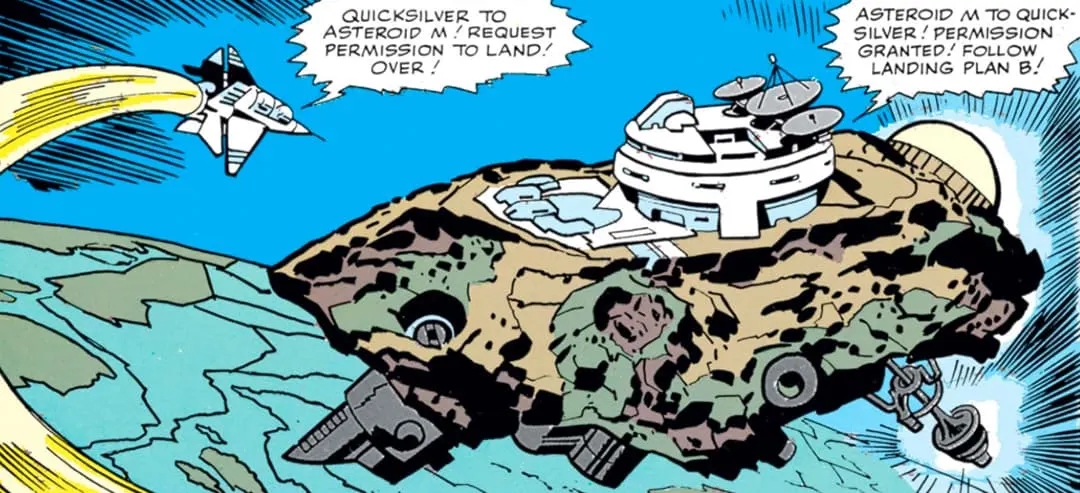
Early in his career, Magneto acquired Asteroid M and transformed it into his orbital headquarters. He also established the Brotherhood of Evil Mutants, which notably included Wanda Maximoff, Scarlet Witch, and Pietro Maximoff, Quicksilver. His association with the twins would eventually become one of the most complicated relationships of his life.
Magneto later travelled to the United States and seized the military missile base at Cape Citadel, Florida. Professor Xavier and his newly assembled X-Men intervened and managed to defuse the situation. Magneto then attempted to trap the X-Men by occupying the small South American nation of Santo Marco and arranging for a bomb to detonate when they arrived. The X-Men managed to foil his plan, helped by Quicksilver, who had become increasingly uncomfortable with Magneto’s obsessive war against humanity. Pietro helped the heroes defuse the bomb, and he and his twin sister Scarlet Witch soon left the Brotherhood to join the Avengers. Magneto’s takeover of Cape Citadel remains one of the defining early moments in his history and is central to his debut-era portrayal.
Magneto continued clashing with the X-Men, and many of those confrontations ended with explosions dramatic enough for the heroes to believe he was dead, only for him to return later with another group of mutants and another plan for world domination. Among his schemes was his discovery of the Savage Land and his manipulation of Namor McKenzie, the Sub-Mariner.
After repeated failures, Magneto established several new versions of the Brotherhood. His scientific ambitions eventually led him to use genetic engineering to create Alpha the Ultimate Mutant. Alpha, however, did not become the obedient creation Magneto expected. Instead, he reverted his creator into a powerless infant. Professor Xavier entrusted the infant Magneto to his colleague Dr. Moira MacTaggert, who performed experiments on the child in an attempt to alter his mind. Magneto was eventually restored to his adult form, and his war with the X-Men resumed.
A major turning point came after Magneto nearly killed the young mutant Kitty Pryde. For perhaps the first time, he was forced to seriously confront the consequences of his actions and began to recognize the error of his ways. Magneto eventually aligned himself with the X-Men. Around the same period, he believed he had discovered that Scarlet Witch and Quicksilver were his children and attempted to reach out to them, although the twins understandably remained wary of their former master. Magneto later helped fight the Beyonder and ultimately surrendered himself for his crimes against humanity. When an attack on his trial left Professor Xavier badly wounded, Magneto reluctantly assumed the role of headmaster in Xavier’s absence, joined the X-Men on missions and mentored the New Mutants.
That transformation did not last. Magneto’s old supremacist beliefs gradually returned after he and X-Men leader Storm attempted to form an alliance with the Hellfire Club. Magneto dethroned the Black King, Sebastian Shaw, and became the Grey King, a move that alienated him from the New Mutants. He then regained control over a grief-stricken Scarlet Witch after she had lost her husband and children. Quicksilver returned to his purported father, helping devise a plan to save Wanda and turn Magneto over to the Avengers. The plan worked, but once again, the heroes believed the Master of Magnetism had died in an explosion.
Magneto subsequently went on an adventure with Rogue and Kevin Plunder, better known as Ka-Zar, in the Savage Land. The journey ended with Magnus killing his alleged daughter Zaladane. He then withdrew into solitude on Asteroid M until the mutant group known as the Acolytes pleaded for his help in reclaiming the island nation of Genosha. The X-Men intervened and destroyed Asteroid M, but Magneto was not deterred. He converted the space station Graymalkin into a new base named Avalon and transformed it into a haven for mutants, recruiting as many mutants as he could to his cause. The government and the X-Men eventually attempted to intervene, and during the resulting conflict Magneto removed James Howlett, better known as Logan or Wolverine, from his Adamantium skeleton. Professor Xavier retaliated by wiping Magneto’s mind.
A mutant named Astra later restored Magneto’s mind while simultaneously creating a clone named Joseph with the intention of destroying the original. Joseph failed to kill Magneto and ultimately sacrificed himself to save the planet. Magneto then attempted to free mutants from humanity by threatening total world destruction unless the United Nations ceded Genosha to him. The United Nations reluctantly agreed, with the condition that Magneto not attack any other nations.
Magneto was later revealed to be one of the Twelve, a group of mutants prophesied to usher in a new era for their people. Apocalypse captured the group, hoping to exploit their abilities for his own purposes. Magneto, whose powers were beginning to weaken, tapped into another mutant’s powers to compensate and ultimately defeated the genetic tyrant. He returned to Genosha with Lorna Dane, Polaris, another of his offspring, and began teaching her how to expand her abilities while attempting to restore himself to full strength.
After the Legacy Virus was cured, Magneto used the mutants under his command to declare war on humanity. The X-Men opposed him and wounded him, leaving Genosha defenseless. Then came one of the darkest tragedies in mutant history. Cassandra Nova’s Sentinels attacked Genosha and executed its approximately 16 million mutant residents. Humanity and the X-Men once again believed Magneto was among the dead, but he had secretly survived and remained on the island, attempting to rebuild it. Eventually, none other than Professor Xavier joined him.
Magneto later found himself caring for Scarlet Witch after she descended into madness and attacked the Avengers. Quicksilver convinced Wanda to alter reality into a world where mutants were the dominant species and Magneto ruled over them. Unaware of the previous state of reality, Magneto eventually regained his memories and killed Quicksilver as punishment for his actions. Scarlet Witch then resurrected her brother and restored reality to its original state, but the process stripped many mutants, including Magneto, of their powers. Magneto subsequently teamed up with the High Evolutionary in an attempt to restore the lost mutant gene, although their efforts ultimately succeeded only in restoring Magneto’s own powers.
Magneto then joined Scott Summers, Cyclops, and the X-Men at their island home of Utopia. There, he worked alongside the team to protect the remaining mutants and participated in missions around the world. He helped Rogue battle the Children of the Vault and learned that two members of the Young Avengers might be reincarnations of Scarlet Witch’s lost sons, Billy Kaplan, Wiccan, and Tommy Shepherd, Speed. Despite being warned not to interfere, Magneto sought out his possible grandchildren and joined their mission to locate Scarlet Witch and restore her memories and sanity.
Magneto also began a relationship with Rogue, who had previously rejected his romantic advances. When the X-Men eventually divided over their conflicting feelings about the return of the Phoenix Force, Magneto remained with Cyclops on the West Coast. He slowly worked to rebuild the trust of his allies while Rogue returned to the newly opened Jean Grey School for Higher Education in New York.
After the Phoenix Force was eventually dissipated by Hope Summers and Scarlet Witch, the mutant gene was reestablished. Magneto joined S.H.I.E.L.D., supposedly operating as a double agent to protect his faction of rogue X-Men. He recruited new mutants for the New Charles Xavier School and helped the world’s heroes defeat Johann Schmidt, better known as the Red Skull, after Schmidt took over Charles Xavier’s brain. Magneto also fought to stop the reality-ending Incursion of the Beyonders. During this period, Scarlet Witch revealed that the supposed biological parentage connecting her and Quicksilver to Magneto was false.
Magneto once again found himself leading a group of X-Men as they searched for a cure to the mutant-poisoning Terrigen Mist. During the second superhuman Civil War, he fought against the Inhuman Ulysses and the idea of predictive justice, mentored the teenage X-Men displaced from their own time and battled an altered Captain America during the Secret Empire. After everything he had done, there was once again a possibility that Magneto might finally be capable of genuine reform.
That possibility was tested when Magneto encountered a cabal of mutants consisting of Frost, Alex Summers, Havok, Bastion and Claudine Renko, better known as Miss Sinister. Their plan was to make mutants the dominant species using a virus called Mothervine. Magneto assembled a team of X-Men to oppose them, but when the virus was released, he was forced to defend himself and kill mutants under Renko’s control. Regretful that he had been forced to kill members of his own species, Magneto withdrew to Asteroid M and created another version of the Brotherhood.
When Nate Grey, X-Man, created a pocket dimension in which everyone was a mutant living in apparent peace, Magneto was pulled into the new reality alongside most of the other mutants, but with altered memories. In the Age of X-Man, Magneto became part of the X-Men and responded to threats against their world. Yet this seemingly perfect mutant society came with an unsettling price: intimate relationships were outlawed and policed by Department X, while revolutionaries such as Apocalypse supported the concept of love.
Magneto eventually shared a vision of their past lives with Storm, and the two spoke privately about what they had experienced. Storm suspected that Apocalypse was behind the strange reality. Soon, Magneto and the X-Men were called away by X-Man to investigate rips in the fabric of their world, where the memories of their previous lives were beginning to bleed through. They also had to solve the murder of a Department X clerk. Once the murder was solved, the truth emerged: X-Man himself had created the reality warp. Magneto and the X-Men confronted him, and X-Man eventually admitted what he had done and restored reality to its true form.
Krakoa and a New Beginning
Perhaps the most significant transformation in Magneto’s entire history arrived when he joined forces with Charles Xavier and Moira MacTaggert to establish a sovereign mutant nation on the living island of Krakoa. Rather than simply fighting humanity from the shadows, Magneto and Xavier attempted to create an entirely new society where mutants could live together, govern themselves and determine their own future.
Krakoa introduced one of the most revolutionary ideas in X-Men history: mutant resurrection. Through the combined abilities of the Five and Cerebro’s stored backups of mutant consciousness, fallen mutants could be restored to life. Death, something that had haunted generations of X-Men, suddenly became something that could potentially be overcome. Marvel describes the Five as the mutants responsible for a resurrection process that takes roughly 48 hours, making the technology central to the Krakoan experiment.
Magneto and Xavier soon discovered the existence of Orchis, an anti-mutant organization whose space station, Orchis Forge, was being used to develop a new Sentinel known as Mother Mold. They feared that its creation would eventually lead to Nimrod, one of the most dangerous artificial intelligence threats ever faced by mutantkind. An X-Men team was sent to destroy the Forge and succeeded, but the mission cost the team their lives. Fortunately, Krakoa’s Resurrection Protocols allowed them to return, while the existence of the technology remained a secret from the wider world.
Magneto and Xavier established the Quiet Council of Krakoa, the governing body responsible for making decisions affecting mutant society. The council included powerful and controversial figures such as Sinister, Apocalypse, Storm, Jean Grey, Emma Frost and Raven Darkhölme, better known as Mystique. Together, they were responsible for decisions ranging from mutant diplomacy to the punishment of dangerous criminals such as Victor Creed, Sabretooth.
When Krakoa’s twin island Arakko returned to Earth after being stranded elsewhere for thousands of years, Magneto played a major role in negotiating with Isca the Unbeaten, who represented millions of battle-hardened Arakki mutants. Concerned about their warrior culture and the sheer number of mutants suddenly returning to Earth, Magneto proposed an extraordinary solution: terraform Mars and make it a new home for the Arakki.
The idea became reality. Magneto and several other Omega-level mutants worked together to transform Mars into a habitable world, which was renamed Arakko. The achievement was unveiled at the Hellfire Gala and became one of the defining accomplishments of the Krakoan era. Marvel confirms that Magneto proposed the terraforming of Mars after the return of Arakko and its battle-hardened mutant population.
At the Hellfire Gala, Magneto met Wanda privately. Despite no longer being her biological father, he told her that she would always be his daughter and embraced her lovingly. Wanda then explained that she wanted to restore mutants whose minds had never been preserved by Cerebro, but the spell required her death. She asked Magneto to kill her so that she could later be brought back through the resurrection process. Magneto agreed, but his role in her death immediately made him the prime suspect in her murder and triggered conflict with the Avengers.
Wanda was eventually resurrected and successfully cast her spell, placing 20 million mutants in line for resurrection. The event was another reminder that Magneto’s relationship with Wanda had evolved far beyond the question of biological parentage.
Magneto and Xavier also continued dealing with the complicated secrets surrounding Moira MacTaggert. They knew that Moira had lived multiple lives and possessed the ability to reset time through reincarnation. They became increasingly concerned about resurrecting precognitive mutants such as Irene Adler, better known as Destiny, because Destiny could potentially discover the secrets that threatened the entire Krakoan experiment.
When Mystique demanded that her wife Destiny be resurrected, Magneto and Xavier refused. Mystique eventually took matters into her own hands, resurrecting Destiny without their permission and securing the Quiet Council’s support for her. Soon afterward, Magneto and Xavier received a distress signal from Moira. When they reached her location, Nimrod and Omega Sentinel were waiting for them. Despite their earlier efforts, Nimrod had been created, and a battle followed that left both Magneto and Xavier dead.
They were eventually restored through Krakoa’s Resurrection Protocols, where Emma Frost revealed that Moira had been depowered by Mystique and Destiny as part of their secret plotting. Magneto resigned from the Quiet Council and joined the mutants of Arakko. Storm later asked him to join her Brotherhood of Arakko, and he defeated Tarn the Uncaring before taking the Seat of Loss as an advisor to Arakko.
However, the Arakki viewed resurrection very differently from the Krakoans. Their warrior culture regarded death and mortality as fundamental parts of their identity, meaning Magneto and Storm’s apparent immortality conflicted with Arakki beliefs. To gain their respect, Magneto deleted his backup consciousness from Cerebro, ensuring that he could not simply be resurrected if he died.
That decision would prove crucial. Magneto’s resurrection ability had attracted the attention of the Eternals, beings created by the Celestials and tasked with protecting Earth from deviation. The Eternals viewed mutant resurrection as a threat and launched an attack against mutantkind. Prime Eternal Druig sent Uranos to deal with Arakko.
Magneto and Storm confronted Uranos and defeated him, but the victory came at an enormous price. Magneto was killed in the battle. Because he had already deleted his Cerebro backup, his death was far more consequential than the many times he had previously fallen and returned. His decision to sacrifice the possibility of easy resurrection transformed his final battle into one of the most meaningful sacrifices of his life.
Magneto’s Resurrection and the Road Ahead

But in the Marvel Universe, death is rarely the end of the story.
Magneto’s death became the foundation for Resurrection of Magneto, a four-issue series written by Al Ewing and illustrated by Luciano Vecchio. With Krakoa collapsing and its once-routine resurrection system no longer functioning as it once did, Storm embarked on a mission to bring Magneto back. The story explored Magneto’s existence after death and forced him to confront the life he had lived, the people he had lost, the people he had hurt and the price he had paid for his beliefs. Marvel’s official description frames the story around a simple but powerful question: after everything Magneto had endured and everything he had done, could he truly bear to return to life?
The resurrection arrived during the climactic final chapter of the Krakoan era. Fall of the House of X and Rise of the Powers of X brought the mutant nation’s extraordinary experiment toward its conclusion as Orchis pushed mutantkind toward extinction. Magneto’s return became an important part of the fight for mutantkind’s future. Marvel presented Resurrection of Magneto as a story directly tied to the conclusion of the Krakoan age.
The end of Krakoa did not mean the end of Magneto’s importance to the X-Men. He continued to occupy a major place in Marvel’s mutant stories, appearing alongside the X-Men in the modern era. Marvel’s current comics listings continue to feature Magneto in titles including X-Men (2024) and X-Men United (2026), demonstrating that the Master of Magnetism remains an active part of the modern X-Men mythos.
Magneto’s relevance has also extended beyond the main comic continuity. The character continues to appear in other versions of Marvel’s X-Men mythology, including X-Men ’97, where his history, ideology and relationship with Professor X remain central to the story. Marvel’s coverage of the series has continued to spotlight Magneto’s importance to the franchise, including his confrontation with Apocalypse and the future of mutantkind.
And perhaps that is the most remarkable thing about Magneto. After more than six decades, he still refuses to fit neatly into a single box. He is not simply a villain who can control metal, nor is he merely an antihero who occasionally decides to do the right thing. Magneto is a survivor whose entire worldview was forged by persecution. He is a revolutionary whose fight for freedom repeatedly threatens to become another form of tyranny. He is a father who has lost children, a mentor who has guided younger mutants, a leader who has built nations and a man who has repeatedly sacrificed himself for a cause greater than his own survival.
His story has taken him from Auschwitz to Genosha, from Asteroid M to Avalon, from Utopia to Krakoa and Arakko. He has lost his family, his powers, his friends, his nations and his own life. He has been hunted by governments, opposed by superheroes, betrayed by allies and feared by the people he wanted to protect. Yet each time he falls, Magneto finds a way to rise again.
That is why the Master of Magnetism remains one of Marvel’s most fascinating and enduring characters. His greatest power has never really been his ability to bend steel, generate electromagnetic fields or tear apart machines with a gesture. His greatest power is his conviction. Magneto believes that mutantkind deserves a future, and even when his methods become horrifying, that conviction never disappears.
His relationship with Professor X captures the heart of the character. Charles believes the future can be built through coexistence. Erik believes survival demands strength. Neither man has ever been completely right or completely wrong, and that tension is precisely what has made their friendship, rivalry and eventual partnership so compelling. Marvel has repeatedly returned to their relationship because the ideological argument between Xavier and Magneto is, at its core, the argument that defines the X-Men themselves.
Magneto’s journey also proves that redemption is rarely a straight line. He has tried to change and failed. He has embraced extremism and later regretted it. He has fought beside the X-Men, fought against them and eventually helped build a mutant nation alongside the man who spent years trying to stop him. Even after his death and resurrection, his history continues to follow him.
Perhaps that is why Magneto has remained so relevant for so long. He forces readers to ask uncomfortable questions about power, fear, prejudice, survival and revenge. If someone has experienced humanity at its absolute worst, how much can you realistically ask that person to trust humanity again? And when someone fights oppression with overwhelming force, at what point does the fight for freedom become oppression itself?
Magneto does not provide easy answers. That is precisely the point.
He can be a terrorist and a freedom fighter, a villain and a hero, a king and a prisoner, a father and a revolutionary. He can threaten the world one day and save it the next. He can stand opposite the X-Men and then risk everything to protect them. He can lose his powers, lose his nation, lose his life and still return to the fight.
For Magneto, survival has never simply meant staying alive. It means ensuring that mutantkind survives with its dignity intact.
And as Marvel continues to expand the X-Men universe, one thing remains certain: the Master of Magnetism is never truly out of the fight. Magneto may fall, but Max Eisenhardt always finds a way back. Because after everything he has endured, everything he has lost and everything he has done, there is still one battle he refuses to abandon — the fight to ensure that the next generation of mutants has the freedom to live without fear.
That is Magneto’s greatest legacy. Not the metal he can move. Not the armies he has commanded. Not even the worlds he has threatened or saved.
It is the fact that, after all these years, he is still fighting for a future he believes mutantkind deserves.
If Magneto's story has reminded you why Marvel characters are so much more than their powers, it's time to bring some of that fandom into your own collection.
Calling all Marvel, Disney, Pixar, DC, Anime, Transformers and Mortal Kombat fans! Discover collectibles inspired by some of the biggest characters, worlds and franchises in pop culture, with up to 40% OFF. Whether you're a lifelong X-Men fan, a Marvel collector, an anime enthusiast or someone who simply loves iconic characters, there's plenty to explore and add to your collection.
Your favourite universe deserves a place beyond the screen. Start exploring, find your next favourite collectible and bring a piece of pop culture home.