


Johnny Cage Explained: Powers, Story & Mortal Kombat Legacy
Jonathan Carlton, better known to the world by his stage name Johnny Cage, stands as one of the most recognizable faces in the Mortal Kombat franchise. Introduced as a Hollywood actor with a flair for martial arts, Cage quickly evolved into far more than just comic relief or a celebrity caricature—he became a core pillar of the series, sharing narrative importance alongside figures like Raiden and Liu Kang.
From the very beginning, Johnny Cage was designed as a fusion of pop culture charisma and combat prowess. His character was originally inspired by martial arts film icons—most notably Jean-Claude Van Damme—blending cinematic showmanship with genuine fighting skill. That combination gave him a unique identity within the roster: a fighter who not only performs for the audience, but thrives on it.
From Hollywood Star to Mortal Kombat Icon
Johnny Cage made his debut as one of the seven original playable characters in the very first Mortal Kombat arcade game in 1992. At the time, his presence felt almost satirical—a flashy movie star entering a deadly tournament to prove his legitimacy. But that initial concept quickly grew into something deeper.
Over the years, Cage transitioned from a self-absorbed celebrity into a character with real stakes in the story. While he never lost his signature humor or arrogance, later entries began to explore his growth—showing him take responsibility, build relationships, and ultimately become a dependable ally in Earthrealm’s defense.
His continued presence across nearly every major title in the franchise speaks to his popularity. He isn’t just a legacy character—he’s a constant.
Role Across the Timeline

In Mortal Kombat (2011)—the franchise reboot that restructured the original timeline—Johnny Cage takes on a more grounded role within the narrative. While still delivering his trademark wit, he becomes an active participant in the story rather than just a spectator. This version of Cage shows early signs of the character development that would define him in later games.
That progression continues in subsequent titles, where Cage evolves into a more mature and self-aware individual. His relationships—particularly with Sonya Blade and their daughter Cassie Cage—add emotional weight to his arc, showing a side of him that contrasts sharply with his earlier ego-driven persona.
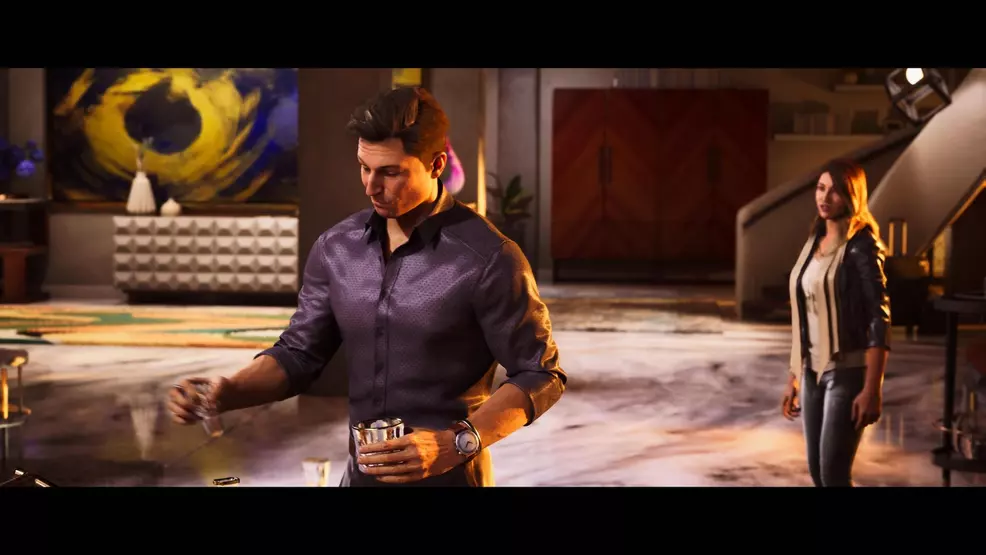
With Mortal Kombat 1, the series introduces yet another iteration of Johnny Cage, shaped by a newly reset timeline. This version retains his identity as a celebrity, but presents him in a slightly different light—still confident and theatrical, but placed within a reimagined world where his journey begins anew. Despite the reset, he once again serves as a supporting character in Story Mode, reinforcing his importance within the narrative structure.
Additionally, alternate timeline variants of Johnny Cage appear in expanded story content such as the Khaos Reigns expansion, where different versions of the character contribute to the broader multiverse narrative. These appearances highlight how adaptable the character is—no matter the timeline, Johnny Cage finds a way to remain relevant.
A Character Defined by Duality
What makes Johnny Cage endure isn’t just his history—it’s the balance he represents. On one side, he’s the overconfident actor, constantly cracking jokes and seeking the spotlight. On the other, he’s a capable martial artist who repeatedly proves himself in life-or-death situations.
That duality is what elevates him. He starts as someone trying to prove he’s more than just a performer, and over time, he becomes exactly that—a fighter who earns his place not through reputation, but through action.
Appearance
The Classic Hollywood Fighter Look
Johnny Cage has always been designed to embody the larger-than-life image of an American action movie star. His appearance leans heavily into that identity—defined by a muscular, athletic build, minimal upper-body clothing, and his ever-present trademark sunglasses. From the moment he first appeared, Cage was meant to look like someone who belonged both on a movie set and in a fight arena.
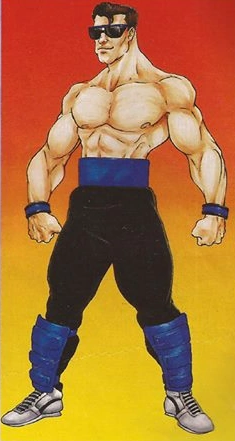
In his debut appearance in Mortal Kombat (1992), his outfit was directly inspired by Jean-Claude Van Damme’s look in Bloodsport. He wore black shorts tied with a red sash and simple black shoes, creating a clean, grounded aesthetic that emphasized agility and realism. It was a look that immediately set him apart—less armored than other fighters, but no less confident.
Evolution Through the Arcade Era
As the series progressed through Mortal Kombat II to Mortal Kombat 4, Cage’s design shifted into something more stylized while still maintaining his identity. His outfit transitioned to black pants accented with blue highlights, paired with blue forearm guards, shin guards, and a matching belt.
He continued to wear his signature sunglasses, reinforcing his persona as a celebrity who never drops the act. His pants featured white horizontal stripes along the thighs, and he completed the look with black Adidas shoes marked by their iconic white stripes. This era defined what many fans still recognize as his “classic” appearance—a balance between athlete and showman.
Reinvention in the 3D Era

With Deadly Alliance and Armageddon, Johnny Cage’s design took on a hybrid identity, blending elements from his earliest look with the more refined aesthetic fans had grown used to. He returned to wearing black shorts, this time enhanced with a Cage emblem and a blue belt tied at the waist. He fought barefoot, with bandage wraps adding a raw, grounded edge to his design.

One of the more noticeable changes during this period was his appearance—his naturally brown hair was now dyed blond, and he sported a prominent Chinese dragon tattoo across his back. It was a visual shift that gave him a slightly more rebellious, modern feel.
For contrast, his alternate costume leaned fully into his celebrity persona: a tuxedo. It was a reminder that no matter how serious things got, Johnny Cage was still, at his core, a performer.
The Reboot Era — A More Personal Identity
In Mortal Kombat (2011), Cage’s look returned to something closer to his earlier designs, but with added detail and personality. He retained the black pants with blue accents and continued wearing his sunglasses at all times, but new elements made him feel more grounded.
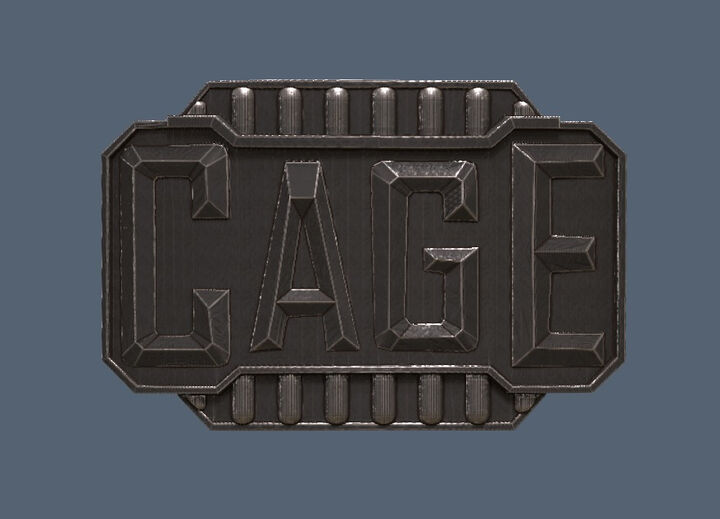
His chest now featured a tattoo of his first name, “Johnny,” a bold statement of ego and identity. Additional straps on his arms and hands gave him a more combat-ready appearance, and his belt buckle prominently displayed his last name, “Cage.” These small details helped bridge the gap between his celebrity image and his role as an actual fighter.
MKX — The Passage of Time


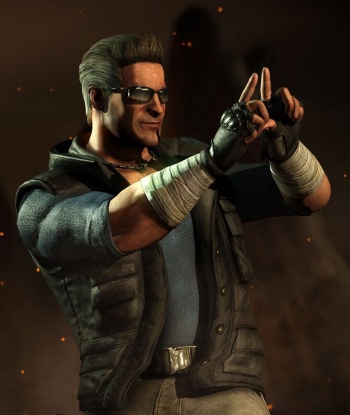
By the time of Mortal Kombat X, Johnny Cage’s appearance began reflecting his evolution as a character. In flashbacks set 20 years before the main story, he’s seen wearing a military-style vest and pants, aligning him more closely with the Special Forces.
In the present timeline, his default look shifts again. He wears a short-sleeved hoodie layered over a grayish-blue shirt that partially conceals his chest tattoo. Bandages wrap around his wrists, and he sports black fingerless gloves, giving him a more practical, grounded aesthetic. His hair also begins to show signs of aging, with visible graying—subtle, but significant in showing his growth over time.
MK11 — Veteran Presence
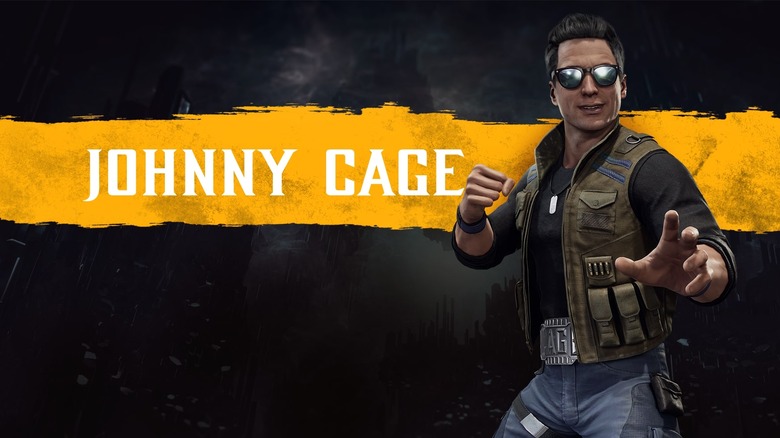
In Mortal Kombat 11, the present-day Johnny Cage carries forward his military-influenced design but with a more refined and seasoned look. He wears an olive green vest over a dark gray long-sleeved shirt, fully covering his chest tattoo. His outfit is completed with knee pads, military boots, and dog tags around his neck, along with a holstered pistol—elements that emphasize his experience and readiness.
At the same time, a younger version of Johnny appears, dressed similarly to his MK (2011) counterpart but enhanced with a blue and purple jacket and purple-framed sunglasses. This dual portrayal highlights the contrast between who he was and who he’s become.
A notable detail from this era is the scar on his left cheek. During the Black Dragon’s infiltration of the Special Forces base, the younger Johnny is grazed by a bullet, leaving a mark that carries over to his older self. However, this scar is later healed in the Aftermath expansion, subtly altering his appearance once again.
MK1 — A Modern Reinvention

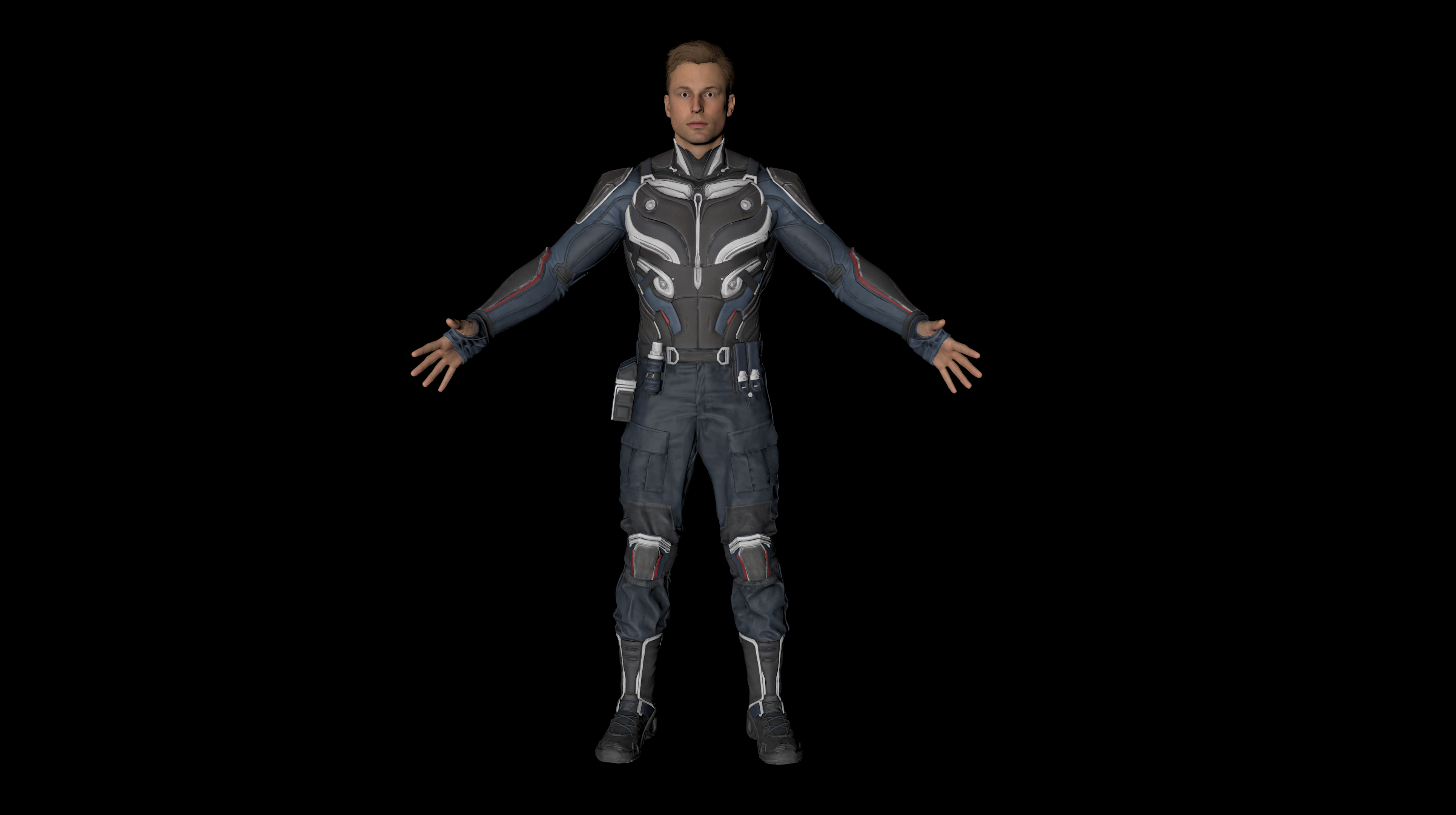

In Mortal Kombat 1, Johnny Cage is reintroduced with a fresh yet familiar style. His primary look leans heavily into his celebrity status—formal attire consisting of a purple shirt with subtle black dot patterns, paired with black slacks and brown shoes. His hair is styled with a left-side part, reminiscent of his earlier appearances from the 1990s era.
As the story progresses, he adopts a more functional outfit—a tactical suit with blue accents—when investigating Outworld. This shift reflects the dual nature of his character once again: performer on the surface, fighter underneath.
In an alternate timeline tied to Havik’s merged reality, a variant known as Jonathan Cage appears. This version wears a World War II-inspired green military uniform, complete with a helmet, aviator sunglasses, and an American shoulder insignia. It’s a striking reinterpretation that places his identity in a completely different historical context while still retaining the core elements that define him.
The Real-World Inspiration Behind Johnny Cage
Johnny Cage didn’t emerge out of nowhere—his creation is deeply rooted in real-world action cinema, particularly the influence of Belgian martial artist and actor Jean-Claude Van Damme. In fact, during the early development of the original Mortal Kombat, the creators initially intended for Van Damme himself to be part of the game. Due to his commitments in film at the time, that collaboration never materialised—but the DNA of his presence remained embedded in the character.
Cage’s original design in Mortal Kombat (1992) reflects this influence almost directly. His outfit—black shorts paired with a red sash—is nearly identical to what Van Damme wore during the final fight in Bloodsport (1988). Even some of Johnny Cage’s signature moves draw inspiration from that film, including his split punch, the infamous Nutcracker, and even elements that later influenced his brutal finishing animations.
Decades later, that connection came full circle. Mortal Kombat 1 introduced an official Jean-Claude Van Damme skin for Johnny Cage as part of its Kombat Pack DLC, effectively turning the long-standing inspiration into a direct in-game tribute.
Cinematic Parallels and Fictional Influences
Johnny Cage’s fictional career as an action star also pulls from Van Damme’s filmography. His in-universe movie Ninja Mime is widely believed to be inspired by scenes from The Quest, another Van Damme film, where the protagonist disguises himself as a mime while using martial arts to evade capture. That blend of performance and combat—fighting while playing a role—is central to Cage’s identity.
Beyond Van Damme, there are other layers to his creation. According to Daniel Pesina, the original actor who portrayed Johnny Cage through motion capture, the character was also influenced by Daniel Rand, better known as Iron Fist from Marvel Comics. That connection adds another dimension to Cage—not just a showman, but someone with legitimate martial arts credibility rooted in discipline and mysticism.
Interestingly, Cage’s surname also echoes that of Luke Cage, another Marvel character from Power Man and Iron Fist. While not officially connected, the shared naming adds to the character’s broader pop culture resonance. In later years, fans have also drawn parallels between Johnny Cage and actor Nicolas Cage—primarily due to the shared surname and larger-than-life persona, even though the connection is more coincidental than intentional.
Creation Within Mortal Kombat

What makes Johnny Cage’s origin even more interesting is his place in the development of Mortal Kombat itself. He was actually the very first character created for the original game. Early test versions of the game featured nothing but two Johnny Cages fighting each other—a simple prototype used to refine the mechanics before the rest of the roster was introduced.
Despite being the first character designed, there’s an ironic twist to his development. He was the last character to receive a Fatality in the original game. Initially, his finishing move was far less dramatic—he was simply meant to throw his opponent across the screen.
That changed late in development, when co-creator John Tobias came up with what would eventually become one of the most iconic finishers in the series: the Head Pop Fatality. It gave Cage a defining moment of brutality that matched the tone Mortal Kombat was becoming known for.
However, the story behind this move isn’t entirely uncontested. In 2018, Daniel Pesina offered a different perspective, claiming that the finisher was actually the first one he created himself. Like many aspects of early game development, the exact origin remains a subject of differing accounts—but either way, it became a defining part of Johnny Cage’s identity.
Skill, Precision, and Pure Showmanship
At first glance, Johnny Cage might come across as all flash—style over substance, a fighter more interested in the spotlight than the fight itself. But once the action begins, that perception doesn’t last long. Beneath the celebrity persona is a highly trained, disciplined combatant with a deep understanding of martial arts and battlefield tactics.
Cage’s fighting style is built on speed, agility, and precision. Years of training under multiple martial arts masters have shaped him into a versatile fighter, with a strong foundation in disciplines such as Karate. His movements are sharp and controlled, his strikes deliberate, and his overall approach reflects someone who knows exactly what they’re doing—even if he pretends otherwise.
Beyond hand-to-hand combat, Cage is also proficient with military-grade equipment. Over time, his involvement with Earthrealm’s defense has seen him trained in the use of firearms, including pistols and battle rifles, and even heavy machinery like armored tanks. It’s an unusual blend—Hollywood actor meets battlefield operative—but it works because he commits fully to both worlds.
The Hidden Power Within


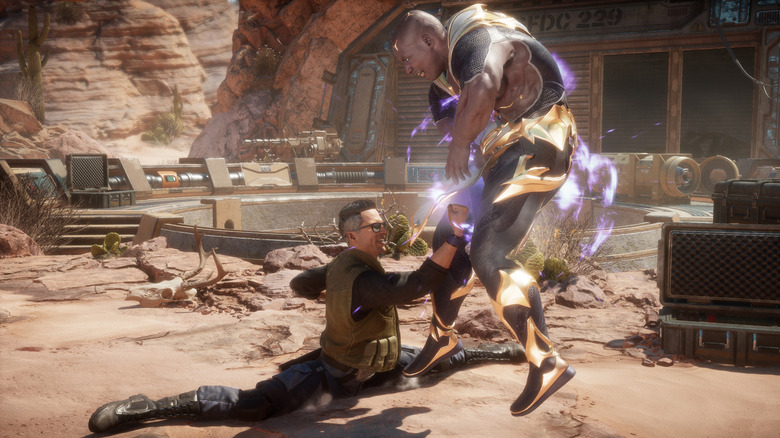
Despite being human, Johnny Cage possesses abilities that go far beyond normal physical limits. As revealed in Mortal Kombat (2011) and expanded in Mortal Kombat X, his powers are tied to an ancient lineage. He is a descendant of a Mediterranean war cult—an order that bred warriors specifically to serve and protect the gods. These warriors were gifted with unique enhancements, and Cage carries that legacy within him.
One of his most recognizable abilities is his “shadow” power. When activated, it allows him to propel himself forward with incredible force, amplifying the strength of his attacks. Visually, this manifests as green afterimages trailing behind his movements—an effect that has become synonymous with his fighting style.
Under certain conditions, Cage can push this ability even further. Enhanced versions of his shadow attacks produce red afterimages, representing a heightened state of power and aggression. Alongside these physical enhancements, he’s also capable of projecting energy outward in the form of blasts, giving him both close-range and ranged combat options.
Power Driven by Purpose
One of the most defining moments of Johnny Cage’s abilities comes during the events of Mortal Kombat X. In a critical confrontation with the Elder God Shinnok, Cage taps into a deeper level of his power—one that goes beyond technique or training.
He surrounds his body with a concentrated energy field, strong enough to withstand what would otherwise be a fatal blow from Shinnok. What makes this moment significant isn’t just the power itself, but the reason behind it. Raiden theorizes that this ability is not something Cage can access at will—it manifests when he is driven by the need to protect someone he cares about from immediate danger.
It’s a rare glimpse into the emotional core of his strength. For all his bravado, Johnny Cage’s greatest power isn’t ego—it’s instinctively stepping up when it matters most.
Unorthodox Tactics and Signature Style

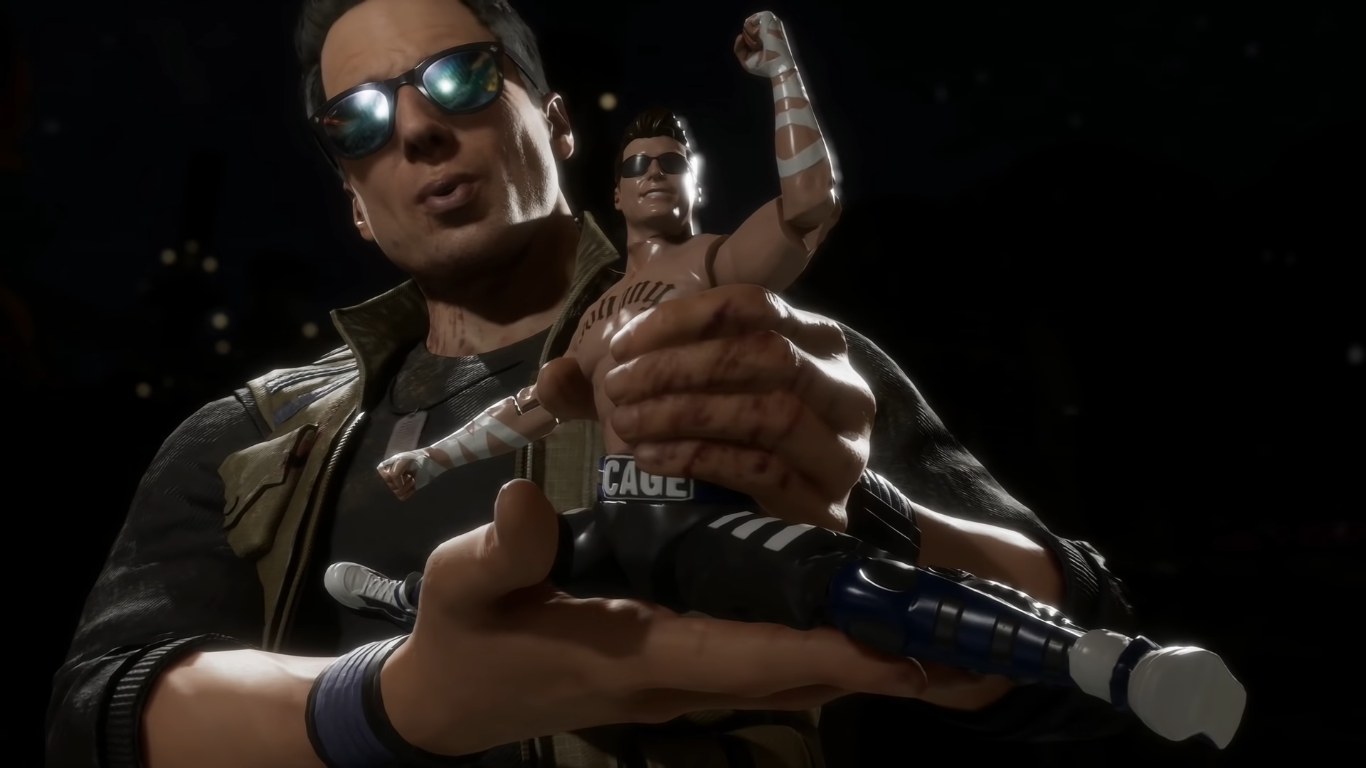
Johnny Cage doesn’t fight like anyone else—and that’s entirely intentional. Alongside fighters like Erron Black, he’s known for incorporating unconventional tactics into combat, often blurring the line between performance and practicality.
He makes use of unusual tools, including a handheld camera that emits blinding flashes to disorient opponents, and even explosive sunglasses—gadgets that feel more like movie props than weapons, yet prove surprisingly effective in battle.
His style also leans heavily into his identity as an actor. He incorporates cinematic flair into his moves, summoning “Stunt Doubles” to assist him during fights. In earlier games, these were energy-based projections, but later entries portray them as actual doubles—adding a layer of humor while still maintaining their effectiveness in combat.
And then there’s his most infamous move—the Nut Punch. Simple, direct, and undeniably effective, it’s a technique that has become synonymous with Johnny Cage. While many characters openly criticize it for being cheap or dishonorable, Cage embraces it without hesitation. For him, if it works, it works.
A New Era — Mortal Kombat 1
In Mortal Kombat 1, Johnny Cage undergoes a significant shift in how his abilities function. The mystical powers tied to his Mediterranean lineage are no longer part of his arsenal in this timeline. Instead, his combat effectiveness is driven by a “Hype Meter”—a mechanic that reflects his performance-based nature.
As he builds momentum during a fight, his special moves become more powerful, reinforcing the idea that Johnny Cage thrives on attention, confidence, and energy. It’s a fitting evolution—his strength is no longer rooted in ancient heritage, but in his ability to command the moment.
Appearances in Other Media
Appearances in Other Media

Mortal Kombat (1995 Film)
Johnny Cage made his live-action debut in the original Mortal Kombat film, portrayed by Linden Ashby. In this version, he is introduced as a successful Hollywood action star who finds himself constantly criticized by the media, with many dismissing his martial arts skills as nothing more than cinematic illusion.
Driven by the need to prove his legitimacy, Cage accepts an invitation to participate in the Mortal Kombat tournament. The invitation comes through his sensei, Master Boyd—who is later revealed to be none other than Shang Tsung in disguise, manipulating events to bring him into the tournament.
Chosen by Raiden alongside Liu Kang and Sonya Blade, Johnny represents Earthrealm. Throughout the tournament, he not only proves his worth as a fighter but also avenges the death of fellow combatant Art Lean—one of the few individuals who truly believed in his abilities. He later accompanies Liu Kang and Kitana into Outworld, witnessing the climactic confrontation between Liu Kang and Shang Tsung. As a playful nod to his personality, Johnny even leaves behind an autographed photo of himself after defeating Scorpion—an homage to his iconic “Friendship” move from Mortal Kombat II.
The film also subtly draws from the Malibu comic series by hinting at a developing romantic dynamic between Johnny and Sonya Blade.
Mortal Kombat: Annihilation
In Mortal Kombat: Annihilation, Johnny Cage appears briefly in the opening sequence, portrayed by Chris Conrad. His role is short but impactful. When Shao Kahn captures Sonya Blade, Johnny intervenes and successfully saves her—only to be immediately confronted by Kahn himself.
In a sudden and brutal moment, Shao Kahn kills Johnny by snapping his neck, sacrificing him in Sonya’s place. His death leaves a lasting emotional impact on her, shaping her motivations moving forward.
Mortal Kombat: Rebirth
In the short film Mortal Kombat: Rebirth, Johnny Cage is played by Matt Mullins and is depicted in a darker, more grounded interpretation. Here, he is a fading movie star whose career has begun to decline significantly.
Attempting to reinvent himself, Johnny transitions into a covert role as a secret agent working with the Deacon City Police Department. His mission is to gather intelligence on Baraka. However, the assignment ends in tragedy—after a brutal confrontation, Johnny is defeated and decapitated by Baraka, marking one of the character’s most violent alternate portrayals.
Mortal Kombat: Legacy
Matt Mullins reprises his role as Johnny Cage in the web series Mortal Kombat: Legacy, where the character receives one of his most layered and grounded explorations.
Johnny is presented as a struggling actor whose career has spiraled downward after early success, including a stint in Power Rangers. His desperation to reclaim relevance leads him to pitch a television series concept centered around hunting DVD pirates. Despite delivering exactly what executives asked for, his pitch is rejected, and he is informed that his career is effectively over.
Frustrated and humiliated, Johnny lashes out violently when he discovers his idea being repurposed for another actress. After attacking a network executive and security personnel, he faces the consequences of his actions—until time itself freezes.
At that moment, Shang Tsung appears and offers him a way out. Johnny initially refuses. Later, after another arrest, he encounters Raiden in a similar time-stopping moment. Skeptical but with nothing left to lose, Johnny agrees to hear him out and ultimately joins the fight for Earthrealm.
Upon arriving at the tournament island, Johnny struggles to comprehend the reality of the situation. He witnesses supernatural abilities firsthand, including Sub-Zero’s ice powers, and gradually realizes that the stakes are far beyond anything he has experienced.
During the tournament, Johnny encounters Mileena and Kitana. What begins as curiosity quickly turns into a life-threatening encounter. After a chaotic chase and fight, he is injured but survives thanks to Kitana’s intervention. He later crosses paths with Liu Kang, engaging him in combat and earning respect for his skill—despite ultimately being defeated.
The season concludes with Johnny unconscious, caught in the larger conflict unfolding between Earthrealm’s defenders.
Mortal Kombat Legends (Animated Films)
Johnny Cage plays a major role in the animated Mortal Kombat Legends series, voiced by Joel McHale.
In Scorpion’s Revenge, he begins as a washed-up action star dealing with personal and professional setbacks. Believing the tournament to be part of a film production, Johnny initially fails to grasp the seriousness of the situation. However, after witnessing real violence—including Goro maiming Jax—he quickly adapts and proves himself as a capable fighter. Over time, he earns the respect of his allies and contributes to Earthrealm’s victory.
In Battle of the Realms, Johnny continues to fight alongside Earthrealm’s champions against Shao Kahn’s invasion. During this period, he gains access to his signature green energy powers. He also develops a romantic relationship with Sonya Blade, and the two ultimately become a couple after the realms are saved.
Cage Match explores Johnny’s past in greater depth. Set in the 1980s, it follows him as a struggling actor in Los Angeles trying to break through with a film titled Ninja Mime. When his co-star Jennifer Grey disappears, Johnny becomes entangled in a supernatural conspiracy involving demons, ancient artifacts, and the Brotherhood of Shadows.
Through a series of encounters—including battles with demons like Jataaka and revelations about Sareena—Johnny discovers that he carries divine blood, making him key to a ritual intended to bring Shinnok into Earthrealm. During the climax, he unlocks his green energy powers and defeats Shinnok, preventing the invasion.
The story also provides insight into his past, including childhood bullying and his journey through martial arts training across the world before entering acting. By the end, Johnny emerges as a successful action star—though his career once again begins to decline, setting up his eventual return to the Mortal Kombat tournament.
Mortal Kombat: The Journey Begins
In the animated prequel Mortal Kombat: The Journey Begins, Johnny Cage appears as one of the central characters alongside Liu Kang and Sonya Blade. Guided by Raiden, the trio learns about the history and stakes of Mortal Kombat.
Throughout their journey, they face multiple threats aligned with Shang Tsung, including Scorpion, Sub-Zero, Goro, and a Tarkatan army. The film serves as an early narrative foundation for Johnny’s role as one of Earthrealm’s defenders.
Mortal Kombat (2021 Film)
Although Johnny Cage does not physically appear in the 2021 Mortal Kombat film, his presence is strongly hinted at. A poster for one of his fictional movies, Citizen Cage, is shown in a gym scene.
By the end of the film, Cole Young sets out for Hollywood specifically to recruit Johnny for the next tournament—clearly setting him up as a major character in future installments.
Johnny Cage has always been more than just a flashy Hollywood star thrown into a world of gods and monsters. Across timelines, reboots, films, and animated adaptations, his journey reflects something deeper—growth earned through failure, confidence tested by reality, and strength revealed when it matters most.
From proving his worth in the Mortal Kombat tournament to standing shoulder-to-shoulder with Earthrealm’s greatest defenders, Johnny’s evolution is one of the most compelling arcs in the franchise. He may enter the arena with swagger, but he stays in the fight because he refuses to back down when the stakes are real.
And if you’re a fan of legends like Johnny Cage and the wider world of pop culture—this is just the beginning.
Explore a massive collection of collectibles featuring Mortal Kombat, He-Man and Masters of the Universe, Anime icons, Marvel, DC, Transformers, LEGO, and more—all crafted for true fans who live and breathe these worlds.