


How Spider-Man Became Man-Spider: A Dark Marvel Tale
Imagine Peter Parker — the brilliant young man bitten by a radioactive spider, the orphan raised by Aunt May and Uncle Ben, and the wall-crawler whose powers and sense of responsibility inspired millions of comic readers. What if that same spider bite didn’t stop at giving him strength, agility, and web-slinging? What if the very essence of who he was began slipping away, replaced by something primal, instinctive… something spider-like in body and mind?
That’s the tragedy — and terror — of Man-Spider. Rather than becoming a typical villain, Man-Spider represents a nightmarish reflection of Spider-Man’s own genetic potential — the dark evolutionary path his powers could take if left unchecked.
From Peter Parker to Monster: The Story Behind the Mutation

In one of Spider-Man’s animated portrayals — most notably the classic 1994 Spider-Man: The Animated Series — scientists learned something shocking about Peter’s powers. After his battle with the Insidious Six, Dr. Curt Connors (the brilliant but tragic scientist best known as The Lizard) discovered that Peter’s mutation was not a static change — it was an ongoing transformation. In other words, the spider bite didn’t just give Peter powers … it had started a living evolutionary process still spiralling inside his DNA.
Connors, himself a walking cautionary tale of how science and mutation can go horribly wrong, warned that whatever Peter was turning into wasn’t human anymore. As parts of Peter’s body began reshaping themselves, he reached out desperately for help.
A Cure That Was Worse Than the Disease

Peter sought out Dr. Mariah Crawford, a researcher who believed — with good intentions — that she might have a cure. But instead of halting the mutation, her experimental treatment accelerated it. In horrifying fashion, Peter sprouted four extra arms, bringing his total limbs to eight — six arms and two legs.
This wasn’t just a physical change. While part of Peter was still in there — especially his emotions and deep love for Mary Jane — his rational memory and human restraint were slipping away. In this half-formed state, he wasn’t fully Peter Parker, nor fully a mindless beast … but somewhere terrifyingly in between.
Between Allies and Enemies

Mutated and confused, the emergent Man-Spider still pursued things Peter would care about — like confronting the tragic vampire scientist Michael Morbius — but his skewed instincts saw even heroes as threats. Enter the Punisher, Frank Castle, who believed the media reports and started hunting Spider-Man, thinking him a threat. Man-Spider fought him ferociously, fueled by emotion rather than reason.
Meanwhile, Dr. Crawford turned to her boyfriend, the famed hunter Kraven the Hunter, to track down this monster that used to be Peter. Kraven finally cornered Man-Spider in a parking garage beneath the World Trade Center and administered another antidote that reversed the mutation — at least temporarily.
Mutation: A Relentless Cycle
Yet even that wasn’t the end. Peter’s DNA was like a ticking time bomb — the mutated state would sometimes reignite and grow arms again, forcing Peter to keep returning to Connors and scientific solutions to keep the condition at bay. Eventually, Peter had to rely on technology like the Neogenic Recombinator — a machine designed to recalibrate his very genetics — just to keep himself human.
When Vulture Paid the Price

In a twist of fate, Peter’s torment didn’t stay his alone. The villain Vulture, using experimental tech meant to steal youth, accidentally contracted the same mutation. Instead of Peter reverting to normal with the treatment, Vulture gained the accelerated mutation, trapping him in a horrifying condition of constantly shifting age and grotesque physiology.
Vulture somehow eventually managed to cure himself — but not before his life was fundamentally twisted by the experience.
The Echoes of Man-Spider
Even in nightmares — like those haunting Harry Osborn — the spectre of Man-Spider lingers: a monster that looks like Peter, feels some of his emotions, yet lacks the humanity that defined him.
In one alternate storyline on Counter-Earth, mystical technology from the Knights of Wundagore briefly turned Spider-Man into Man-Spider again — another reminder that no matter how much Peter achieves, there’s always a part of his mutation that can reach back like a shadow.
What Man-Spider Really Represents
Deep down, Man-Spider isn’t just a monster. He’s the fear of losing oneself, the idea that even the hero inside can be overtaken by the very power that defines him. In the context of comic book storytelling — especially adaptations like the ’90s animated series — Man-Spider is a biological nightmare, a dark “what if” that realizes the fullest horror of Spider-Man’s powers: not strength and heroism … but transformation into something unrecognizable and driven by instinct over intellect.
Man-Spider: Not Just Stronger — A Terrifying Upgrade
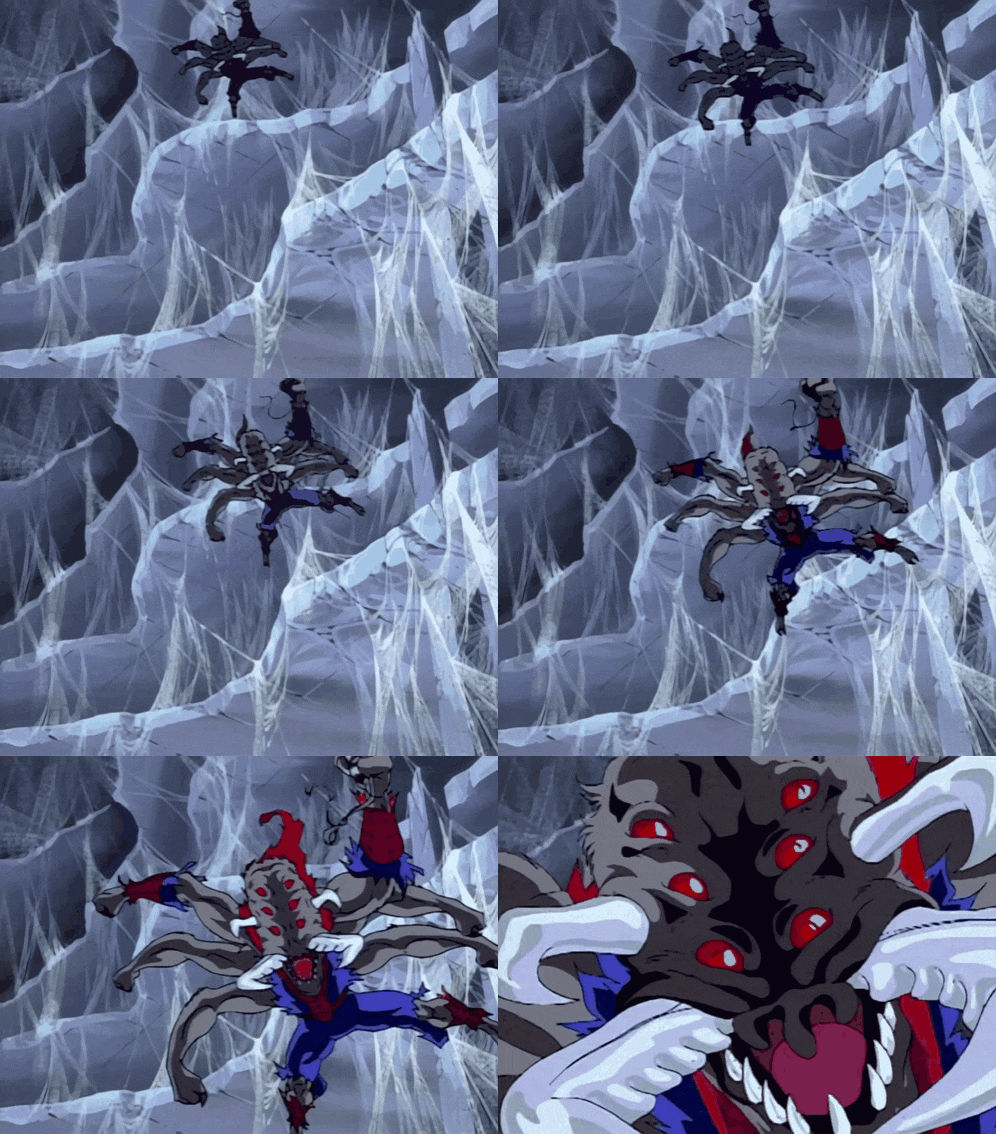
When Peter Parker’s body breaks the boundaries of what a “superhero mutation” should be, it doesn’t just make him stronger — it reshapes him into something biologically and instinctively spider-like. This isn’t Spider-Man with better gadgets or bigger muscles — this is a living mutation, where every part of him becomes a weapon.
Enhanced Spider Powers — Turned Up to Eleven
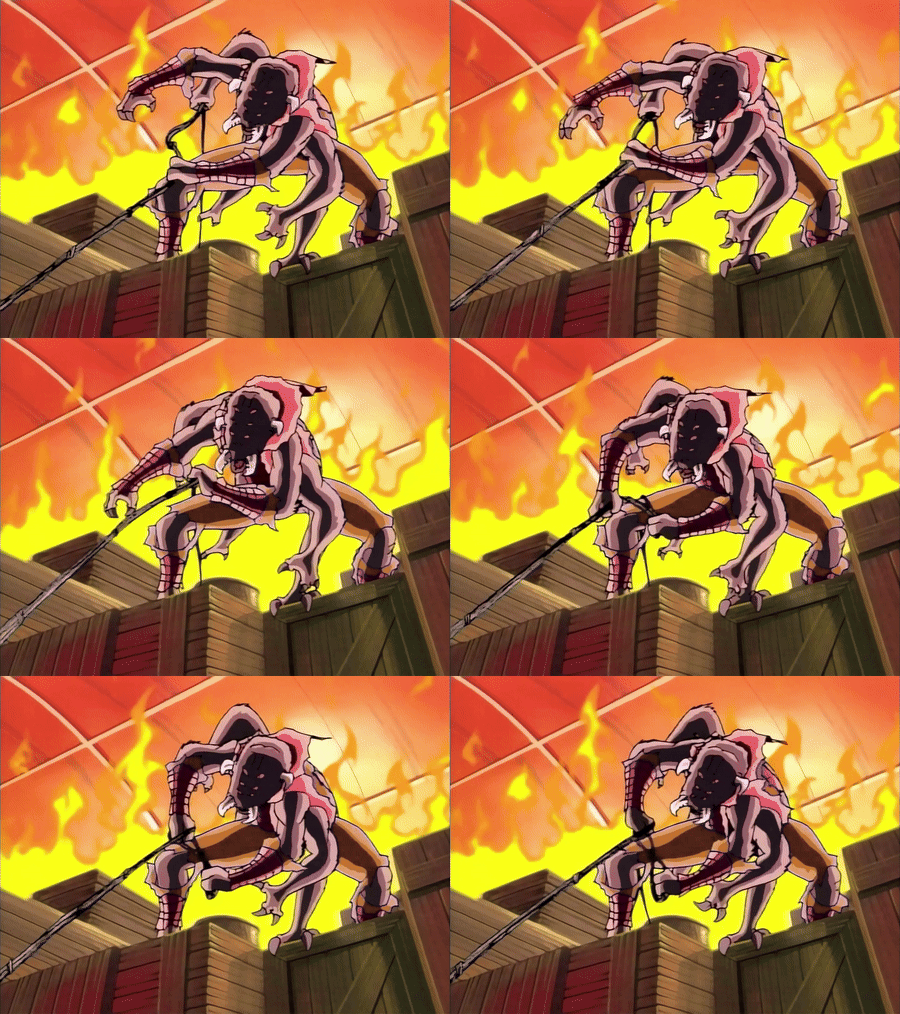
In his Man-Spider form, Peter still carries every ability that made him Spider-Man — but amplified and warped by mutation:
Superhuman Strength & Durability
Man-Spider’s strength is heightened far beyond what the normal Spider-Man already possessed. He can lift and throw massive objects with ease, overpower foes that even Spider-Man struggled with, and survive blows that would incapacitate lesser beings. His body is built for brute force and resilience.
Organic Web Generation
Unlike everyday Spider-Man — who relies on mechanical web-shooters he invented himself — Man-Spider can produce webbing organically from every limb without any external devices. Every arm, leg, and mutation point becomes a spinneret, shooting strong, sticky strands at will.
Acidic Spit from the Mouth
Perhaps one of Man-Spider’s most unnerving upgrades is his ability to spit corrosive acid directly from his mouth. This isn’t just cosmetic — it’s biologically potent, a natural weapon emerging from his mutated physiology that can burn through materials.
All the Classic Spider-Man Traits — But More Primal
Because Man-Spider is Spider-Man — just transformed — he retains the core abilities that defined Peter:
-
Wall-crawling — Still able to scale walls and cling to surfaces with unnatural grip.
-
Enhanced agility and reflexes — Faster, sharper, more responsive than an average human.
-
Spider-Sense (inherited traits) — Although in some portrayals this instinct becomes more like primal awareness than controlled precognition, the sense of danger still plays a part in how the creature reacts. (Derived from standard Spider-Man lore.)
Feral Instincts — A Mind Divided
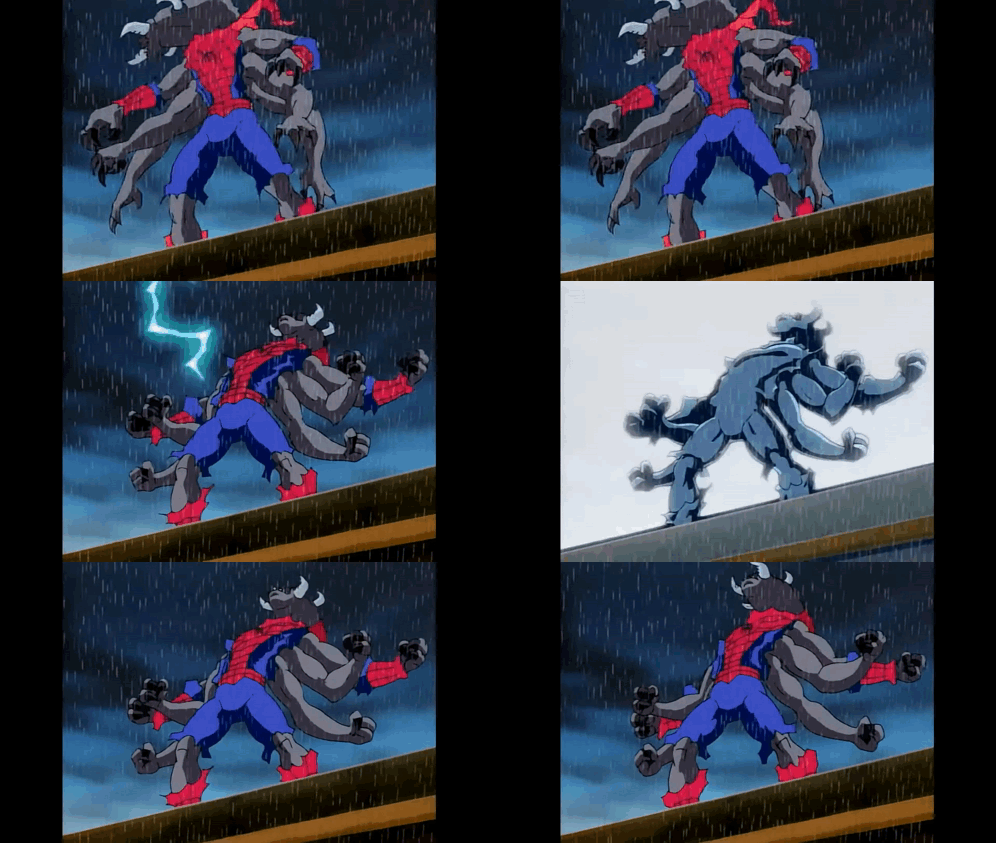
Man-Spider isn’t just physically different — he’s mentally shifted. In most portrayals, especially in the 1990s animated series, his intelligence regresses toward animal instinct, while fragments of Peter’s emotions — like love or protective drive — still echo through his behavior. This makes his abilities not just physically enhanced, but emotionally unpredictable.
How He Stands Apart From Regular Spider-Man
So what truly defines Man-Spider’s powers?
| Ability | Normal Spider-Man | Man-Spider |
|---|---|---|
| Web Generation | Requires web-shooters Peter built himself | Natural webbing from every limb |
| Acid Production | None | Acid spit from mouth |
| Strength | Superhuman | Even more powerful and primal |
| Intellect | Genius-level human | Shifts toward instinct with emotional flashes |
In Summary — A Hero and a Monster
Man-Spider represents what happens when Peter’s spider powers stop being a tool he controls and start being a biology he can’t tame. He can web and clamber like the classic Spider-Man, but now he does it from the very marrow of his bones. He can spit acid like a predator. His strength isn’t just superhuman — it’s shockingly bestial. And through it all, his human heart still flickers underneath — confused, instinctive, and tragically powerful.
Personality — When Peter Parker Slips Into Instinct
Man-Spider is not a villain in the traditional sense. He is something far more unsettling: Spider-Man stripped of his humanity, reduced to instinct, emotion, and raw biological impulse.
At his core, Man-Spider is a feral creature. The intelligence that once defined Peter Parker — the wit, the scientific mind, the self-reflection — is almost entirely absent. He appears to lack higher cognitive functions such as speech or complex reasoning, communicating instead through body language, aggression, and animalistic reactions. What remains of Peter is fragmented and incomplete.
Yet Peter Parker is not entirely gone.
Man-Spider retains faint emotional memories rather than clear recollections. These memories don’t manifest as thoughts or plans — they surface as feelings. Love, fear, protectiveness. This is why Man-Spider instinctively seeks out Mary Jane Watson. He does not remember why he loves her — only that she is important, familiar, safe. His pursuit of her is not romantic or conscious; it is pure instinct, like an animal returning to what it emotionally recognizes as home.
Emotion Over Intellect
Unlike Peter Parker, who balances logic with responsibility, Man-Spider operates almost entirely on emotion and impulse. He reacts instead of thinks. He attacks threats immediately, without strategy or restraint.
This explains why Man-Spider violently confronts Punisher, even though Punisher was once an enemy Spider-Man understood on a moral and strategic level. Man-Spider doesn’t recognize nuance — only danger. Similarly, he instinctively intervenes to stop Michael Morbius from attacking others. Not because of ethical reasoning, but because the protective instinct of Spider-Man still survives beneath the mutation.
In essence, Man-Spider doesn’t choose to be heroic — he reacts heroically, guided by leftover emotional wiring rather than conscious responsibility.
A Mind Trapped Between Man and Monster
What makes Man-Spider tragic is not just his appearance, but his psychological limbo. He is not fully Peter Parker, yet not entirely a mindless beast. The human soul is still present — muffled, buried, and unable to communicate.
This aligns with how Marvel often portrays failed or incomplete mutations: intelligence fades first, while emotional bonds linger the longest. In Man-Spider’s case, love and protection outlast reason and speech — a haunting reminder that Peter Parker is still trapped inside.
Alternate Version — The Path Not Fully Taken
An alternate version of Man-Spider presents a chilling “almost” scenario.
In this timeline, Spider-Man reaches the stage where he grows four extra arms, but instead of panicking or rejecting the mutation, he adapts. Viewing the arms as an inconvenience rather than a curse, he designs a new costume to accommodate them and equips himself with additional web-shooters, maintaining control over both his body and mind.
However, during a confrontation with Spider-Carnage, the mutation suddenly accelerates beyond his control. He fully transforms into Man-Spider and attacks the other Spider-Men present. The threat becomes so severe that Beyonder intervenes, forcibly teleporting Man-Spider away.
What happens to this version afterward is unknown. Whether he was cured, contained, or lost entirely to the mutation remains unanswered — making this one of the most unsettling unresolved threads in Spider-Man lore.
Background Information
In Spider-Man: The Animated Series (1994), Man-Spider was brought to life vocally by Jim Cummings, a legendary voice actor known for portraying characters that blur the line between monstrous and sympathetic. His performance helped emphasize Man-Spider’s animalistic rage while still conveying traces of pain and confusion beneath the surface.
Man-Spider in the Comics — A Key Difference
In Marvel Comics canon, Spider-Man did experience a mutation where he grew four additional arms — a storyline famously tied to Peter’s attempt to rid himself of his powers. However, unlike the animated series, he did not transform into a giant spider-like creature at that time.
It wasn’t until much later comic storylines — particularly those exploring Spider-Man’s connection to the mystical concept of The Other — that Peter would undergo transformations that echoed the Man-Spider horror, blending physical mutation with psychological strain. The animated series effectively pushed that idea further and faster, turning metaphor into full biological nightmare.
Final Thought — A Personality Defined by Loss
Man-Spider’s personality is defined not by malice, but by absence.
No speech.
No intellect.
No conscious identity.
Only emotion, instinct, and echoes of love.
He is what Spider-Man becomes when power outpaces humanity — a living reminder that Peter Parker’s greatest strength was never the spider inside him, but the man who kept it under control.
Man-Spider is not just a mutation — he is a warning. A living embodiment of what happens when power outruns humanity, when instinct drowns intellect, and when the hero inside struggles to be heard beneath the monster’s roar. Through Man-Spider, Spider-Man’s greatest fear is realised: not death, not failure — but losing himself.
This transformation strips Peter Parker down to his rawest essence, leaving behind emotion without reason, love without memory, and protection without choice. It’s a haunting reminder that Spider-Man was never defined by his powers, but by the fragile human will that kept them in check.
And perhaps that’s why Man-Spider endures in Marvel lore — not as a villain, but as a mirror. One that asks a terrifying question: what happens when the spider finally wins?
Calling all pop-culture fans and collectors!
Dive deeper into the worlds of Anime, Marvel, DC, Transformers, LEGO, and more with premium collectibles, statues, action figures, and exclusives — now available at up to 40% OFF.
Whether you’re building your multiverse or upgrading your display shelf, now’s the perfect time to level up your collection.