


Electro Explained: Origins, Powers & Marvel Legacy
Maxwell Dillon was born in Endicott, New York, the son of Jonathan and Anita Dillon. His childhood was defined by instability. Jonathan struggled to hold down steady employment, forcing the family to move repeatedly from one town to another. Eventually, that instability turned into abandonment. One day, Jonathan announced that he was leaving — running off with another woman — and walked out on both Anita and Maxwell, leaving them to fend for themselves.
Jonathan’s departure shattered the family dynamic and permanently altered Maxwell’s upbringing. Anita Dillon, terrified of losing the only person she had left, became overprotective of her son. She poured all her fears, expectations, and anxieties into Maxwell, smothering him with concern while quietly shaping his future through control rather than trust.
After graduating high school, Maxwell announced his intention to attend university and pursue a degree in electrical engineering. It was a path that made sense — he was intelligent, mechanically inclined, and fascinated by how power flowed through systems. But Anita, haunted by Jonathan’s failures, couldn’t bear the thought of her son risking disappointment. Rather than supporting him, she lied, telling Maxwell that he had been rejected from college. Instead, she pushed him toward what she believed was a safer, more practical route: employment at the local electric company. Trusting his mother, Maxwell followed her advice and became an electrical lineman.
That lie quietly sealed his fate.
When Maxwell was 24 years old, his mother suffered a heart attack and died shortly afterward. Her death left him emotionally isolated and burdened with unresolved resentment — love tangled with betrayal. Though he found steady work with the electric company, his income was modest, and his life felt painfully stagnant. He was surviving, not progressing.
Maxwell soon began dating Norma Lynn, a billing clerk at the same electric company. Their relationship progressed, and the two eventually married. Maxwell believed he had found stability — but history repeated itself. Norma wanted a comfortable, upwardly mobile life with financial security. She saw Maxwell’s refusal to abandon his lineman job for “greener pastures” as a weakness. To her, he wasn’t ambitious — he was stuck.
Eventually, Norma left him, running off with an engineer who could provide the lifestyle Maxwell could not.
The collapse of his marriage mirrored the failure of his parents’ relationship, and the realization cut deeply. In Maxwell’s mind, love had become transactional, loyalty conditional on money and status. Determined never to be abandoned again, he resolved to change the equation. He would find a trophy wife, someone whose affection could be secured — and controlled — through wealth. Someone who wouldn’t leave, because leaving would mean losing everything.
At that moment, something inside Maxwell hardened.
Pride had already taken root. Lust followed close behind. And now greed completed the trio.
No longer content with “treading water” through life, Maxwell Dillon began searching for any way to rise above mediocrity — regardless of the cost. That desperate hunger would soon intersect with fate, electricity, and a storm that would transform him forever into Electro.
From Man to Menace
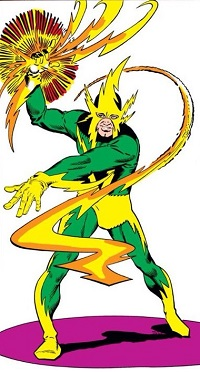
The tragic irony of Electro’s origin is that his powers didn’t create his greed — they justified it. When a freak accident struck while he was repairing an electrical line during a violent storm, Maxwell Dillon was imbued with the ability to generate, store, and control electricity. In his mind, the universe had finally acknowledged him.
With godlike power at his fingertips, Maxwell embraced a new identity — Electro — using his abilities to acquire wealth, status, and dominance. He became a recurring enemy of both Spider-Man and Daredevil, not out of ideology or revenge, but out of entitlement. The world had denied him comfort and respect — now it would pay him back in full.
The Core of Electro
Electro is not driven by chaos or cruelty for its own sake. He is driven by scarcity — the fear of being powerless, poor, and forgotten ever again. Money is safety. Power is validation. Control is love.
And no matter how much he takes…
…it’s never enough.
Becoming Electro
Maxwell Dillon’s transformation into Electro was not born from heroism — but from ambition disguised as it.
One fateful day, another lineman found himself in mortal danger high above the ground. Dillon agreed to help, but not selflessly. He insisted that his coworker formally praise his bravery to the electric company afterward, believing such recognition would finally improve his chances of promotion. It was a calculated act — heroism as leverage. Before Dillon could act, however, a freak lightning storm struck. The lineman lost his balance and fell to his death.
In the chaos, Max Dillon was struck by lightning while still in contact with live high-tension power lines connected to a wound spool of cable. The unusual configuration of the magnetic field created by the coiled wire and active current triggered a catastrophic reaction. Dillon’s nervous system underwent a body-wide mutagenic transformation, converting him into a living electrical capacitor. His body became capable of storing and releasing vast amounts of electricity, powered by the micro-fine rhythmic muscle contractions that normally regulate human body temperature.
Dillon survived — but the man he had been did not.
Adopting the elaborate costume and persona of a super-villain, the increasingly unstable Dillon embraced his new identity as Electro. His crimes were governed almost entirely by greed and personal gain. Power, to him, existed to be monetized. His first — and most frequent — enemy was Spider-Man, whose wit and ingenuity repeatedly humiliated him.
Electro’s public notoriety reached absurd levels when J. Jonah Jameson, publisher of the Daily Bugle, became convinced that Spider-Man and Electro were the same man. This belief persisted until Spider-Man defeated Electro using nothing more than rubber gloves and shoes, exploiting his electrical vulnerability.
Electro next clashed with Daredevil during an attempted break-in at the Fantastic Four’s headquarters, the Baxter Building. Law enforcement eventually subdued Electro using fire hoses, keeping him short-circuited long enough to apprehend him.
Sinister Six
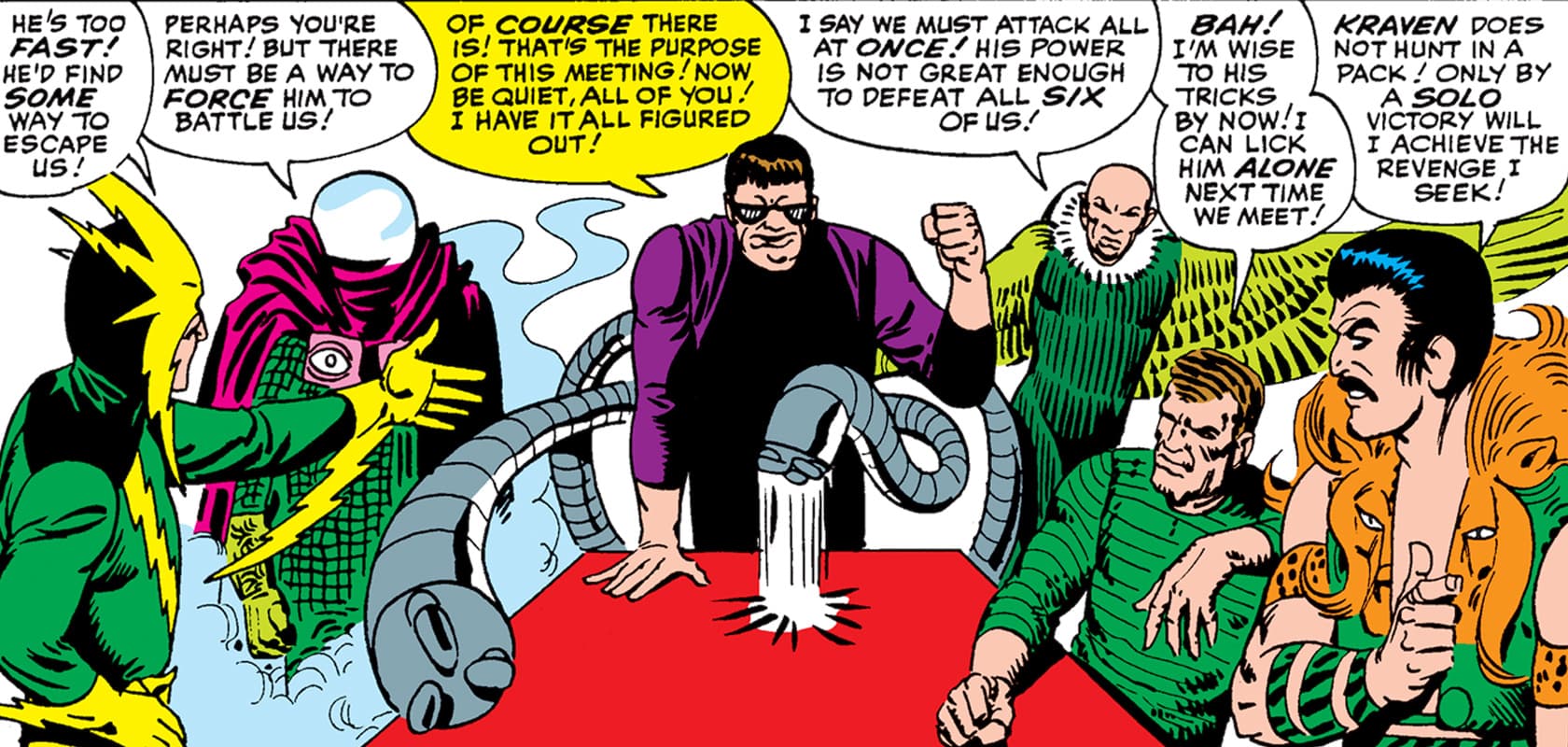
Unable to defeat Spider-Man alone, Electro soon realized that strength lay in numbers. Early in his career, he joined forces with five other enemies of Spider-Man under the leadership of Doctor Octopus. This original incarnation of the Sinister Six also included Sandman, Mysterio, Vulture, and Kraven the Hunter.
Their plan was brutally simple: attack Spider-Man one by one, wearing him down until one of them finally succeeded. Electro stationed himself inside an electrical power plant to amplify his abilities — yet even there, he was defeated by a single knockout punch from Spider-Man.
Electro later confronted Spider-Man again, but this time the wall-crawler received unexpected assistance from Captain America. The battle ended ignominiously for Electro when he was doused with water from a tower, neutralizing his power.
Emissaries of Evil

Following these defeats, Electro’s reputation made him a valuable — if unreliable — hired gun. He was recruited by Doctor Doom and others to disrupt the wedding of Reed Richards and Susan Storm.
After being defeated yet again by Daredevil, Electro sought legitimacy through organization and founded his own group of villains, the Emissaries of Evil, hoping collective power would finally earn him respect.
Ignominious Defeats
Electro’s downward spiral continued. In a particularly bitter chapter, J. Jonah Jameson secretly hired Electro to fight Spider-Man on live national television, hoping to discredit the hero publicly. Instead, before millions of viewers, Spider-Man once again emerged victorious.
Desperate for validation, Electro attempted something catastrophic: he tried to drain the entire city’s electrical grid into his own body, believing such power would finally command fear and respect. The plan nearly killed him. Once more, Spider-Man stopped him.
Electro later battled Daredevil again and even crossed paths with the confused extraterrestrial Omega the Unknown. For a brief time, he joined the Frightful Four, fighting alongside Spider-Man’s enemies against both Spider-Man and the Fantastic Four.
Other Sinister Six Incarnations
The Sinister Six reformed again, this time replacing Kraven with the half-demonic Hobgoblin. Their new plan involved holding the world hostage under a cloud of poison gas. Even Spider-Man struggled against their combined might — until Doctor Octopus betrayed the team, realizing he could sell the gas as a cure for cocaine addiction. Without Doc Ock’s leadership, the villains quickly fell apart and were defeated.
A later attempt to assassinate Doctor Octopus failed, and the fractured group dispersed, each villain returning to their own obsessions.
Electro also became a member of Sinister Seven, assembled by Mysterio to combat Spider-Man’s insane clone, Kaine. When Kaine disappeared, the group dissolved, and Dillon retreated into self-imposed exile, bruised, bitter, and still craving recognition.
The Tragedy of Electro
Electro’s story is not about lightning — it’s about validation. Every defeat chips away at his pride, every alliance is a desperate attempt to feel important, and every crime is fueled by the belief that power should guarantee respect.
But no matter how much energy he absorbs, it’s never enough.
Upgrade
For a time, Electro faded into obscurity — bruised by failure, mocked by defeats, and quietly sidelined in the criminal world he once believed he should rule. But men like Maxwell Dillon never truly retire. They wait.
That opportunity arrived in the form of Rose, a calculating underworld power broker who understood exactly how to manipulate Dillon’s deepest insecurity: the fear of being forgotten. The Rose offered Electro something no one else had — a chance at redemption through power. In exchange for serving as the Rose’s enforcer, Dillon would undergo an experimental procedure designed to greatly enhance his abilities.
Dillon didn’t hesitate. He agreed immediately, convinced this was his moment to finally rise above his past humiliations and reclaim relevance in New York’s criminal hierarchy.
The procedure worked.
Recharged and empowered, Electro was unleashed on the Rose’s enemies. He swiftly eliminated several members of the True Believers, a dangerous offshoot of The Hand, carrying out the Rose’s orders with brutal efficiency. For the first time in a long while, Dillon felt feared again — useful again.
But old obsessions die hard.
Despite his new role, Electro quickly reverted to his familiar grand ambition: seizing control of New York City’s power supply. To Dillon, domination of the electrical grid wasn’t just a tactical goal — it was symbolic. Control the power, control the city. Control the city, finally control his life.
Once again, however, Spider-Man stood in his way.
This time, Spider-Man came prepared, wearing a fully insulated suit designed specifically to counter Electro’s enhanced abilities. The battle ended as so many others had — with Dillon defeated, humiliated, and staring down the crushing reality that no upgrade could fix what was broken inside him.
Overwhelmed by rage, despair, and the suffocating sense that he would never escape this cycle, Dillon made a final, desperate choice. In a moment that blurred frustration with resignation, he hurled himself into the Hudson River, electricity crackling around him as the waters swallowed his form.
To the world, it appeared that Electro had finally killed himself.
Whether it was an act of surrender or one last gamble is left deliberately ambiguous — fitting for a man whose entire life was defined by reckless attempts to prove he mattered.
What This Moment Represents
Electro’s “upgrade” wasn’t just physical — it was psychological. It was his last attempt to outrun irrelevance, to prove that more power would finally earn him respect. Instead, it reaffirmed the cruel truth at the heart of his story:
No amount of electricity can fix a man who measures his worth in dominance.
Sinister Twelve
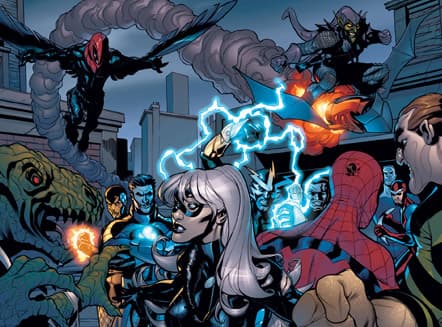
Despite the apparent finality of his plunge into the Hudson River, Electro did what he has always done best — he survived. Maxwell Dillon resurfaced once more, slipping back into the criminal ecosystem of New York and becoming a recurring fixture in subsequent incarnations of the Sinister Six. None of these later versions ever reached the infamy of the original lineup. Each collapsed the same way: defeat at Spider-Man’s hands or internal conflict born from clashing egos, betrayal, and mistrust. Electro endured them all, less a leader and more a constant — a living reminder that he would always return, no matter how many times he fell.
That persistence ultimately led Dillon into his most ambitious alliance yet: the Sinister Twelve.
This expanded supervillain collective was assembled by Green Goblin, not merely to overpower Spider-Man, but as part of a larger, calculated scheme. The Goblin’s true objective was twofold: to engineer his escape from prison and to annihilate Spider-Man once and for all, using overwhelming numbers and chaos to tip the scales where smaller teams had failed.
What the Sinister Twelve Reveals About Electro
Electro’s role in the Sinister Twelve underscores a central truth about his character:
he is not driven by loyalty, ideology, or even revenge — he is driven by relevance.
As long as there is a larger machine to plug into, a greater villain to serve, or a final “big plan” to be part of, Electro will keep returning. Not because he believes he will win — but because disappearing would be worse than losing.
Breakout

By the time this chapter unfolded, Electro was no longer just chasing money or notoriety — he had become a catalyst for chaos on a global scale.
Electro was hired by Brainchild to carry out an audacious mission: free Karl Lykos, also known as Sauron, from The Raft—a floating, maximum-security prison specifically engineered to hold the world’s most dangerous supervillains. Designed with advanced containment systems and isolated power controls, the Raft was considered virtually escape-proof.
Electro proved otherwise.
Tapping directly into the prison’s electrical infrastructure, Dillon initiated a prison break on an unprecedented scale, unleashing a catastrophic power failure that freed scores of incarcerated supervillains in a matter of moments. Cells opened, systems collapsed, and panic spread across the facility. The event would go down as one of the most devastating mass breakouts in Marvel history.
But the fallout extended far beyond escaped criminals.
Electro’s actions triggered an emergency response that drew together some of the most powerful heroes on Earth, many of whom were already present at the Raft when the power was cut. Among those forced into action were Captain America, Iron Man, Luke Cage, Spider-Woman, Daredevil, Sentry, and Spider-Man. When the prison lost power, many of these heroes found themselves trapped inside the Raft, fighting both escaped inmates and the failing environment itself.
With the exception of Daredevil—and initially the Sentry—this spontaneous coalition of heroes would reassemble shortly after the breakout, united by the sheer scale of the disaster. That reunion directly led to the formation of a new Avengers lineup, later known as the New Avengers. In one of Marvel’s great ironies, Electro’s criminal act became the spark that reshaped Earth’s premier superhero team.
As the chaos subsided, Dillon attempted to flee the scene, hoping to escape with his girlfriend, a waitress from Boston, clinging to the idea of a normal life even as the world burned behind him. He never made it far. Electro was captured by the New Avengers themselves — the very team his actions had inadvertently brought together.
In trying to free one monster, Electro had unleashed a new era of heroes.
The Raft breakout is remembered not just as one of Electro’s most destructive acts, but as a turning point in Marvel history. It elevated Dillon from a recurring Spider-Man villain to a universe-shaping catalyst, proving that even a man driven by greed and insecurity could alter the balance of power.
Electro, ever hungry for relevance and power, took his place among the Twelve without hesitation. For him, the Sinister Twelve represented validation — proof that he was still dangerous enough to matter, still powerful enough to be included in the Goblin’s endgame.
But even twelve villains were not enough.
The Sinister Twelve’s assault drew a response far greater than Spider-Man alone. Their plot was ultimately undone through the combined efforts of some of Marvel’s greatest heroes: Captain America, Iron Man, Daredevil, Yellowjacket, and the entire Fantastic Four. Faced with such unified resistance, the Sinister Twelve collapsed, their grand plan reduced to another failed entry in the long history of villains underestimating collective heroism.
For Electro, the defeat was familiar — but not final. The Sinister Twelve did not mark his end, only another chapter in his endless cycle of resurgence. Time and again, Dillon proves that while he may never win the war, he will always survive the battle.
Second Upgrade
As time caught up with Electro, Maxwell Dillon discovered a cruel truth: his immense power was no longer stable. Age and repeated overexertion had begun to fracture his control over electricity, turning what was once his greatest weapon into a liability. Desperate to stabilize himself, Dillon entered into the service of Mad Thinker, a super-genius capable of understanding and regulating Electro’s volatile abilities.
Through blackmailing Dexter Bennett, Dillon secured both financial resources and a technological power upgrade. Recharged and emboldened, Electro lashed out at the institution he had long blamed for shaping public hatred of him: the Daily Bugle. In a dramatic escalation, he attacked and destroyed the Bugle’s headquarters, symbolically striking at the voice that had chronicled his failures for decades. Even so, history repeated itself. Electro was defeated once again by Spider-Man, reinforcing the bitter pattern Dillon could never escape.
Ends of the Earth
Electro soon aligned himself with Doctor Octopus’s newly formed Sinister Six, joining a globe-spanning campaign to seize advanced technology. As part of this operation, Electro assisted in robbing technology from the Baxter Building, headquarters of the Fantastic Four, and helped steal the Zero Cannon from the Intelligencia.
Doctor Octopus’s ultimate scheme went far beyond robbery. Obsessed with being remembered as the man who saved the world, he devised a plan involving satellites capable of both halting and accelerating the Greenhouse Effect. To force world leaders into compliance, Chameleon disguised himself as Al Gore, attempting to manipulate global policy. The deception was uncovered by Spider-Man, who arrived with the Avengers to stop the plan.
When Chameleon escaped, he regrouped with the Sinister Six in the Mediterranean. The Avengers followed, leading to a massive confrontation. Although the villains initially defeated the Avengers, the victory came at a devastating cost. During the battle, Thor sent Electro into space, removing him from the conflict entirely and leaving him drifting helplessly away from Earth.
Superior Six
Electro eventually returned to Earth, burning with rage and seeking revenge against Thor. To do so, he forced an A.I.M. scientist to modify his powers so that he would generate protons instead of electrons, radically altering the nature of his energy output. This new form made him even more dangerous—but also unstable. He was ultimately defeated by Spider-Man, who at the time was actually Doctor Octopus inhabiting Spider-Man’s body. Using superior intellect, Spider-Man converted Electro into a stream of protons and trapped him in a containment cell located next to Sandman inside a hidden underwater laboratory.
Following this, Spider-Man assembled a new group of controlled villains known as the Superior Six. Electro became a member of this mind-controlled team, forced to act as a pawn rather than a threat. When Spider-Man’s control eventually failed, Electro and the other five members rampaged across New York City, unleashing widespread destruction. The chaos was finally ended when Electro was subdued by both Spider-Man and the newly emerged hero Sun Girl.
Alliance with the Black Cat
Electro’s forced servitude shattered what little reputation he had left in the criminal underworld. Viewed as Spider-Man’s puppet, Dillon lost credibility as a serious villain. In a desperate attempt to reclaim fear and relevance, he attempted to replicate his most infamous crime — the Raft breakout — by storming Conway Penitentiary. This time, however, his unstable powers spiraled completely out of control, destroying the entire building.
Now more powerful than ever, yet utterly uncontrollable, Electro found himself isolated. It was then that Black Cat offered him an alliance. Together, they planned to finish Spider-Man once and for all, even as Parker Industries secretly began developing technology to permanently depower Dillon.
Using Electro’s raw energy, Black Cat established dominance over the criminal underworld. The duo kidnapped Sajani Jaffrey, a key executive at Parker Industries, to uncover details about the company’s super-prison project. They later attacked the headquarters of Fact Channel News, demanding Spider-Man appear on live television. When he did, Spider-Man was nearly unmasked before being rescued by his ally Silk.
Their final confrontation came during a public demonstration of Parker Industries’ Anti-Electro technology. Electro and Black Cat infiltrated the event, and Felicia activated the machine, further amplifying Electro’s power. Spider-Man and Silk intervened, forcing Black Cat to change tactics. Using exposed wiring, she deliberately overloaded Electro, triggering a massive explosion. The blast failed to kill Spider-Man as Felicia intended—but it succeeded in completely depowering Maxwell Dillon.
With his electricity finally gone, Electro was taken into custody, stripped of the power that had defined his life.
The Tragedy of the Second Upgrade
Electro’s second upgrade arc is not about becoming stronger — it’s about losing control. Every enhancement pushed Dillon further from autonomy, turning him into a weapon wielded by others: geniuses, crime lords, lovers, and even Spider-Man himself. In the end, it wasn’t a hero who truly defeated Electro.
It was the power he could never master.
Death
By this stage of his life, Electro was no longer the crackling force of chaos he once had been. Stripped of his powers and incarcerated at Andru Correctional Facility, Maxwell Dillon was left alone with the consequences of a lifetime defined by electricity, obsession, and loss.
That imprisonment did not last.
Max was violently broken out of the facility by Rhino, alongside Lizard, acting on the orders of the new Jackal. Jackal’s plan was precise and cruelly familiar: restore Electro’s powers and return him to the battlefield as a living weapon.
As preparations began for the procedure that would return the electricity to his body, something unexpected happened. Maxwell Dillon hesitated. For the first time since the lightning strike that defined his life, he chose fear over power. He realized he could not go through with it again — that reclaiming his abilities would only drag him back into the same endless cycle of destruction and loss.
The Jackal would not allow that choice.
To break Dillon’s resolve, Jackal summoned Francine Frye — resurrected and standing before him. Francine was the woman Dillon had accidentally killed months earlier, a trauma that had haunted him even after losing his powers. Seeing her alive shattered his resistance. Overwhelmed by guilt, love, and desperation, Dillon agreed to proceed with the experiment.
The procedure failed.
Dillon’s body, weakened and altered by years of mutation, rejected the energy meant to restore his powers. The experiment collapsed into chaos. As Max staggered past Francine, the containment suit designed for him began to transfer its stored electrical energy into her instead. In an intimate and devastating moment, Francine kissed Dillon, fully absorbing the energy and inheriting Electro’s powers.
The transference killed Maxwell Dillon, his body overwhelmed and fried to death by the electricity that had once defined him.
Electro did not die in battle. He died letting go.
Resurrection
Death, however, has never been permanent for men made of lightning.
At the command of Kindred, Doctor Octopus used a special resurrection machine to bring Electro back to life. The revival was complete: Maxwell Dillon returned with his powers fully restored, electricity once again coursing through his body.
The success of the resurrection pleased Kindred, who viewed Electro not merely as a villain, but as a necessary instrument in a larger, more sadistic design.
Once revived, Electro quickly fell back into old patterns. He joined a new Sinister Six assembled by Doctor Octopus, aligning himself once more with familiar enemies under familiar leadership. Together, they launched a violent campaign against the Savage Six, plunging Dillon straight back into the endless war that had defined his existence.
What Electro’s Death Truly Means
Electro’s death was not heroic.
His resurrection was not triumphant.
Together, they form the clearest statement of his tragedy: Maxwell Dillon can escape prison, death, and even his own body — but he cannot escape who he is. Every chance at peace is overridden by manipulation, obsession, or the promise of power. Even when he chooses to stop, the world refuses to let him.
Electro doesn’t just return from death.
He returns because the Marvel Universe will not let lightning fade quietly.
Attributes
Power Grid
At the core of Electro lies one of Marvel’s most dangerous energy profiles. His powers are not external tools or devices — they are biological, constant, and self-sustaining, turning his body into a living power station.
Powers
Electrokinesis
Electro possesses the ability to generate, store, and manipulate electrostatic energy directly within his body. This energy production is powered by the micro-fine rhythmic muscle contractions that normally regulate human body temperature. Under normal conditions, Electro’s body can generate electricity at a rate of approximately 10,000 volts per minute, up to a maximum internal storage capacity of 10,000,000 volts. Once that threshold is reached, his body automatically halts further generation to prevent overload. As he expends energy, his body immediately begins recharging itself, creating a continuous cycle of power generation.
Electro can mentally regulate how much electricity he discharges — from a single volt to his entire 10,000,000-volt charge in one release. At a distance of ten to thirty feet, even his maximum discharge is more than sufficient to kill a human being. He can also function as a biological transformer, drawing electricity from external sources such as generators and channeling it through his body. How much energy he can process beyond his natural storage limit remains unknown.
Applications of Electrostatic Energy
Lightning Bolt Projection
Electro’s most recognizable attack is the emission of a lightning-like electric arc from his fingertips. These bolts can travel through air or any conductive medium at roughly 150,000 feet per second, the speed of lightning itself. The trajectory does not always follow a straight line, as it can be influenced by nearby metals or electrical fields. If a target is not properly grounded, the bolt’s effectiveness is reduced. His maximum effective range is approximately 100 feet.
Electromagnetic Propulsion via Electrical Lines and Bridges
Electro can propel himself along electromagnetic force lines generated by high-tension electrical structures, such as power cables. By surrounding his legs with swirling electrical fields, he creates an opposing magnetic field strong enough to suspend him above active power lines. By altering the balance of these fields, he can “ride” magnetic ripples at speeds of up to 140 miles per hour, which is the fastest speed at which he can still breathe unaided. On rare occasions, Electro has formed temporary electrostatic bridges to walk across, though the energy cost is enormous.
To a limited extent, he can also replicate Spider-Man’s wall-crawling ability, using electromagnetic attraction to cling to iron bars and metal structures.
Electrical Detection and Control
Electro can sense the flow of electricity through machines and circuitry. By “feeling” how current moves through a device, he can override it, forcing systems to obey his mental commands. This allows him to disable alarm systems, partially control computers, or overload any electronic system that lacks sufficient shielding.
Electrocution Aura
When Electro is fully charged, the electrical flux surrounding his skin is so intense that physical contact alone can electrocute a person.
Recharging
If Electro connects himself to an external electrical power source, he can replenish his internal reserves continuously, allowing him to expend energy indefinitely without draining his natural storage.
Electrical Conversion into Enhanced Physical Attributes
The electricity flowing through Electro’s altered physiology enhances his strength, speed, and recuperative ability, pushing him beyond normal human limits.
Peak Human Strength
When fully charged, Electro can lift (press) approximately 500 pounds.
Metal Ionization
During a period of incarceration, Doctor Octopus taught Electro how to ionize metals, allowing him to manipulate conductive materials more effectively during combat.
Disruption of Wall-Crawling Abilities
Electro’s electromagnetic field can interfere with Spider-Man’s electrostatic adhesion, preventing him from clinging to walls.
Advanced Phenomena
Localized Electromagnetic Storms
Electro once demonstrated an extreme application of his abilities by generating a localized electromagnetic storm. Using this technique, he defeated Invisible Woman by carbonizing the air around her, trapping her inside a sheath of rock-hard electro-carbon atoms and effectively turning her into a living statue.
Immunity to Electricity
Electro’s body is completely immune to the effects of electricity — both his own and from external sources. No amount of voltage can electrocute him.
Overcharging and Energy Form
Electro can deliberately overcharge himself, reaching extremely high voltage levels. In this state, he has been known to grow in height and transform into a massive humanoid form composed entirely of electricity, shedding physical limitations in favor of raw energy presence.
What Electro’s Attributes Truly Represent
Electro is not merely a man who controls electricity — he is bound to it. His power is cyclical, self-sustaining, and relentless, mirroring his psychology. The same system that fuels him also traps him, forcing him to constantly discharge, recharge, and escalate.
Electro doesn’t just wield energy.
He is energy — unstable, dangerous, and always seeking release.
Abilities
Hand-to-Hand Combat
Despite the overwhelming nature of his powers, Electro possesses minimal skill in hand-to-hand combat. Electro has always relied far more on ranged electrical attacks, intimidation, and environmental control than on physical technique. When deprived of his powers or forced into close-quarters combat, he is significantly less effective, a limitation that opponents such as Spider-Man have exploited repeatedly.
Weaknesses
Short Circuiting
When Electro is fully charged, his body becomes extremely sensitive to anything capable of short-circuiting his electrical flow, with water being the most notable and historically consistent weakness. Exposure to large quantities of liquid can disrupt his charge, neutralize his attacks, and leave him vulnerable.
In later encounters, following experiments conducted on him by Spider-Man, Electro developed an additional instability. These experiments caused him to lose fine control over his powers, sometimes triggering an internal electrical burnout. When this occurs, Dillon can collapse entirely, temporarily unable to generate or regulate energy, leaving him physically exhausted and defenseless.
Paraphernalia
Transportation
Electro does not require conventional vehicles. Instead, he is capable of “riding” electricity itself, traveling along power lines, electrical currents, and conductive infrastructure. This unique method of transportation allows him to move rapidly through urban environments, particularly cities like New York, where electrical grids are dense and interconnected.
Notes
A continuity inconsistency appears in Despicable Deadpool #297, published long after the events of Amazing Spider-Man (Vol. 4) #17. In this issue, Electro is shown alive and present among the patrons aboard the supervillain gambling ship Queen Kathleen, despite prior storylines indicating otherwise. This appearance is generally regarded as a continuity error rather than a canonical resurrection.
Trivia
Electro may be either bisexual or bi-curious, a detail referenced in supplemental material rather than core narrative, reflecting Marvel’s occasional use of ambiguity rather than explicit confirmation in earlier eras.
Up until Superior Spider-Man #1, Electro holds a unique distinction: he has been a member of every incarnation of the Sinister Six to date. This includes not only the original Six, but also the Sinister Seven, Sinister Twelve, and the Superior Six. Despite this unparalleled consistency, Electro has never served as the leader of any of these groups, reinforcing his long-standing role as a powerful but subordinate figure.
Shortly after gaining his powers, Magneto approached Electro with an offer to join the Brotherhood of Evil Mutants. Magneto made it clear that Electro was not a mutant, but suggested that some other latent gene had been activated, arguing that Dillon possessed the raw potential to stand alongside any Brotherhood member. Electro ultimately rejected the offer, choosing independence — and criminal ambition — over ideological allegiance.
In a lighter and more meta appearance, a Spider-Man–themed MAD Libs book allows readers to rewrite Electro’s origin story themselves, using interchangeable verbs and nouns to humorously reconstruct his transformation into a supervillain. This reflects Electro’s long-standing presence in Spider-Man pop culture beyond traditional comics.
Electro’s story is not just about lightning — it’s about longing. From a forgotten lineman to a living conduit of raw power, Maxwell Dillon’s journey is defined by a hunger for relevance in a world that never stopped moving without him. Every upgrade, every alliance, every return from defeat or death reflects the same truth: Electro doesn’t crave destruction — he craves validation.
Across decades of Marvel history, Electro has been a constant presence in Spider-Man’s world, evolving alongside the city itself. His powers have grown, fractured, vanished, and returned — but his struggle has always remained painfully human. In the end, Electro stands as one of Marvel’s most tragic villains: not because of what he can do, but because of why he keeps trying.
Explore an electrifying range of Anime, Marvel, DC, Transformers, LEGO, and MORE collectibles — from action figures and statues to exclusives and display pieces — now available at up to 40% OFF.
Whether you’re powering up your Spider-Man shelf or expanding your multiverse collection, this is the moment to plug in