


Baraka MK Character Guide: Origin, Story, Powers & Evolution
Baraka is not just another warrior in the brutal, blood-soaked universe of Mortal Kombat—he is a living embodiment of survival, savagery, and loyalty forged in the harshest corners of Outworld. As the former General of the Tarkatan Horde, Baraka has long stood as one of the franchise’s most fearsome antagonists, a creature whose very existence is shaped by violence, instinct, and an unwavering sense of allegiance.
Born among the Tarkatans—a nomadic, war-driven race known for their grotesque physiology, razor-sharp arm blades, and insatiable hunger for combat—Baraka rose through sheer brutality and dominance. Leadership among Tarkatans isn’t granted; it’s taken. And Baraka took it. His command over the Horde wasn’t just about strength, but about embodying the very nature of his people: relentless, unyielding, and unapologetically savage.
Throughout the series, Baraka has served the Outworld Empire with fierce dedication. His loyalty has often been tied to powerful rulers like Shao Kahn, the tyrannical emperor whose rule thrives on conquest and fear. At the same time, Baraka has shown allegiance to Mileena—herself a hybrid born of Tarkatan blood and Edenian royalty. In many ways, Mileena represents something deeply personal to Baraka: a bridge between monstrosity and legitimacy, between exile and belonging. His loyalty to her is not just political—it feels almost tribal, instinctive, like protecting one of his own.
Baraka first carved his name into the franchise in Mortal Kombat II, where he debuted as the first playable Tarkatan in the series. From that moment on, he became a recurring antagonist, often positioned as a ruthless enforcer of Outworld’s will. His design—those extended arm blades, the predatory grin filled with needle-like teeth—instantly set him apart. But it wasn’t just aesthetics; Baraka’s fighting style reflected raw aggression, favoring relentless offense and overwhelming brutality over finesse.
As the series evolved, so did Baraka. In Mortal Kombat 11, he returned as a playable character, but with a subtle shift in narrative weight. While still dangerous, he was portrayed with more dimension, stepping into a supporting role in the Story Mode. Here, Baraka wasn’t merely a mindless servant of tyranny—he showed glimpses of leadership, strategy, and even a sense of honor toward his people. It was a rare moment where the monster was allowed to feel… human.
That evolution continues in Mortal Kombat 1, where a reimagined version of Baraka emerges. Once again playable and woven into the story as a supporting character, this iteration leans even further into tragedy and depth. In this timeline, Baraka is afflicted with Tarkat—a disease that transforms victims into the very creatures Tarkatans are feared to be. This adds a haunting layer to his character: Baraka is no longer just born into monstrosity; he is shaped by it, struggling with identity, pain, and what it means to retain humanity while becoming something feared and rejected.
Baraka’s journey across Mortal Kombat isn’t just about bloodshed—it’s about evolution. From a seemingly one-dimensional brute to a layered warrior carrying the weight of his people, his story reflects one of the franchise’s most compelling transformations. He is rage, yes—but also resilience. A creature of blades, but also of burden.
About Baraka
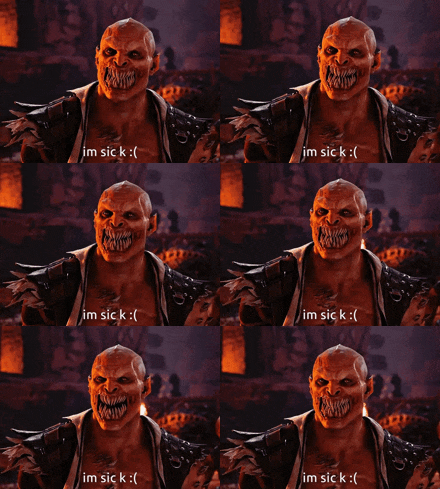
Baraka entered the world of Mortal Kombat like a storm you don’t see coming—violent, unsettling, and impossible to ignore. When he was first introduced in Mortal Kombat II, he was portrayed as a mean, frightening, and wildly unpredictable warrior of Outworld, operating under the iron rule of Emperor Shao Kahn. There was something feral about him from the very beginning, like he wasn’t just fighting battles—he was the battle.
Baraka belongs to a race of nomadic mutants who roam the desolate, unforgiving wastelands of Outworld. These beings, later formally named the Tarkata in Mortal Kombat: Deception, are as much a product of survival as they are of brutality. Early lore described them as a grotesque crossbreed between Netherrealm demons and Outworld natives—creatures born from chaos itself. But as the franchise evolved, so did their origin. In the reimagined timeline, the Tarkatans are no longer hybrids but a distinct species altogether, one that traces its roots back to a forgotten realm conquered long ago by Shao Kahn. That shift doesn’t soften them—it deepens their tragedy. They are no longer accidents of creation, but a displaced people, shaped by conquest and exile.
Like every Tarkatan, Baraka carries the physical markers of his kind—long, retractable blades that extend from his forearms with terrifying ease, and a physiology built for relentless combat. His cannibalistic nature, often highlighted across the series, isn’t just shock value—it’s a reflection of the harsh, survivalist culture he comes from. In the food chain of Outworld, hesitation is death. Baraka doesn’t hesitate. That’s precisely what makes him one of the deadliest fighters in the entire Mortal Kombat universe.
And yet, beneath all that savagery, Baraka isn’t driven by blind hatred—especially not toward Earthrealm or its warriors. Despite numerous clashes with Earthrealm’s champions, he doesn’t carry a personal vendetta against them. There’s no obsession, no deep-rooted grudge. His motivations are far more grounded, almost surprisingly so. At his core, Baraka is driven by a singular priority: the survival and prosperity of his people. That’s it. That’s the lens through which he sees the world. Alliances, betrayals, battles—they’re all just means to an end. If siding with an enemy ensures the future of the Tarkatans, Baraka will do it without hesitation.
In the hierarchy of Outworld, Baraka stands tall as the General of the Tarkatan Horde, commanding the Tarkatan Army under Shao Kahn’s regime. His authority is absolute among his kind, earned not through politics but through dominance and respect. However, there is one figure who stands above him in the Tarkatan chain of command—Mileena. A genetic hybrid created by the sorcerer Shang Tsung, Mileena was designed to replace Kitana as Shao Kahn’s daughter after he deemed the original unworthy. To Baraka, Mileena represents something more than royalty—she is part Tarkatan, and that alone commands his loyalty. In her, he sees both a leader and a symbol of his people’s place within the empire.
In the newer timeline, Baraka’s role remains that of a leader, but the nature of his people undergoes a haunting transformation. Tarkatans are no longer a naturally occurring race—instead, they are the result of a devastating affliction known as the Tarkat disease. Victims, whether Outworlders or Edenians, are twisted into the monstrous forms Tarkatans are known for and subsequently cast out by society. This reimagining adds a heavy layer of tragedy to Baraka’s existence. He is no longer just the leader of a brutal race—he is the voice of the rejected, the outcast, the feared. His fight is no longer just about dominance; it’s about dignity, survival, and carving out a place in a world that has already decided what he and his people are worth.
Baraka, in every version of his story, stands at the intersection of brutality and purpose. He may look like a monster—but everything he does is for something deeply, undeniably human: his people.
Character Development
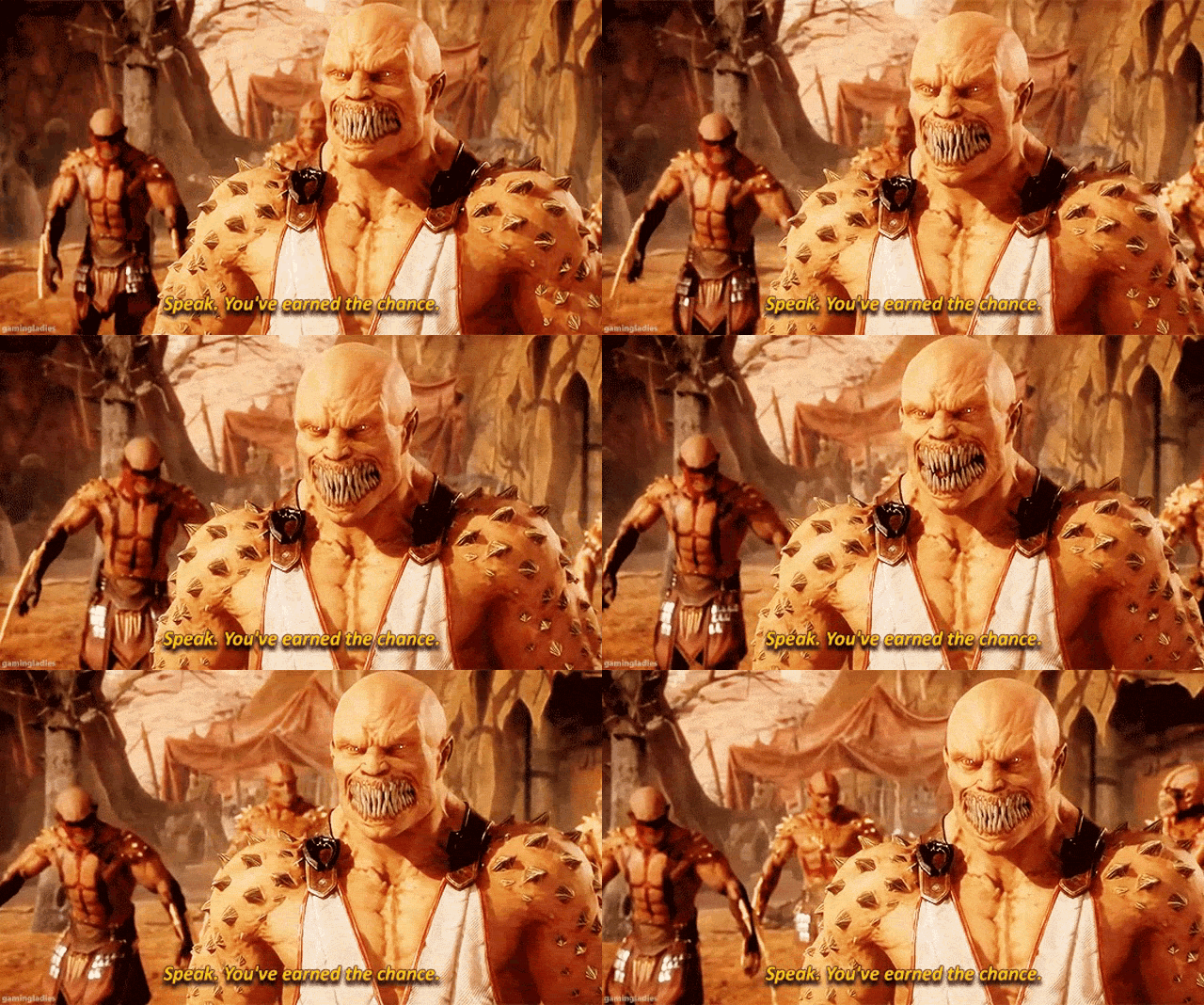
Baraka’s creation wasn’t born in a polished studio pipeline—it came from something far more raw, almost experimental, much like the character himself. During the early brainstorming sessions for Mortal Kombat II, the design team went hunting for inspiration in the real world. A visit to a local costume shop led them to a Nosferatu mask—already eerie on its own—but they didn’t stop there. They painted it, distorted it, exaggerated its horror, and even added false fingernails to mimic elongated, fang-like teeth. What emerged was something deeply unsettling.
That mask would eventually be worn by Richard Divizio, the man who physically brought Baraka to life through motion capture. And it wasn’t exactly comfortable. Divizio later shared, in an interview featured on the special edition of Mortal Kombat: Deception, that the mask clung tightly to his face, trapping heat as he performed. Under those conditions, he was sweating constantly—literally suffering to give life to a character built on pain and aggression. Reflecting on the experience, he admitted to Electronic Gaming Monthly back in 1994, “He was a pretty cool character… but I didn’t like him too much.” There’s something oddly fitting about that—Baraka was never meant to be liked. He was meant to be felt.
But Baraka wasn’t always the blade-armed beast we know today. Early concept art by John Tobias imagined him as something entirely different—a masked, bald human ninja wielding hook swords. His design leaned heavily into the ninja archetype that defined much of early Mortal Kombat, complete with a striking red, black, and yellow costume and a large yellow circle emblazoned across his torso. That version never made it to the final stage, but its DNA didn’t go to waste. The hook swords would later find new life in the hands of Kabal—another character portrayed by Divizio—in Mortal Kombat 3.
Another iteration pushed Baraka even further into the monstrous. One concept depicted him with exaggerated, muscular arms lined with long, metal talons—an intimidating visual, but one that came with a gameplay problem. The extended reach would’ve given him an unfair advantage in combat. So the design was refined, scaled back, and ultimately reimagined into something far more iconic: retractable arm blades inspired by Wolverine from the X-Men. That decision didn’t just balance gameplay—it defined Baraka forever.
Over the years, those blades have told their own story of evolution. In early appearances, they carried a metallic sheen, almost like weapons grafted onto his body. Later, they shifted toward a more organic, bone-like aesthetic, reinforcing the idea that Baraka is the weapon. Initially portrayed as singular elongated blades, they were reshaped in Mortal Kombat X with arrowhead-like tips and slightly shorter lengths, giving them a sharper, more tactical edge. Interestingly, in mobile adaptations, these blades appear significantly longer, amplifying their visual brutality.
By the time Mortal Kombat 11 arrived, Baraka’s physiology had evolved into something almost grotesquely fascinating. His blades appeared bone-like, and more disturbingly, he could snap them off and regrow them at will—an ability showcased in his Fatal Blow and combat variations. The game also introduced cosmetic customization, allowing players to alter the design of his blades—from classic metallic variants to uniquely shaped, differently colored renditions—each one subtly changing how Baraka is perceived in combat.
Design experimentation didn’t stop there. One of the final early concepts gave Baraka a completely different silhouette—he had a full head of black hair tied into a bun, paired with a red-and-white tunic, black pants, and a decorative red dot on his belt. That small detail, however, led to an unexpected issue. The red dot was misinterpreted as a reference to the Japanese flag, and to avoid unintended symbolism, it was removed. Shortly after, the hair disappeared too, cementing the bald, more alien appearance that would define Baraka for decades.
In Mortal Kombat X, his facial design was tweaked further, adding small spikes protruding from his upper cheeks. It was a subtle change, but an intentional one—to make him stand out even among his own kind. His face was also restructured to allow for greater emotional expression during cinematic sequences, a small but meaningful step toward humanizing a character long seen as purely monstrous.
Then came Mortal Kombat 11, where those cheek spikes were removed, bringing Baraka visually closer to his classic roots. Still, he wasn’t just a copy of his past self. His build became noticeably bulkier, setting him apart from the leaner Tarkatans around him. His arm blades also split into two distinct visual identities: sharpened, metallic-looking blades in Story Mode—echoing his classic design—and bone-like versions in Arcade Mode. Shoulder spikes were emphasized as well, adding to his imposing silhouette. On top of that, players could customize his appearance through multiple Kosmetic Outfits—some echoing his classic Mortal Kombat II look, others introducing topless variations or body paint and tattoos rooted deeply in Tarkatan culture.
Narratively, Baraka spent most of the franchise as a recurring antagonist, often aligning himself with power figures like Shao Kahn, Shang Tsung, and Mileena. He was the enforcer, the loyal general, the embodiment of Outworld’s brutality. But that role began to shift in Mortal Kombat 11. After the devastating fate of the Tarkata following the events of Mortal Kombat X, something in Baraka changed. Loyalty gave way to reflection. When Kronika promised to restore his people in her envisioned New Era, Baraka initially aligned with her—but he wasn’t blind anymore.
Eventually, he chose a different path.
Baraka turned away from blind allegiance and instead sided with Kitana and her allies, working toward uniting Outworld after decades of civil war. In a moment that speaks volumes about his growth, he even made peace with Kotal Kahn—the very ruler responsible for the Tarkatans’ near extinction in the alternate timeline. It wasn’t forgiveness born of weakness, but of necessity and vision. Baraka chose the future over vengeance, ultimately serving Kitana as she rose to become Empress of Outworld.
In the reimagined timeline of Mortal Kombat 1, Baraka’s story takes on an even more human, almost heartbreaking dimension. This version of him is not born a monster—he becomes one. Once an Edenian merchant, Baraka is afflicted by the Tarkat disease, a condition that grotesquely transforms its victims and brands them as outcasts. Stripped of his former life, he rises again—not as a conqueror, but as a protector.
Leading a colony of infected Tarkatans, Baraka fights not just for survival, but for dignity. He shields his people from capture, imprisonment, and execution by Outworld’s forces desperate to contain the disease. And in doing so, he reveals a side of himself never truly seen before. He aids warriors like Johnny Cage and Kenshi in their mission against Shang Tsung, even defending them from his own kind when they are manipulated into violence.
Perhaps the most devastating revelation comes in a quiet, human moment. Baraka confesses to Kenshi that before the disease took everything, he had a family—a wife, children, a life that felt whole. He lost them all to Tarkat. And while part of him longs for death, believing it might reunite him with them, his body refuses to succumb the same way. So he endures. Not for himself—but for those who still remain.
Game Information
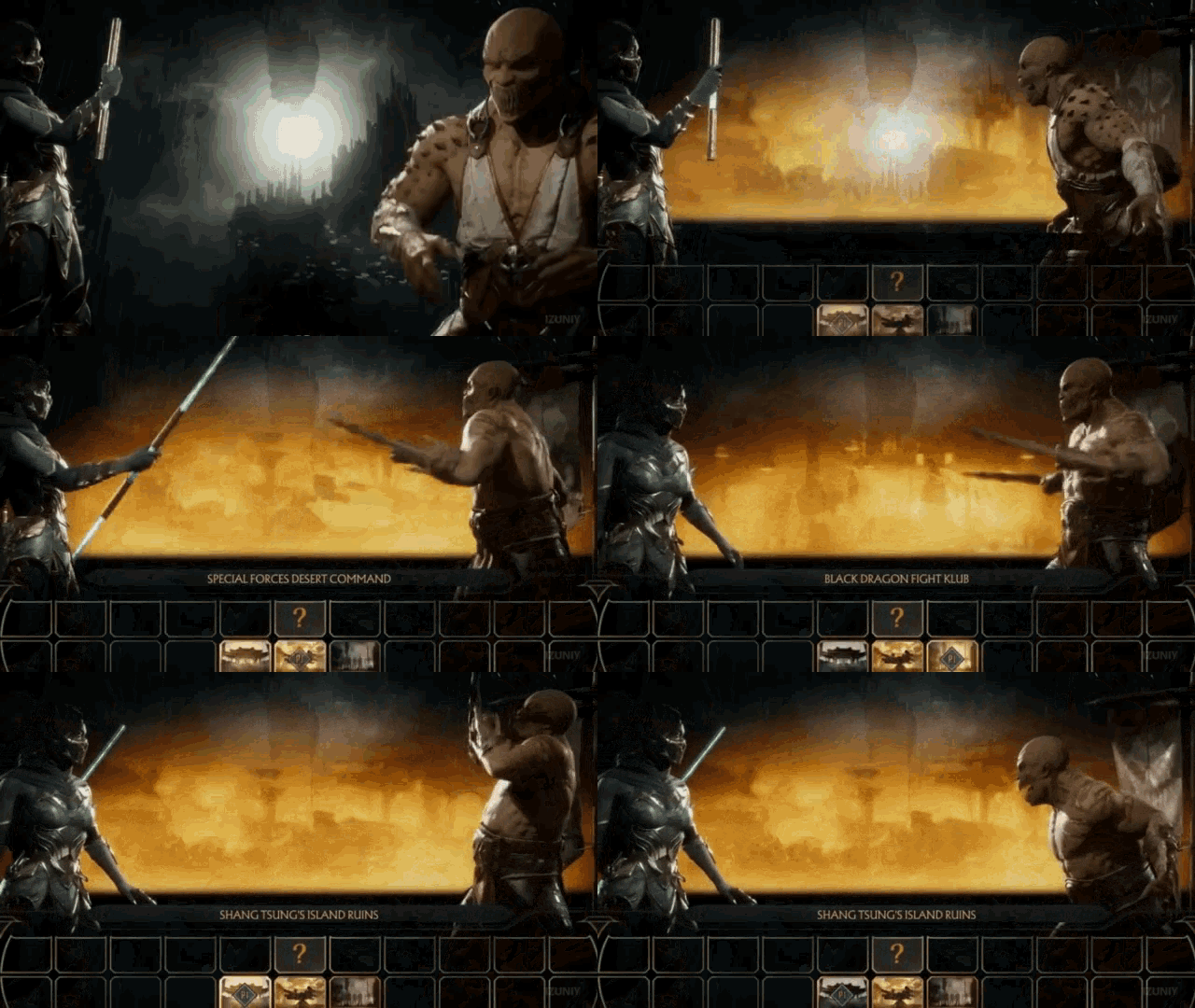
Behind all the bone-crunching combat and savage screen presence, Baraka’s journey through the gameplay side of Mortal Kombat is just as fascinating—and at times, surprisingly imperfect. In fact, some of the earliest ideas for him pushed even Mortal Kombat’s famously controversial limits.
During the early development of Mortal Kombat II, Baraka was originally planned to have a Fatality that would see him slice open his opponent’s stomach, leaving their entrails to spill onto the ground. For a series already known for redefining video game violence, this was apparently a step too far. The developers ultimately scrapped the idea, deeming it excessively gruesome—even by their own standards. Interestingly, the concept didn’t disappear entirely. It was later reworked and eventually found a home as one of Kabal’s Fatalities in Mortal Kombat, proving that in Mortal Kombat, no idea truly dies—it just waits for the right moment to strike.
From a gameplay perspective, Baraka’s debut came with its own set of struggles. In Mortal Kombat II, one of his biggest drawbacks was the lack of a moving special attack, a limitation that significantly impacted his viability in competitive play. While he wasn’t alone in this—Jax shared the same issue—Jax’s overall toolkit was far more effective, allowing him to remain a high-tier character while Baraka lagged behind. To make matters worse, Baraka was plagued by a peculiar bug tied to his Blade Spark move. Because his blade extended slightly forward during the attack, opponents could exploit this by landing leg sweeps from distances that should’ve been impossible. It was a small glitch with big consequences, and it cemented Baraka’s reputation as a low-tier fighter in his earliest outing. Fortunately, later entries in the series corrected this imbalance, refining his move set and fixing the exploit, gradually elevating him into a more formidable and well-rounded combatant.
By the time Mortal Kombat Gold arrived, Baraka’s physical design began telling deeper stories of survival. One of the most striking details was a massive scar running straight down his body, held together by large metal staples. It wasn’t just for visual flair—it hinted at a brutal past encounter. According to a render found in the Krypt of Mortal Kombat: Deception, this injury was the result of Baraka surviving Kung Lao’s devastating Hat Slice Fatality, originally seen in Mortal Kombat Trilogy and Mortal Kombat: Shaolin Monks. The idea that Baraka endured such a fatal blow—and lived—only adds to his mythos. The staples weren’t cosmetic; they were necessary, holding his body together as it healed.
However, this narrative wasn’t without confusion. An unused character bio suggested that Baraka had actually died from Kung Lao’s attack and was later resurrected by Shinnok. This version of events appeared in select strategy guides, leading many fans to believe it was canon. In reality, it remained an unused concept—another “what could have been” in Baraka’s already chaotic history.
In Mortal Kombat: Deception, Baraka’s gameplay quirks became even more distinct. Normally, after executing a special move, his blades would retract silently—a subtle but noticeable detail. But in his Blade fighting style, something unusual happens: once the blades are drawn, they never slide back in. It’s as if, in that stance, Baraka commits fully to the weapon, abandoning restraint altogether. The game also formally brands him with the title “The Scourge of Outworld,” a name that echoes across Mortal Kombat history, having previously been associated with Kintaro in the Malibu comic series. It’s a title that fits—Baraka isn’t just a soldier; he’s a force.
Another unique gameplay trait sets him apart from the entire roster: if Baraka is defeated in the first round, he doesn’t simply reset like other fighters. Instead, he rises back up using his blades—literally pulling himself into the next round—and continues fighting in his weapon stance. No other character carries this mechanic. While others revert to their default styles or remain unchanged, Baraka alone transitions into a more aggressive form after defeat. It’s a small detail, but thematically powerful—it reinforces the idea that Baraka doesn’t just endure loss, he adapts to it.
Beyond traditional fights, Baraka also found his place in the franchise’s more experimental modes. In both Mortal Kombat: Armageddon and Mortal Kombat: Deception, he is fully playable across all mini-games, including Chess Kombat, Puzzle Kombat, and Motor Kombat. These modes, while lighter in tone compared to the main series, still benefit from Baraka’s presence—proof that even in the most unconventional arenas, his identity as a relentless warrior remains intact.
Across every iteration, every tweak, every fix, Baraka’s gameplay evolution mirrors his narrative one. He started flawed, unbalanced, even underestimated—but over time, he was sharpened, refined, and redefined. Much like his blades, Baraka himself became something far more dangerous with every passing entry.
Appearance
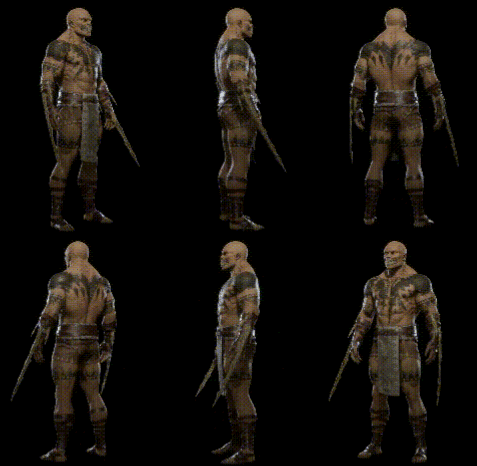
Baraka’s look has always felt like something torn straight out of a nightmare and forced into flesh. Across the long, brutal history of Mortal Kombat, his appearance has remained remarkably consistent at its core—recognizable instantly, even as details evolve around the edges. He stands as a humanoid, mutant-like figure, defined by pointed ears, a completely bald head, and that unforgettable, almost disturbing grin. It’s a wide, Glasgow-like, lipless smile stretched unnaturally across his face, packed with large, jagged, gnashing teeth that seem permanently bared, as if he’s always seconds away from tearing into something. His eyes, often hollow or glowing, add to that sense that there’s something deeply inhuman behind them.
From his forearms extend several sharp, steel-like spikes—two of which can slide outward into the massive, signature arm blades that have become synonymous with his identity. These aren’t just weapons; they feel like extensions of his rage, always ready, always waiting.
What makes this even more fascinating is how humble—and almost accidental—his origins were. Baraka’s original look was crafted using a cheap Halloween Nosferatu mask. The developers didn’t just use it—they transformed it. Fake teeth were added and painted silver, exaggerating the horror, while the mask’s hollow black eyes were used to amplify his unsettling presence. It wasn’t high-budget design—it was raw creativity, and somehow, that made him even more terrifying.
By the time Mortal Kombat Gold arrived, Baraka’s appearance began to carry the scars of his battles—literally. He was given a new black and green outfit, but more strikingly, large metal staples were embedded across his torso and even his head. These weren’t just aesthetic choices. According to lore referenced in Mortal Kombat: Deadly Alliance, these staples were the result of surviving Kung Lao’s Hat Slice Fatality—an attack that should have killed him. Instead, Baraka endured, his body held together by metal as it healed. Around this time, his eyes also shifted into a striking yellow, cat-like appearance—a detail that would become a permanent and defining feature moving forward.
In Mortal Kombat: Deception, those staples were gone, but the evolution didn’t stop. Baraka appeared in a new dark green and red cuirass, designed with spine-like straps that gave him an even more predatory silhouette, as if his armor itself echoed the anatomy of something dangerous. His alternate outfit paid homage to his classic Mortal Kombat II look, but enhanced with added shoulder pads and greaves, reinforcing his role as both warrior and general. In some renders, his eyes were even shown glowing, pushing his design further into the realm of the supernatural.
The rebooted Mortal Kombat brought him back closer to his roots, featuring a version of his original outfit, now refined with additional black detailing across his attire. His alternate costume leaned into full aggression—red and black spiked armor reminiscent of the chaotic Battle of Armageddon, visually tying him to one of the most devastating conflicts in the franchise’s lore.
With Mortal Kombat X, Baraka’s design took cues from his Deception era but stripped away the more elaborate spinal elements in favor of a sturdier, more grounded armored look. His breastplate was secured with multiple thin rope straps, with additional bindings wrapped around his biceps—giving him the appearance of a warrior constantly held together, restrained only just enough to function. A small but chilling detail appears during his “Food for Thought” Fatality, where his pupils visibly dilate—an almost animalistic reaction that adds a layer of biological realism to his brutality.
Then came Mortal Kombat 11, where Baraka’s design once again revisited his classic roots, but with refined updates. His outfit featured new cloth wrappings around his forearms, adding texture and a sense of practicality to his combat gear. Physically, subtle changes made him feel more imposing—most notably the addition of stud-like spikes protruding from his shoulders, reinforcing his already dangerous silhouette.
In the reimagined timeline of Mortal Kombat 1, Baraka’s appearance shifts in a way that feels more tragic than ever before. His features are pushed further into mutation—additional studs now grow from his chest, and his mouth appears slightly atrophied, a haunting detail tied to the fact that he is no longer a naturally born Tarkatan, but a victim of the Tarkat disease. His outfit leans heavily into red with white detailing, maintaining visual continuity with his past while signaling a new chapter. One of the most distinct additions is a large black tattoo running across his right arm, giving him a more grounded, almost human touch—like a remnant of the life he once had before everything changed.
Across every iteration, Baraka’s appearance tells a story that words often don’t. It’s a visual timeline of pain, survival, adaptation, and identity. He doesn’t just look like a monster—he looks like someone who became one, piece by piece.
Baraka Beyond the Arena — A Legacy Carved Across Worlds
Appearances in Other Media
Baraka’s presence hasn’t been confined to the blood-soaked battlegrounds of Mortal Kombat alone. Over the years, his character has been reimagined, reshaped, and sometimes radically reinvented across films, web series, and comic books—each version adding a new layer to the myth of the blade-wielding Tarkatan.
Mortal Kombat: Annihilation
Baraka made his live-action film debut in Mortal Kombat: Annihilation, portrayed by Dennis Keiffer. In this adaptation, he appears alongside two other members of his race, forming a trio that briefly clashes with Liu Kang. The encounter is short-lived but intense—a quick sword fight that ends with all three Tarkatans being killed.
Interestingly, there’s a small behind-the-scenes quirk that fans have picked up on over the years. The shot of Baraka’s body falling into the fire pit surrounding the arena isn’t entirely what it seems. It’s actually reused footage—originally showing Rain meeting a similar fate earlier in the film. It’s a subtle piece of cinematic recycling, but one that adds a bit of trivia to Baraka’s brief appearance.
Mortal Kombat: Rebirth
In the gritty, grounded reimagining Mortal Kombat: Rebirth, Baraka is portrayed by Lateef Crowder—but this isn’t the Baraka fans were used to. Here, he’s reinterpreted as Dr. Alan Zane, a once-promising plastic surgeon whose story spirals into something deeply disturbing.
According to this version, Zane accidentally caused the death of a patient during surgery—a moment that shattered his sanity. The weight of that failure consumed him, pushing him into a descent that led to the murder of twenty-four more victims. What follows is less transformation and more self-inflicted horror. He takes surgical instruments and mutilates himself—piercing his own face, sharpening his teeth into something predatory, and surgically attaching ten-inch blades to his arms.
This version of Baraka is less a warrior and more a psychological nightmare. His confrontation with Johnny Cage ends brutally, with Cage being killed—cementing this interpretation as one of the darkest and most grounded takes on the character.
Mortal Kombat: Legacy
In Mortal Kombat: Legacy, Baraka is brought to life by Fraser Aitcheson, and while his screen time is limited, his impact is anything but small.
Through flashbacks in the fourth episode, viewers witness Baraka leading the Tarkatan hordes during one of Outworld’s most pivotal and devastating campaigns—the conquest and merging of Edenia into Outworld. It’s a brutal sequence, showing him slaughtering countless innocent Edenians with ruthless efficiency. There’s no hesitation, no mercy—just execution.
One moment stands out sharply: Baraka personally executes a decoy of King Jerrod, who attempts to help Sindel and the infant Kitana escape. The execution is carried out using his signature Blade Lift Fatality—a chilling reminder of how closely the series ties into the games. Though this marks his only appearance in the show, it leaves a lasting impression of Baraka as a relentless instrument of conquest.
Comic Books
Baraka’s story also extends into the pages of comic books, particularly within the Malibu Comics run of Mortal Kombat titles. His first appearance came in the debut issue of Prince of Pain, where he was immediately framed as a classic “brawn over brains” archetype—physically imposing, brutally effective, but not particularly articulate.
In these comics, Baraka often spoke in broken, pidgin-style English, reinforcing that primal image. Even in the 1993 Midway-produced Mortal Kombat II tie-in comic, his dialogue is minimal and direct, with his only line being a declaration: “Baraka shows Johnny Cage pain!” It’s simple, but it captures exactly who he was at the time—pure intent, no nuance.
He later received his own standalone spotlight in a 1995 one-shot comic by Malibu Comics, further cementing his place in the expanded universe. Like many characters in that series, Baraka had the peculiar habit of referring to himself in the third person—a stylistic choice that added to his otherworldly presence.
Narratively, the comics stayed relatively faithful to his roots, portraying him as the leader of a mutant faction within Shao Kahn’s armies. However, things took an interesting turn in the Battlewave storyline. When Shao Kahn began replacing Baraka’s Tarkatan forces with Scorpion’s undead army, Baraka’s loyalty fractured.
In a rare shift, he turned against the emperor and aligned himself with a rebel faction that included Kitana, Kung Lao, and Sub-Zero. Together, they sought to bring down Shao Kahn’s rule. Yet even among allies, Baraka remained… Baraka. His violent instincts and unpredictable nature often created tension within the group, making it clear that while he could change sides, he would never truly change who he was.
Across every medium, Baraka remains consistent in one crucial way—he adapts, but he never softens. Whether he’s a war general, a tragic outcast, or a man driven insane by his own failures, every version carries the same underlying truth: Baraka is not just a character. He’s a force that reshapes itself depending on the world it inhabits, but always leaves behind the same thing—blood, fear, and an unforgettable presence.
Baraka — Hidden Details, Brutal Truths, and Unseen Layers
Trivia
Baraka is one of those characters whose details run far deeper than what you see in a fight. Even his name carries meaning—“Baraka” translates to “bless” in Arabic and “blessing” in Swahili, an oddly poetic contrast to a character defined by violence and survival.
Since Mortal Kombat 1, Baraka has been one of the few fighters to battle barefoot, a small but striking detail that connects him visually to other raw, primal warriors like Reptile, Sheeva, Goro, Kintaro, Drahmin, Moloch, Kobra, Meat, and Blaze.
Among the Tarkatans, Baraka stands in rare company. Only three Tarkatan-based characters have been playable in the series—Baraka himself, Mileena, and the Alien in Mortal Kombat X. But even within that trio, Baraka is unique—he is the only pure-blooded Tarkatan. Mileena is a genetic hybrid, while the Alien is a guest character infused with Tarkatan DNA for gameplay purposes. In fact, Baraka and Mileena are the only playable Tarkatans considered canon to the Mortal Kombat storyline, as the Alien’s appearance remains non-canon.
Baraka also holds a surprising distinction in the franchise’s comic history—he was the first character to swear. During an interrogation scene while searching for Kung Lao, he lashes out at a monk with the line: “Well, have a wild fucking guess!”—a moment that set the tone for the series’ unfiltered brutality beyond the games.
His classic Mortal Kombat II design proved so iconic that it carried forward into Mortal Kombat: Deception and Mortal Kombat: Armageddon as an alternate costume. That same look would return once again in Mortal Kombat 11, where his primary Story Mode and Arcade outfit was a modernized version, while the klassic design could be unlocked through customization.
There was once a persistent rumor that Baraka could be played in Mortal Kombat 3 and Ultimate Mortal Kombat 3 via a transformation by Shang Tsung, sporting a look similar to Kano but with a white stripe. Despite how widely it spread, testing eventually proved the rumor false.
Before Deception, many fans believed Baraka had died. This was largely due to a cutscene in Mortal Kombat Gold that could be unlocked in the Krypt of Mortal Kombat: Deadly Alliance. Unlike other endings presented in a montage, Baraka’s was a standalone unlockable, giving it an air of finality that fueled the misconception.
His apparent death in the original timeline closely mirrors his brutal encounter with Kung Lao in Mortal Kombat II, and his later reappearance in Mortal Kombat Gold, where he again suffers Kung Lao’s Body Slice Fatality—reinforcing the idea that Baraka exists in a constant cycle of destruction and survival.
One of Baraka’s Fatalities—Mutant Dissection—briefly appears in the film The 40-Year-Old Virgin, followed by a Fatality from Sub-Zero. However, the scene plays out far too quickly for two full matches to realistically occur, adding a layer of humorous inconsistency. The moment is made even more absurd by the characters using Nintendo 64 controllers while supposedly playing a later Xbox title—an intentional gag.
Baraka is also among the few pure Outworlders to curse on-screen. In an interaction with Kano, he declares, “Fuck you and Kronika!”—though notably, he delivers the line in his native tongue. The only other Outworlder known to openly curse is Bo' Rai Cho, who, in Mortal Kombat X, insults the Predator with a blunt “One ugly motherfucker.”
Mortal Kombat Gold
In Mortal Kombat Gold, Baraka’s design from the waist down is actually recycled from Reptile’s Mortal Kombat 4 model, simply recolored—a clever reuse of assets that many players never noticed.
Additionally, if Meat is selected using Baraka, or if Quan Chi uses Baraka’s Blade Lift Fatality via his Steal Fatality ability, Baraka’s forearms are visually transferred to those characters to accommodate the Tarkatan blades—an unusual but fascinating technical workaround.
Mortal Kombat: Deception
In Mortal Kombat: Deception, Baraka utilizes the Hung Gar fighting style, previously used by Reptile in Deadly Alliance. Later, Drahmin adopts the same style in Armageddon, creating an unexpected lineage of combat techniques.
A peculiar glitch appears in Konquest Mode—while learning his blade style, Baraka’s weapon briefly flashes purple as he congratulates the player for completing a task, a small but memorable visual oddity.
Baraka is also seen in the opening cinematic of Mortal Kombat: Armageddon fighting Kung Lao, and later being struck by Shao Kahn’s hammer atop the pyramid. In Mortal Kombat, his fate appears even more brutal—his head split in half by Kung Lao’s hat, his left arm missing, and later seen embedded in Sub-Zero’s spine. This sequence led many fans to speculate that Baraka killed Sub-Zero before being slain himself.
Mortal Kombat vs. DC Universe
In Mortal Kombat vs. DC Universe, Baraka’s counterpart from the DC side is Deathstroke. In his ending, Baraka and the Tarkata evolve into the Mortal Kombat equivalent of the Dominators, a powerful alien race from DC Comics lore.
Mortal Kombat (2011)
Baraka’s alternate costume in the 2011 reboot draws heavy inspiration from his armored appearances in Mortal Kombat vs. DC Universe and Armageddon, blending classic and modern design elements.
A unique gameplay detail appears if Baraka performs a Stage Fatality in the PS3-exclusive Chamber of the Flame—his Tarkatan blade pierces through the opponent as he suspends them over the fatality selection points.
Alongside Nightwolf, Sonya Blade, Kabal, and Quan Chi, Baraka never appears in his alternate costume during Story Mode, except briefly in the intro.
Interestingly, his Ladder Ending is the only one where Shao Kahn is not physically killed—a rare deviation in a game defined by decisive, often violent conclusions.
Mortal Kombat X
In Mortal Kombat X, Baraka appears not as a playable fighter but as a fightable NPC in Story Mode alongside Rain and Sindel. None of them possess X-Ray attacks, setting them apart from the main roster.
All three, along with Shinnok’s Corrupted form, can also appear as Invasion Bosses.
In the reveal trailer for Kombat Pack 2, an alternate, non-canon scene shows an Alien bursting from Baraka’s chest just moments before his execution by D'Vorah—a gruesome nod to the Alien franchise.
Mortal Kombat Mobile
Baraka is playable in the mobile adaptation, using his Mortal Kombat X Story Mode model. Despite lacking an X-Ray attack in that version, he is given an updated variation of his X-Ray from Mortal Kombat (2011).
His Lizard Card uses a Killer Croc-inspired skin, yet retains the default arm blades from Mortal Kombat 11’s Arcade mode—a curious mix of visual elements.
Even more interestingly, despite visually resembling his MK11 version, Baraka still uses his MK2011 fighting stance and X-Ray attack rather than his newer Fatal Blow.
He is also the only character to receive a Mortal Kombat 11-themed card that is not classified under the MK11 class.
Baraka’s Scourge Card introduced a gameplay first—it was the first card capable of applying a status effect through a Combo-Ender.
Meanwhile, his Lizard Card stands out as the only Outworld card that boosts Critical Chance across all Outworld classes, rather than being limited to a specific subclass.
Mortal Kombat 11
In Mortal Kombat 11, Baraka is voiced by Steve Blum, who had previously contributed minor voice work for the character in Mortal Kombat Mobile.
When Baraka’s gameplay was first revealed, fans noticed his voice sounded almost identical to Reptile from Mortal Kombat X, leading to criticism of the performance.
In response, his voice was adjusted during Jade’s reveal trailer, making it slightly deeper—a change that was received more positively.
Later Kombat Kast streams featuring Cassie Cage and Kano revealed yet another revision, this time significantly deeper and more guttural.
As a result, Baraka became the only character in Mortal Kombat 11 to undergo three distinct voice iterations before release.
He also received DC-inspired cosmetic outfits alongside Kitana, Noob Saibot, and Geras with the addition of the Joker. Baraka’s themed outfit drew inspiration from Killer Croc.
Interestingly, despite Spawn being a Hellspawn, Baraka is the only character who refers to him as human.
Mortal Kombat 1
In Mortal Kombat 1, Baraka’s defining virtue is “Preservation,” reflecting his deeper, more protective role.
His backstory is reimagined—he is now a former Edenian merchant transformed by the Tarkat disease into his current form.
Dialogue with General Shao suggests that Baraka may have once served as an Outworld soldier, though this detail is never directly explored in the main story.
A particularly intriguing interaction with Conan the Barbarian reveals that Baraka’s face once resembled Conan’s before the disease altered him completely.
Errors
Mortal Kombat X
When performing an X-Ray attack on Baraka—particularly when he appears as an Invasion Boss—his internal model reveals a human skull, a clear inconsistency with his Tarkatan physiology. This same error carries over into Mortal Kombat Mobile during X-Ray attacks and Krushing Blows.
Mortal Kombat 11
Several visual and gameplay glitches persist in Mortal Kombat 11. Baraka’s arm blades disappear entirely when a Brutality or Fatality is performed on him. During his Outworld Bash Krushing Blow, his retracted blade visibly clips through his hand.
Certain helmets clip awkwardly through his neck during gameplay, while his Sparkler Brutality can be amplified—resulting in a second, ineffective spark passing through the opponent.
His blades are also not physically connected to his arms, causing them to move independently or clip through his forearms during specific animations.
In Story Mode, during the assault on Kronika's Keep led by Fire God Liu Kang, Baraka’s blades are seen inverted as he runs—pointing inward toward his own body.
Additional glitches include the ability to perform his Stuck Brutality without deploying his War Banner, and a bug where his War Banner Charge retains its armor bonus if parried by Johnny Cage’s Mime Time move. This armor persists temporarily and can even trigger abilities tied to armor breaking.
Baraka’s journey through the world of Mortal Kombat is more than just a tale of violence—it’s a story carved in survival, identity, and evolution. From his terrifying debut in Mortal Kombat II to his deeply humanised portrayal in Mortal Kombat 1, Baraka has transformed from a seemingly one-dimensional brute into one of the franchise’s most layered and emotionally resonant characters.
He is brutality, yes—but he is also burden. A leader forged in exile. A warrior shaped by loss. A protector standing at the edge of extinction. Whether he’s fighting for the Tarkatans, challenging emperors, or simply trying to hold on to what little remains of his past, Baraka represents something rare in Mortal Kombat—a monster with meaning.
And maybe that’s why he endures.
Because in a universe built on power, conquest, and destruction… Baraka reminds us that even the fiercest blade can carry a story.
If Baraka’s savage legacy has you fired up, it’s the perfect time to level up your collection. Explore an insane range of collectibles from Mortal Kombat, He-Man and the Masters of the Universe, Anime, Marvel, DC, Transformers, LEGO, and so much more—now available at up to 40% OFF with free shipping across India.
From action figures to premium statues, this is where fandom meets craftsmanship. Don’t just follow the story—own a piece of it.